
5 Ways to Earn 5-Star Airbnb Reviews Through Better Hosting
- 23 October 2026
- Blog
In 2024, 85% of Airbnb reviews were five stars, so guests clearly value a stay that delivers on its promise. To understand... Read More
 by BNB Booking
The constant stream of holidaymakers through your front door might actually be the best thing that ever happened to your property’s condition. While it feels logical to assume that fewer occupants mean a better-preserved home, the reality of high-frequency professional oversight often tells a different story. You’ve likely felt that familiar pang of anxiety when thinking about holiday home wear and tear, especially with the Brisbane City Council’s new permit laws and stricter ATO tax rulings looming for the 2026 financial year. It’s natural to worry about scuffed skirting boards or the confusion of navigating insurance claims versus guest bonds.
We’re here to provide the clarity you need to protect your investment with confidence. You’ll discover the truth about rental depreciation and learn a professional framework to distinguish fair wear and tear from actual guest damage. We will also explore proven strategies to minimise maintenance costs while ensuring your Queensland retreat remains in pristine, guest-ready condition. This guide offers the strategic roadmap you need to manage your asset’s longevity and enjoy the peace of mind that comes with expert property oversight.
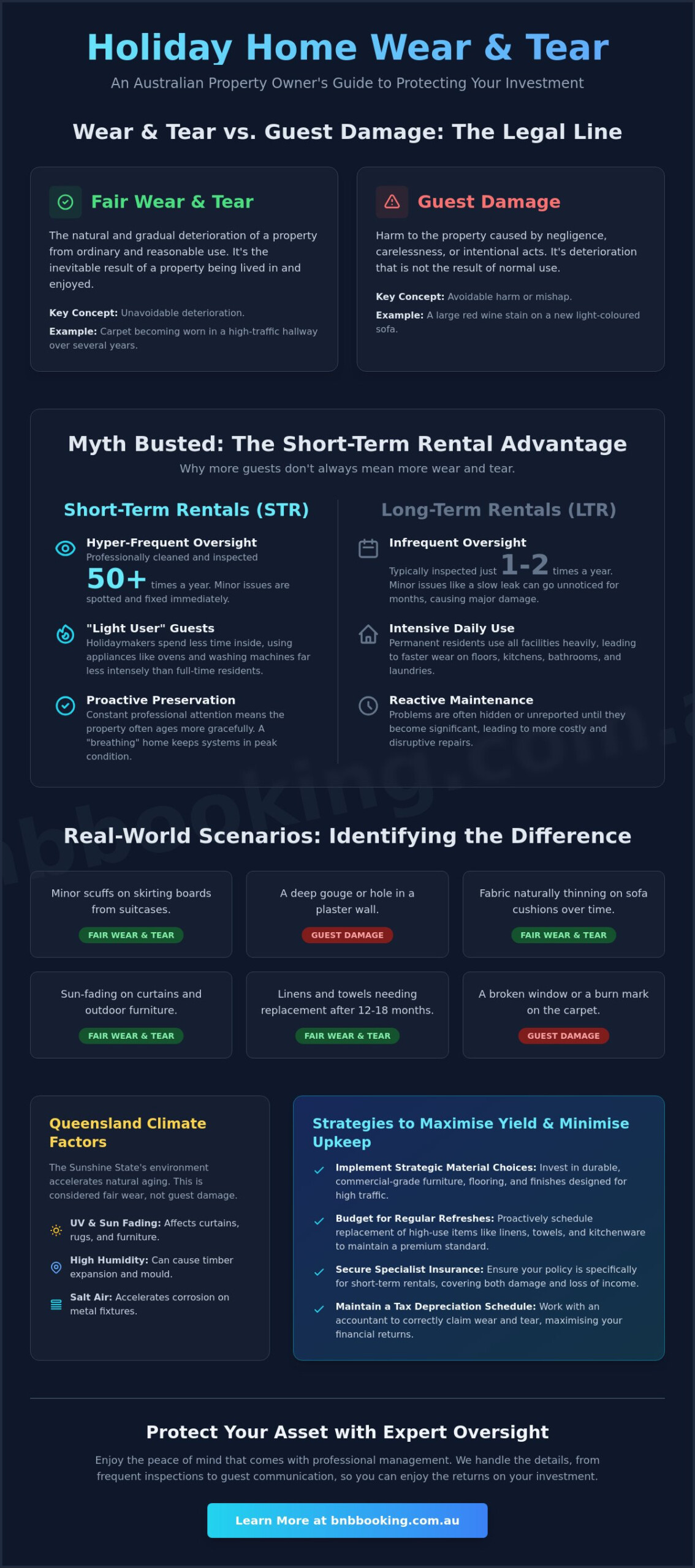
Property owners often feel a pang of anxiety when they spot a new mark on the floorboards or a slight fray on a designer rug. In the Australian legal context, Defining Fair Wear and Tear centres on the concept of “ordinary and reasonable use.” This refers to the natural deterioration that occurs over time, even when a guest treats your property with the utmost respect. It’s the inevitable result of a building being lived in and enjoyed.
However, holiday home wear and tear follows a different rhythm than a standard residential lease. While a long-term tenant might move furniture once a year, a holiday rental sees guests wheeling heavy suitcases through hallways every three to four days. This high-frequency turnover changes what the Queensland Office of Fair Trading considers “ordinary.” For instance, industrial-grade laundering means your high-thread-count linens and plush towels have a much shorter reasonable lifespan than they would in a private home. Expecting five years of use from a bath mat in a high-occupancy Gold Coast apartment simply isn’t realistic. Professional managers typically budget for these items to be refreshed every 12 to 18 months to maintain a premium guest experience.
The line between wear and damage usually comes down to intent or negligence. A minor scuff on a skirting board from a suitcase is almost always fair wear; it’s a predictable outcome of the short-stay model. A deep gouge in the timber or a hole in the plaster, however, constitutes damage. Australian courts apply a “reasonableness” test to these disputes. They look at whether the deterioration was avoidable. A wine stain on a sofa is an accidental mishap (damage), whereas the fabric naturally thinning on the seat cushions over three years of bookings is fair wear.
Queensland’s environment is notoriously tough on property assets. For owners in Brisbane or coastal pockets, salt air and high humidity accelerate the aging process through corrosion and timber expansion. This “weathering” is a significant factor in property oversight. Sun-fading on curtains, rugs, or outdoor furniture is a classic example of fair wear in the Sunshine State. You can’t hold a guest accountable for the UV index. Distinguishing these environmental factors from a lack of maintenance is crucial for your tax depreciation schedules and insurance accuracy.
Many owners fear that a high volume of guests inevitably leads to rapid holiday home wear and tear. It’s a common misconception. In reality, the short-term rental model offers a unique “frequent eyes” advantage that long-term leasing simply cannot match. When a property is professionally cleaned and inspected every few days, minor issues are identified and rectified immediately. A loose cupboard hinge or a flickering lightbulb is caught before it evolves into a larger, more expensive repair. This proactive oversight preserves the structural integrity of your investment while ensuring you stay on top of the Tax Implications for Holiday Homes by documenting all necessary maintenance.
Long-term leasing often hides problems for months at a time. A tenant might live with a slow leak under the kitchen sink, and by the time the annual inspection occurs, the cabinetry is ruined by rot. In a holiday home, that leak is spotted by the housekeeping team within days. This level of scrutiny is why many managed properties actually age more gracefully than those with permanent residents. The “lock and leave” fallacy is another trap; unoccupied homes are prone to stale air, unnoticed pest infestations, and plumbing seals drying out. A managed home is a “breathing” home where constant activity keeps systems running in peak condition.
Short-term rentals undergo professional cleans 50 or more times a year. This provides a level of property oversight that is unparalleled in the traditional rental market. Holiday guests are also typically “light users” of the property. They spend their days exploring the Gold Coast or attending business meetings in Brisbane, meaning they rarely use the stove or laundry with the same intensity as a permanent resident. If you want to see how this oversight works in practice, exploring specialised management options can reveal the significant difference in long-term asset longevity.
The psychological impact of the two-way review system provides a powerful layer of protection. Guests know their future booking ability depends on their “house guest” rating, creating a high level of accountability. In Brisbane, industry professionals report that corporate and family bookings are statistically safer; these demographics typically treat the home as a base rather than a party venue. Rigorous screening further reduces the risk of malicious damage, leaving you with only the expected holiday home wear and tear to manage through your standard maintenance budget.
Identifying the line between expected aging and preventable damage is essential for maintaining a profitable portfolio. Queensland’s Residential Tenancies Authority defines fair wear and tear as the natural deterioration that occurs through ordinary use. While this legal baseline exists, applying it to the high-turnover environment of a short-stay property requires a more nuanced perspective. You’ll find that holiday home wear and tear often manifests in specific areas that see the most guest interaction.
Flooring and walls are the primary indicators of a property’s age. It’s reasonable to expect traffic marks on carpets in high-flow areas like the hallway or lounge. These are natural consequences of occupancy. However, a red wine stain in the centre of the rug or a cigarette burn on the carpet constitutes accidental damage. Similarly, while minor scuffs on skirting boards from rolling suitcases are considered wear, a significant hole in the plaster from a guest moving furniture is a clear-cut case for a claim. In the kitchen, a benchtop that has slightly faded due to Queensland’s intense sun is fair wear, but deep knife cuts or heat scorch marks from a hot pan indicate a lack of care.
Outdoor areas also face unique challenges. A timber deck that loses its lustre over a summer season is a victim of the elements, not the guest. Conversely, finding broken glass in the pool area or a snapped umbrella frame after a storm where the guest failed to close it is damage. These distinctions ensure you aren’t unfairly penalising guests for the climate while still protecting your asset from negligence.
Soft furnishings are high-touch items where quality matters. Pilling on a sofa fabric after a year of heavy use is typical wear. A ripped cushion or a broken sofa leg, however, is damage. Smart owners often pivot to commercial-grade fabrics that are designed to withstand holiday home wear and tear far better than standard residential pieces. When it comes to linens, it’s best to view towels and sheets as consumables. Constant industrial laundering means they will thin and fray. This is a cost of doing business rather than guest damage.
Mechanical failure is rarely the guest’s fault. If a kettle or toaster fails after two years of service, it’s reached the end of its functional life. A smashed TV screen or a remote control that has been submerged in the pool is another matter entirely. Smart locks and air-conditioning units often face the most scrutiny. A lock failing due to a flat battery or a mechanical glitch is your responsibility. A guest forcing a handle or tampering with the internal wiring is damage. Keeping a detailed log of appliance ages helps you defend these distinctions if a dispute arises.
Strategic design and proactive scheduling are your primary defences against excessive holiday home wear and tear. While we established that managed properties often age better than long-term rentals, the speed of that aging depends heavily on your choice of materials. Opting for guest-proof surfaces like high-quality leather instead of delicate fabrics ensures that spills become minor wipes rather than permanent stains. Similarly, tiles or engineered timber are far more resilient than carpet, especially in coastal Queensland where sand and humidity are constant companions.
Financial planning is equally vital for long-term success. We recommend establishing a “Restoration Fund” within your weekly budget. By setting aside a small percentage of each booking, you transform maintenance from a stressful surprise into a planned business expense. Standardising your linens is another high-yield strategy. By using identical high-quality white towels and sheets across your property, you make individual replacements cost-effective and seamless. This ensures your property always meets a premium hospitality standard without requiring a complete set replacement for every minor blemish.
Implementing a quarterly preventative maintenance schedule allows you to stay ahead of holiday home wear and tear before it impacts guest reviews. These checks should include testing smoke alarms, tightening cabinetry hinges, and inspecting silicone seals in wet areas. Catching these minor adjustments early prevents them from escalating into the structural damage we discussed in previous sections. For a deeper understanding of how to build a robust system around these checks, our complete guide to Airbnb property maintenance in Brisbane outlines a practical “set and forget” framework tailored to Queensland’s unique climate challenges.
Brisbane’s subtropical climate demands specific styling choices. Washable slipcovers are a game-changer for lounge suites, allowing for deep cleans between peak seasons. We also suggest the utilisation of outdoor-rated fabrics for indoor sun-rooms to combat UV fading. In high-traffic hallways, scuff-resistant paint can significantly reduce the visibility of suitcase marks. A minimalist approach to decor also pays dividends; fewer ornaments mean less surface area to collect dust and fewer items prone to accidental breakage.
Immediate intervention is what prevents minor wear from spiralling into expensive damage. A loose hinge that is tightened today saves a cabinet door from being ripped off tomorrow. This requires a robust local Brisbane trade network that understands the urgency of short-stay timelines. BnB Booking organises trades with clinical efficiency, ensuring repairs are completed in the narrow windows between guest check-out and check-in. This level of property oversight is a core component of our full-service Airbnb management, protecting your asset’s value while you focus on the returns.
Physical maintenance is only one half of the property oversight equation. To truly safeguard your investment, you must implement a robust financial and legal framework that accounts for the unique nature of short-stay accommodation. Many owners mistakenly believe that standard landlord insurance provides adequate coverage. In reality, standard policies often contain exclusions for commercial short-term use, which could leave you entirely exposed during a major claim. Specialist short-term rental insurance is a non-negotiable requirement. These policies are tailored to address the specific risks of high-turnover occupancy, including guest-caused damage and public liability cover that often ranges between $20 million and $30 million.
While holiday home wear and tear represents a gradual decline in your property’s physical state, it also serves as a significant tax lever. Utilising a professional tax depreciation schedule allows you to realise the financial value of this natural aging. Under the new ATO guidance (TR 2026/1) applicable from the 2026-27 financial year, documenting the genuine investment use of your property is more critical than ever. By turning depreciation into a non-cash deduction, you can significantly offset your taxable income and improve your overall yield.
Professional oversight also creates what we call a “Management Shield.” Insurers often view managed properties as lower risk because they aren’t left vacant for long periods and are subject to constant inspection. This professional presence can lead to more favourable policy terms and a much smoother claims process. The key to a successful claim is evidence; documenting your property’s condition with professional photography before every stay ensures that any damage is indisputable.
Digital time-stamping is the gold standard for winning damage disputes. Our professional cleaners act as your boots on the ground, conducting thorough inspections during every changeover. This constant monitoring ensures that holiday home wear and tear is tracked and that any deviations are reported immediately. Combined with rigorous guest vetting, this systematic approach to reporting ensures that only the highest quality occupants enter your home, further preserving your asset’s condition.
When you compare the cost of management fees against the potential price of unmanaged depreciation, the value of expert care becomes clear. An unmanaged property can quickly lose its premium appeal through neglected repairs and poor guest screening. Brisbane owners are increasingly choosing a hands-off approach to meet the strict requirements of the 2025 Short-Stay Local Law, which requires a 24/7 contact person. If you’re ready to secure your property’s future, organise a free rental appraisal with BnB Booking today. We provide the strategic oversight needed to protect your investment while you enjoy the rewards of a high-performing holiday rental.
Managing a short-stay property shouldn’t be defined by constant anxiety over the physical condition of your home. We’ve explored how the “frequent eyes” of professional turnover actually provide a strategic maintenance advantage that traditional long-term leases simply can’t match. By mastering the legal distinctions of holiday home wear and tear and implementing durable styling choices, you transform your property into a resilient, high-performing asset that stands the test of time.
Navigating the competitive Queensland market requires more than just a beautiful space; it demands clinical precision in oversight and a deep understanding of evolving local regulations. Protect your investment with BnB Booking’s expert management to leverage our 100% local Brisbane expertise. Our comprehensive service includes rigorous guest vetting and meticulous maintenance coordination to ensure your home remains in pristine, guest-ready condition after every stay. It’s time to replace property anxiety with the peace of mind that comes from professional, hands-on partnership. We’re ready to help you maximise your returns while meticulously guarding your most valuable investment.
Minor surface scuffs from ordinary foot traffic or rolling suitcases are typically classified as fair wear and tear. These marks are an inevitable result of regular occupancy in a high-turnover environment. Deep gouges or scratches caused by dragging heavy furniture or sharp objects are considered damage. The distinction relies on whether the deterioration was a predictable outcome of use or the result of a negligent act.
No, AirCover specifically excludes holiday home wear and tear and natural deterioration from its coverage. The program is designed to protect hosts against accidental damage, theft, and specific deep cleaning requirements. You should never view booking platform protections as a substitute for a maintenance budget or a specialist insurance policy that covers gradual asset aging.
Most high-performing Brisbane rentals require a professional refresh or touch-up every three to five years. Properties in humid coastal pockets may need more frequent attention to combat the effects of salt air and moisture. Implementing a strategy of using scuff-resistant paint in high-traffic hallways can significantly extend the time between full repaints by masking minor suitcase marks.
Yes, you can generally claim the decline in value for furniture and fittings used to generate rental income. It’s essential to have a professional tax depreciation schedule prepared to ensure you maximise these non-cash deductions under current ATO guidelines. This process allows you to turn the natural holiday home wear and tear of your assets into a tangible financial win.
The property owner is responsible for ensuring the home remains functional, which includes the provision of working light globes. In a professionally managed property, these replacements are handled as part of routine maintenance oversight. It’s considered a standard operational expense rather than a cost that can be recovered from a guest’s security deposit.
You must document the broken item with clear photography and compare it against your latest entry report. If the failure was mechanical due to the appliance’s age, it’s classified as wear and is your responsibility to replace. If the item shows signs of physical impact or misuse, you can seek reimbursement through the booking platform’s resolution centre or your specialist insurance provider.
Yes, standard residential landlord insurance often contains exclusions that void coverage for properties used for short-term holiday letting. You require a specialist short-stay policy that specifically addresses the risks of high guest turnover. These products provide the necessary public liability and malicious damage protection that standard policies lack.
High-resolution, time-stamped digital photography is the only definitive way to prove guest-caused damage. You must maintain a rigorous system of entry and exit reports for every single booking. By comparing the condition of an item immediately before check-in with its state at check-out, you create an indisputable evidentiary trail for insurance claims or guest disputes.