
Pool safety for Airbnb in QLD: certificates and host duties
- 22 October 2026
- Blog
A pool at a Queensland short-stay rental comes with a clear compliance duty: pool safety compliance for an Airbnb in QLD requires... Read More
 by BNB Booking

Can your body corporate committee actually lock the door on your short-term rental income, or are they simply overstepping their legal bounds? If you’ve been met with stern letters or conflicting advice from neighbours, you aren’t alone in feeling frustrated by the noise. Most owners are surprised to learn that under the BCCM Act 1997, specifically section 180(3), a body corporate generally cannot ban short-term letting if the use is otherwise lawful. Understanding the specific body corporate rules airbnb gold coast buildings enforce is the first step toward securing your investment’s future without the fear of legal action.
We understand the pressure of managing a high-performing asset while trying to maintain harmony within your complex. You deserve to know exactly what the law says about your rights as a lot owner so you can stop guessing and start earning. This guide provides a clear roadmap through the current Queensland strata landscape, from identifying if your scheme falls under the restrictive BUGTA regulations to meeting the mandatory 2027 smoke alarm requirements. You’ll discover a strategic approach to committee approval and learn how professional management acts as a peace treaty to protect your investment’s reputation.
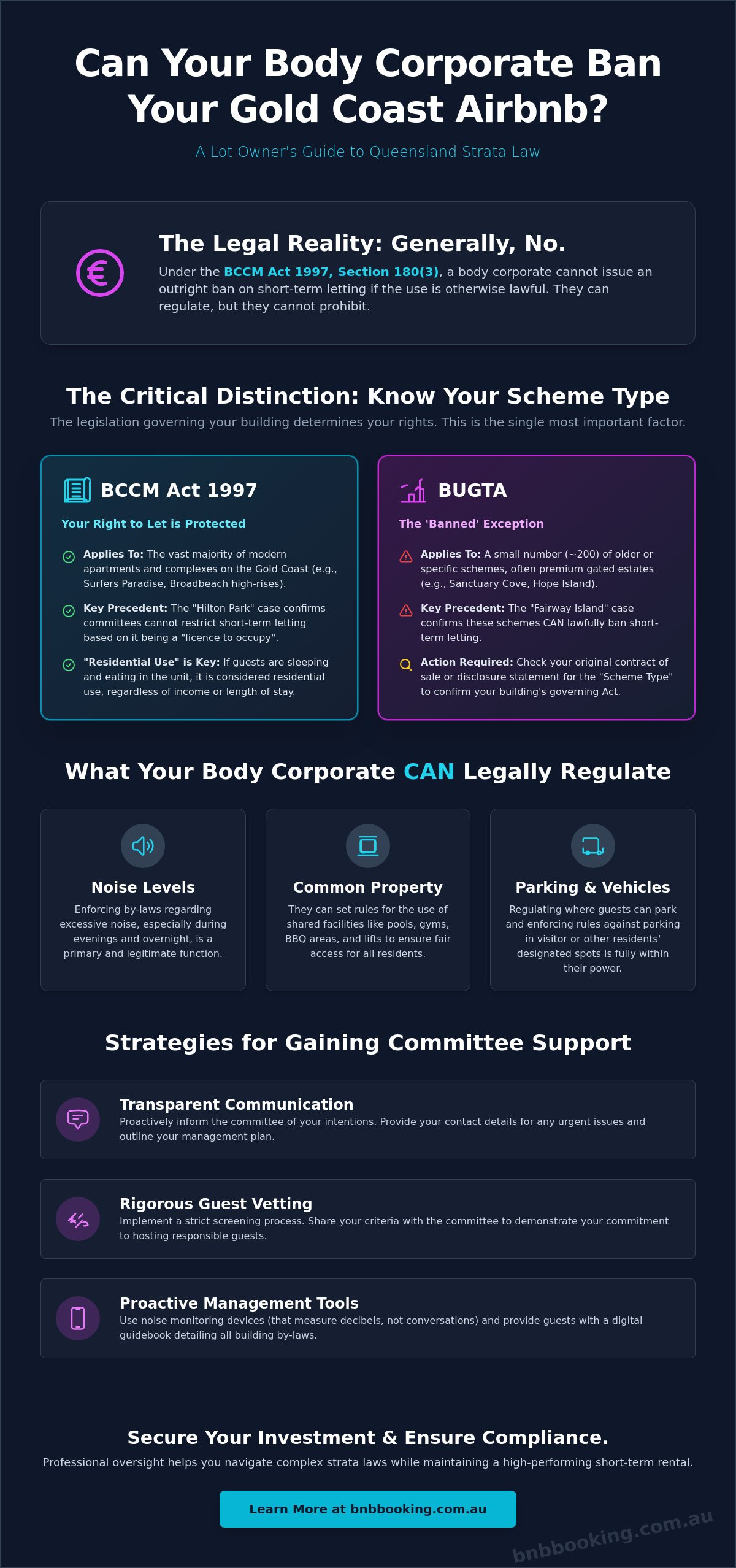
Many Gold Coast owners live in fear of a sudden by-law change that could wipe out their rental yield overnight. The reality is far more stable than the rumours suggest. Under the Body Corporate and Community Management Act 1997 (BCCM Act), the general rule is clear; a body corporate cannot prohibit you from using your lot for short-term rentals if that use is otherwise lawful. This protection is a cornerstone of strata title ownership in Queensland. Unless your building is one of the rare few governed by the older Building Units and Group Titles Act (BUGTA), your committee lacks the legal authority to issue an outright ban.
The Queensland Civil and Administrative Tribunal (QCAT) has consistently reinforced this position. The “Hilton Park” case remains a significant precedent, proving that even when committees attempt to restrict “licences to occupy,” the tribunal typically sides with the lot owner. It is vital to distinguish between banning and regulating. While a committee cannot stop you from listing your property, they have significant power to regulate guest behaviour. They can enforce strict rules regarding noise, parking, and the use of common facilities like the pool or BBQ area. When you understand these body corporate rules airbnb gold coast committees often try to push, you can respond with strategic confidence.
A common tactic used by frustrated committees involves attempting to reclassify short-term letting as a “commercial business” rather than “residential use.” They do this to trigger different by-law restrictions that apply to commercial ventures. However, Queensland law remains firm in 2026. The nature of the stay is what matters. If a guest is sleeping, eating, and relaxing in the unit, it remains residential use, regardless of the length of stay or the income generated. Committees often use intimidating language in newsletters to discourage owners, but these claims rarely hold up under legal scrutiny if the building is registered under the BCCM Act.
This year has introduced higher standards for committee transparency across the coast. New regulations now require committees to provide documented evidence and clear justifications for their decisions, making it harder to enforce “unwritten” rules against short-term hosts. Additionally, the City of Gold Coast’s mandatory registration for short-term accommodation has actually strengthened the position of compliant owners. By being a registered participant in the local economy, you shift from being a “rogue operator” to a legitimate stakeholder. Identifying your “Scheme Type” is the first thing you should do before listing, as this determines which legislative framework governs your rights.
Determining which legislation governs your building is the single most important step in your investment journey. Most modern high-rises in Surfers Paradise or Broadbeach fall under the Body Corporate and Community Management Act 1997 (BCCM Act). This is the standard for the vast majority of schemes on the coast. However, a small but powerful subset of properties, approximately 200 schemes across Queensland, still operate under the Building Units and Group Titles Act (BUGTA). If your property is located in premium gated estates like Sanctuary Cove or Hope Island, you’re likely governed by BUGTA. This distinction isn’t just legal jargon; it’s the difference between a thriving rental and a total prohibition.
You won’t find this information on a lobby sign or a lift notice. To be certain, you must check your original contract of sale or the disclosure statement provided during your purchase. Look for the “Scheme Type” or the specific Act mentioned in the community management statement. If you’re still unsure, a quick title search or a call to your body corporate manager will clear the air. Understanding the specific body corporate rules airbnb gold coast investors must follow starts with knowing your governing Act. Getting this right early prevents the heartbreak of investing in premium furniture and photography only to find your building is one of the few where a ban is legally enforceable.
Older or highly specific gated communities governed by BUGTA have significantly more power to stop Airbnb. Recent court rulings in late 2025 and early 2026 have continued to uphold the 2019 Fairway Island precedent, confirming that these schemes can lawfully ban short-term letting. If you discover your property is under BUGTA, you’re in a more challenging position. Your options usually involve seeking a long-term tenant or attempting to lobby the committee for a by-law change, though this requires a significant majority of owners to agree. It’s a high bar to clear in buildings that value long-term residential stability over holiday income.
For the vast majority of Gold Coast owners, the BCCM Act is your primary shield. Section 180(3) of the Act explicitly states that Body corporate by-laws cannot restrict the type of residential use of a lot if it’s otherwise lawful. This is why committees often fail when they try to pass “90-day minimum stay” rules; such restrictions are typically viewed by tribunals as an invalid attempt to bypass the Act. While an outright ban is nearly impossible to enforce under this Act, don’t forget that by-laws regarding noise, parking, and guest conduct are 100% legal and strictly enforced. To ensure your guests stay on the right side of these regulations, many savvy owners opt for full-service Airbnb management to handle guest communication and on-site compliance.
Committees may not be able to stop you from hosting, but they can certainly control how your guests behave once they step out of your front door. While we established that an outright ban is usually illegal under the Body Corporate and Community Management Act 1997, the legislation provides a robust framework for managing common property. This means the body corporate rules airbnb gold coast buildings enforce are often focused on the “peaceful enjoyment” of the scheme. If your guests treat the lobby like a playground or the pool like a private beach club, you will hear about it quickly.
Common property usage is the first area of regulation. Committees can set strict hours for gyms and BBQ areas and limit the number of visitors allowed per lot. Parking is another frequent battleground. Guests often mistakenly park in visitor bays or, worse, a neighbour’s titled spot. Because parking is usually at a premium in Surfers Paradise and Burleigh, committees are often aggressive with towing or breach notices. Security is the final pillar of regulation. Many schemes have now banned lockboxes from being attached to common property fences or pipes, citing both aesthetic and security concerns. You must ensure your check-in process respects these local sensitivities.
The formal process for a breach usually starts with a “Future Breach Notice.” This is a legal warning that stays on your property’s record. If a guest repeats the behaviour, the committee can escalate the matter to the Commissioner’s Office. In 2026, it’s a common misconception that a body corporate can fine you directly like a council ranger. They cannot. They must seek an order through the Queensland Civil and Administrative Tribunal (QCAT). However, if they are successful, the resulting legal costs and penalties can be substantial. When you receive a committee letter, respond calmly and show that you’ve taken immediate steps to educate your guests or change your house rules.
Section 167 of the Act defines “nuisance” as any activity that interferes unreasonably with another person’s use of their lot. This is the ultimate weapon for committees. It covers everything from loud music at midnight to cigarette smoke drifting into a neighbour’s apartment. Rubbish disposal is also a major flashpoint; guests who leave bags in the hallway or fail to use the correct recycling bins trigger immediate complaints. As the owner, you’re legally on the hook for these actions. Managing these body corporate rules airbnb gold coast requires a proactive approach to guest education before they even arrive on the coast.
Winning over a sceptical committee requires a shift in perspective. You must stop viewing them as an obstacle and start treating them as a primary stakeholder in your business. Most friction arises from the fear of the unknown; neighbours worry about noise, security, and the degradation of common areas. When you approach the committee with a proactive plan, you replace that fear with professional certainty. Understanding the body corporate rules airbnb gold coast committees value most allows you to build a bridge instead of a wall, ensuring your investment is welcomed rather than merely tolerated.
Transparency is your most powerful tool. Informing the committee of your intentions before they discover your listing online prevents the “gotcha” moment that often leads to formal complaints. Your pitch should focus on three non-negotiable pillars: rigorous guest vetting, specialized short-term rental insurance, and a 24/7 local emergency contact. Providing the building manager with a direct line to someone who can physically attend the site within 30 minutes effectively neutralizes the “what if there’s a party?” argument. By aligning your strategy with the existing body corporate rules airbnb gold coast buildings already have in place, you demonstrate that you are an ally, not an adversary. It’s also worth noting that the cost of professional management used to secure this compliance is among the airbnb management fees tax deductible australia hosts can claim, making the investment even more financially strategic.
Committees generally trust managed properties far more than “DIY” hosts who may be uncontactable during a crisis. A professional firm brings a level of clinical efficiency that individual owners often struggle to replicate. BnB Booking acts as a vital buffer, handling everything from guest screening to the enforcement of building-specific by-laws. When a committee knows that a reputable management company is overseeing the cleaning, maintenance, and guest conduct, their anxiety levels drop significantly. We provide the professional oversight that turns a potential nuisance into a high-standard residential asset.
A formal “Host Commitment” letter to the Body Corporate Manager can set the tone for a harmonious relationship. This document should outline your commitment to the building’s reputation and detail your operational standards. Highlight that you only accept guests with high ratings and that you have a strict “No Party” policy enforced by technology. You might even offer to pay for additional key fobs or contribute to a security audit if the committee has specific concerns about access. This level of professional courtesy is rare and goes a long way in securing long-term support from the committee members.
Ready to transform your property into a compliant, high-earning asset without the strata stress? Partner with our experts for full-service Airbnb management and let us handle the committee relations for you.
Successfully managing your investment isn’t just about the initial setup; it’s about maintaining a standard that makes your presence invisible to the committee. Long-term compliance relies on a proactive strategy that addresses potential friction before it ignites into a formal complaint. By rigorously adhering to the body corporate rules airbnb gold coast buildings mandate, you protect your yield and your reputation simultaneously. This transition from reactive damage control to professional oversight is what separates a hobbyist from a high-performing property investor.
Technology plays a pivotal role in this operational harmony. Installing noise monitoring devices like Minut allows you to detect elevated decibel levels in real-time, giving you the chance to stop a party before the neighbours even reach for their phones. Pair this with digital guidebooks that explicitly outline the building’s specific by-laws regarding pool hours and rubbish disposal. These tools ensure your guests are well-informed and respectful from the moment they check in. When guests understand that their conduct is being monitored and that the rules are non-negotiable, they are far more likely to respect the “peaceful enjoyment” of the scheme.
Regular property inspections are equally vital to prevent issues like overcrowding, which can lead to excessive wear on common facilities and immediate red flags for the committee. Establishing a professional rapport with the onsite manager or building caretaker is also a strategic move. They are the eyes and ears of the complex; showing them that you are a responsible, hands-on owner makes them much more likely to call you directly with a minor concern rather than filing a breach notice with the committee. A simple introductory coffee or a regular check-in can transform a gatekeeper into a valuable ally.
Even the most diligent hosts may encounter neighbours who are ideologically opposed to short-term rentals. The secret to handling these situations is professional speed. When a complaint arises, a local Gold Coast presence is essential for immediate intervention. By resolving issues within minutes, you demonstrate a level of control that most long-term tenants cannot match. Over time, you can turn neighbours into allies by proving that your guests are consistently the quietest and most respectful residents in the building. Your goal is to make your short-term rental the most well-behaved unit in the entire complex.
From the high-rises of Surfers Paradise to the boutique complexes of Burleigh Heads, we understand the specific nuances of local strata schemes. Our team handles the heavy lifting of guest vetting and by-law enforcement so you don’t have to worry about the next committee meeting. We ensure your property remains a welcomed part of the community while maximizing your returns through strategic, high-level service. We don’t just manage keys; we manage the entire relationship between your investment and the building it calls home.
Ready to secure your investment’s future? Organise a free rental appraisal and compliance check for your Gold Coast property today.
The path to a successful short-term rental on the Gold Coast isn’t paved with legal battles, but with professional transparency and strategic compliance. You’ve learned that while the BCCM Act generally protects your right to host, the real victory lies in mastering the behavioural by-laws that committees use to maintain order. By identifying your building’s governing Act and implementing proactive noise and guest management, you shift from being a source of concern to a model resident. This professional approach ensures your yield remains high while your strata relationships stay harmonious and your neighbours remain satisfied.
Managing the complex body corporate rules airbnb gold coast schemes enforce requires more than just a listing; it demands a dedicated local presence. As specialists in South East Queensland strata compliance, we provide the expert oversight needed to protect your standing within the building. From managing luxury portfolios across the coast to providing 24/7 local guest support that prevents complaints before they start, we ensure your investment thrives. Maximise your Gold Coast rental yield with professional, committee-friendly management. Take the next step with confidence, knowing your property is in the hands of regional experts who value your investment’s prestige as much as you do.
No, your body corporate committee does not have the legal power to issue fines directly like a local council. They must apply to the Queensland Civil and Administrative Tribunal (QCAT) for an order if a by-law is breached. While the committee can issue a formal “Future Breach Notice,” any financial penalty only occurs if the tribunal finds against you; this usually involves significant legal costs rather than a simple on-the-spot fine.
Yes, you must register your property with the City of Gold Coast to reclassify it as short-term accommodation. This registration is mandatory for all hosts and affects your property rates. Depending on your building’s specific zoning, you might also need a Material Change of Use (MCU) application if the area isn’t designated for tourist use, so checking the Gold Coast City Plan is a vital first step.
The primary difference lies in their power to prohibit short-term rentals. BCCM schemes, which govern most modern apartments, are restricted by section 180(3) and generally cannot ban Airbnb. Conversely, BUGTA schemes are older frameworks found in estates like Sanctuary Cove where committees have the legal authority to enforce outright bans on stays under a certain duration, as upheld in recent court decisions.
Generally, a committee cannot enforce a blanket ban on guest pets if the building is already pet-friendly for long-term residents. Queensland strata laws prevent by-laws from being “oppressive or unreasonable.” If the scheme allows pets, they must typically apply the same approval process to your guests. However, you should still check for specific by-laws that might require prior committee consent for every animal entering the scheme.
Changing a restrictive by-law requires a special resolution passed at a general meeting of the body corporate. This means you need at least 75% of the voting owners to agree to the change. It’s a high bar to clear, so most owners find it more effective to provide evidence of professional management and noise mitigation technology to ease the committee’s specific concerns rather than attempting to rewrite the by-laws.
While the BCCM Act doesn’t strictly require you to ask for permission to list, being transparent is the best way to manage body corporate rules airbnb gold coast committees often enforce. Providing the committee with a professional management plan and a 24/7 emergency contact demonstrates that you’re a responsible owner. This proactive approach often prevents the initial friction that leads to formal breach notices and neighbour complaints.
Yes, guests legally have the same rights to use common property facilities as any other resident. A body corporate cannot create a “two-tier” system that excludes short-term guests from pools, gyms, or BBQ areas. Any by-law attempting to restrict guest access to these facilities while allowing owner access is likely invalid under the BCCM Act, as it’s considered discriminatory and unreasonable.
You’re ultimately responsible for the actions of your guests on common property. If a guest violates body corporate rules airbnb gold coast buildings have in place, the committee will issue a formal breach notice to you, not the guest. Repeated issues can lead to legal action in QCAT, which is why rigorous guest vetting and clear digital guidebooks are essential tools for every Gold Coast host. Beyond compliance, remember that the fees you pay for professional management to prevent these very issues are among the airbnb management fees tax deductible in Australia that can meaningfully reduce your taxable income at year’s end.