
Setting Up a Corporate Executive Rental: Furnishings and Lease Terms
- 24 October 2026
- Blog
A furnished executive rental can be a more practical fit than a hotel when a work assignment lasts beyond a few nights.... Read More
 by BNB Booking

The sudden abandonment of the proposed 2026 permit scheme isn’t a signal to lower your guard; it’s a return to a complex baseline of planning and rating laws that require even sharper oversight. While the headlines suggest a regulatory rollback, the reality for property owners involves navigating a maze of zoning codes and a hefty council rate surcharge. Understanding the current airbnb regulations brisbane city council is no longer about ticking a single box, but about managing a sophisticated asset within a shifting legal landscape.
We know how exhausting it is to track these changes, particularly when a simple misstep in “Transitory Accommodation” status can more than double your annual rates. You’ve worked hard to curate a premium space, and the fear of council fines or body corporate disputes shouldn’t overshadow your hospitality. This 2026 host compliance guide promises to clear the fog, offering a definitive roadmap to keep your property profitable and protected. We’ll explore the impact assessable rules of the Brisbane City Plan 2014, the 60-day threshold for rate hikes, and the vital safety standards required to maintain your status as a sophisticated host in the River City.
The landscape for short-term rentals in Queensland’s capital shifted dramatically in May 2026 when Lord Mayor Adrian Schrinner announced that the proposed permit system would not proceed. This decision effectively shelved the “Short Stay Accommodation Local Law 2025” which was originally designed to introduce mandatory registration and annual fees for hosts. For property owners, this means the immediate pressure of obtaining a specific council-issued licence has vanished. However, the absence of a permit scheme doesn’t imply a lack of oversight. Instead, the focus has returned to the existing planning framework, making a deep understanding of the sharing economy and its local constraints more vital than ever.
Navigating the airbnb regulations brisbane city council currently enforces requires a focus on zoning and rating categories rather than a single registration number. While the “abandoned” status of the permit scheme provides a more predictable environment leading up to the Brisbane 2032 Olympics, the Council remains committed to managing the impacts of short-stay accommodation through established local laws. With short-term stays making up less than 1% of Brisbane’s total housing stock, the Council has opted for a lighter regulatory touch, focusing on platforms rather than individual administrative burdens.
The decision to halt the permit scheme was driven by several key economic factors. Data from early 2026 indicated a slowing growth rate for platform-based stays, alongside a growing recognition that these properties provide essential temporary housing for domestic violence survivors and families of hospital patients. Crucially, the Council noted that the management of short-term homes has significantly improved. At BnB Booking, we see this as an endorsement of the professional standards we’ve championed since 2016, where high-level guest vetting and proactive oversight have reduced the need for heavy-handed council intervention.
While you won’t need to display a permit number on your listing, you’re still bound by the fundamental rules that govern every Brisbane neighbourhood. These include:
The Council still holds the authority to enforce the Brisbane City Plan 2014, meaning airbnb regulations brisbane city council officers can still audit properties to ensure they aren’t operating in breach of their specific residential zone. Compliance isn’t optional; it’s simply moved from a permit-based system to a performance-based one.
The Brisbane City Plan 2014 serves as the primary rulebook for how every square metre of land in the city is utilised. While the headlines often focus on the scrapped permit scheme, the underlying zoning requirements established by the City Plan remain the most significant hurdle for hosts. Every property sits within a specific zone, such as “Low density residential” or “Principal centre,” and these designations dictate whether you can legally host guests without a formal Development Application (DA). Ignoring these airbnb regulations brisbane city council enforces can lead to costly enforcement notices and significant interruptions to your rental income.
Short-term accommodation is defined under the Brisbane City Plan 2014 as the use of premises for providing accommodation of less than 60 consecutive days to tourists or travellers. This definition is the baseline for all council assessments, regardless of whether you’re listing a spare room or a luxury penthouse.
The distinction between a Bed and Breakfast and a whole-home rental is a critical legal threshold in Brisbane. To be classified as a B&B, the host must reside on the premises, guest numbers are strictly capped, and the provision of breakfast is generally required. This model often fits under the “Home-based business” code, which allows for a more streamlined compliance path in many residential areas. However, if you rent out an entire house or apartment while living elsewhere, you’re operating “Short-term accommodation.”
In many “Low density residential” zones, whole-home letting is considered “impact assessable.” This means you’ll likely need to lodge a DA with Council to prove your business won’t negatively affect the neighbourhood’s character or amenity. Operating without this approval flags your property for Transitory accommodation rates, which are designed to capture the commercial nature of your investment. For those who find the planning process daunting, our team offers professional compliance management to ensure your property meets every council requirement from day one.
Council identifies properties operating without correct planning approval through a combination of community complaints and sophisticated data matching with global booking platforms. There’s a vital difference between “lawful non-conforming use”—where a property has historical rights to operate—and an illegal operation that has simply never been authorised. If your property is in a quiet residential street and you haven’t verified its DA status, you’re vulnerable to audits that can result in heavy fines.
To mitigate this risk, you should first check your zoning via the Council’s PD Online tool. This will clarify if your intended use is “accepted,” “code assessable,” or “impact assessable.” If you discover your property requires a DA, it’s better to address the issue proactively rather than waiting for a council investigator to knock on your door. Clear planning approval provides the peace of mind needed to scale your short-term rental business with confidence.
While the headlines focused on the scrapped 2026 permit scheme, the financial mechanism that Brisbane City Council uses to regulate short-stay stock remains firmly in place. This mechanism is the “Transitory Accommodation” rating category. Council identifies properties used for short-term rentals through data-sharing with platforms and community reports. If a property is offered for short-term stays for more than 60 days in a year, in periods of less than 42 consecutive days, it triggers a reclassification that can more than double your standard council rates. Understanding these airbnb regulations brisbane city council maintains is essential for any owner looking to protect their investment’s bottom line.
A common trap for new hosts is the assumption that paying these higher rates constitutes a “green light” for their operation. It’s vital to recognise that paying a commercial rate does not equal having planning approval. Council’s rating department and planning department operate independently; you can be charged the higher rate while still being technically unapproved under the Brisbane City Plan 2014. This dual-layered compliance environment is why professional oversight is no longer a luxury but a strategic necessity for Brisbane owners.
Your rate notice holds the key to your compliance status. Most residential properties sit in Category 1 (Owner Occupied) or Category 2 (Non-owner Occupied). However, once your property is flagged for short-term use, it moves to Category 17 for Transitory Accommodation. This shift often includes a significant surcharge, sometimes exceeding 50% of the general rate, reflecting the increased demand on city infrastructure. If you believe your property has been incorrectly categorised, perhaps because you’ve returned to long-term leasing, you can lodge an objection with Council. This dispute must typically be filed within 30 days of receiving your notice, supported by evidence of the change in land use.
Successful hosting in 2026 requires a shift from “hobbyist” thinking to professional asset management. When calculating your annual ROI, the Transitory Accommodation levy must be treated as a fixed overhead rather than a variable cost. High-performing properties often offset these levies through sophisticated pricing strategies and higher occupancy rates that only experienced managers can consistently deliver. At BnB Booking, we focus on the pragmatic side of hospitality, ensuring that every guest stay is optimised to cover these regulatory costs while maintaining a premium profit margin. Accurate record-keeping is your best defence; keeping a detailed log of guest stay durations and vacancy periods is critical for both tax purposes and potential rate disputes with Council.
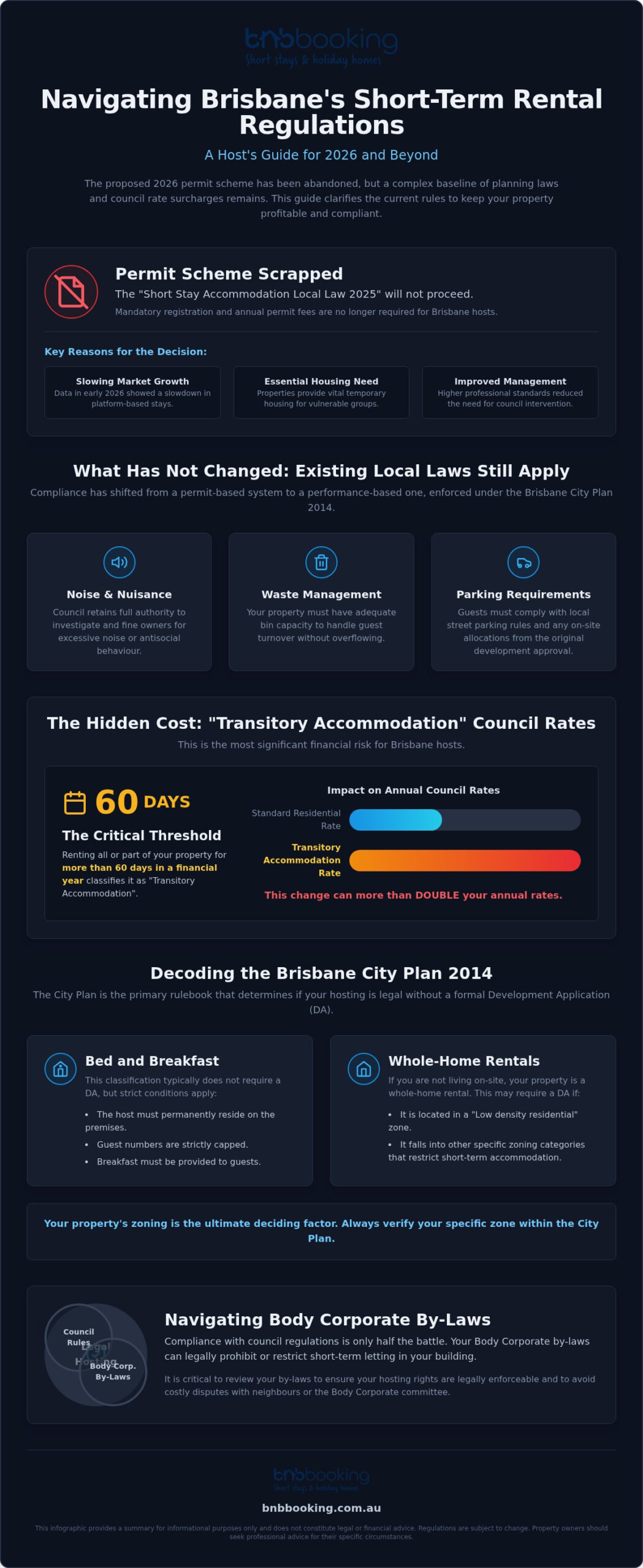
While the airbnb regulations brisbane city council enforces provide the legal framework for land use, they don’t override the specific by-laws of a strata scheme. For many owners in Brisbane’s high-density hubs like South Brisbane, Kangaroo Point, or Newstead, the Body Corporate is often a more immediate regulator than the Council itself. Understanding this hierarchy is vital because a property can be perfectly compliant with city planning yet still face litigation or fines from a committee concerned about building security and resident amenity. The May 2026 decision to scrap the council permit scheme hasn’t changed the fact that you must still satisfy your building’s internal rules.
The relationship between council zoning and strata rules is often misunderstood. A Body Corporate cannot typically “ban” short-term letting if the zoning allows it, but they can certainly regulate the behaviour of guests through strictly enforced conduct by-laws. If your building’s committee is particularly active, you must ensure your management strategy is robust enough to prevent the “nuisance” triggers that lead to formal breach notices and potential stays in the Commissioner’s Office.
The 2024-2025 QLD Strata law reforms provided clearer boundaries for committees. While they cannot easily prohibit the sale or lease of a lot, they’ve gained stronger footing to regulate guest conduct on common property. This includes enforcing strict rules around the use of shared facilities like pools, gyms, and visitor parking. Before listing your property, you must review your specific scheme’s by-laws to identify any “no short-stay” clauses. Even if these clauses are legally questionable, fighting them is an expensive and time-consuming process that’s best avoided through proactive engagement and professional representation.
The most effective way to stay compliant is to ensure your guests are nearly invisible to long-term residents. This starts with a set of “House Rules” that are even stricter than the building’s own by-laws. High-standard guest vetting is the foundation of this approach, filtering out potential “party house” issues before they reach the lobby. Maintaining a dedicated 24/7 contact person ensures that any neighbour concerns are resolved in real-time, preventing minor issues from escalating into formal Council complaints or Body Corporate disputes.
Managing these interpersonal and legal complexities requires a level of oversight that most individual owners find overwhelming. Our full-service Airbnb management takes this burden off your shoulders, handling every committee interaction and neighbour enquiry with professional diplomacy. By positioning your property as a well-managed asset rather than a transient hotel room, you build the social capital needed to host successfully for the long term in Brisbane’s competitive market.
Since 2016, we’ve watched the airbnb regulations brisbane city council enforces evolve from simple zoning rules to a complex interplay of commercial rates and strata by-laws. The Council’s decision to shelf the 2026 permit scheme was a vote of confidence in the industry’s ability to self-regulate, but it places the burden of proof squarely on the shoulders of property owners. At BnB Booking, we take a proactive stance, ensuring your property doesn’t just meet the minimum legal requirements but sets the benchmark for neighbourhood harmony and guest experience. Our management style is built on the philosophy that a well-run home is a compliant one.
Our approach centres on preventing friction before it starts. By implementing rigorous guest vetting protocols, we eliminate the “party house” risks that trigger council noise complaints and body corporate disputes. This strategic oversight is the primary reason why professional management has become the preferred model for Brisbane’s most successful hosts. We don’t just manage bookings; we manage the long-term reputation and legal standing of your property within its specific sub-region.
Maintaining a five-star rating while navigating the 2026 market requires more than just a clean apartment. We coordinate with local trades to ensure your property meets the latest safety standards, including the upcoming state-wide smoke alarm mandates. Our team acts as the 24/7 point of contact for neighbours and committees, diffusing potential issues with the clinical efficiency of a firm that understands the South East Queensland market. This local expertise ensures your property remains a welcome part of the community rather than a source of local frustration.
Our onboarding process is designed to bring clarity to the confusion of rate classifications and planning queries. We begin with a comprehensive review of your property’s current zoning and rate status, identifying opportunities to maximise your yield even if you’re subject to Transitory Accommodation levies. We handle the listing optimisation, professional photography, and dynamic pricing needed to outperform the competition and cover the higher fixed costs of hosting in Brisbane today. This holistic management ensures you’re protected from both regulatory fines and market volatility.
If you’re ready to secure your property’s future in this evolving regulatory landscape, now is the time to act. You can organise a rental yield assessment for your Brisbane property today to see how our boutique, hands-on management can transform your compliance headaches into consistent, high-performing returns.
The landscape of airbnb regulations brisbane city council has shifted from a proposed permit system back to a rigorous focus on zoning and rating classifications. Success in 2026 requires more than just a great listing; it demands a strategic understanding of the Brisbane City Plan 2014 and the financial impact of Transitory Accommodation rates. While the administrative burden of registration has lifted, the expectation for professional conduct and neighbourhood harmony has never been higher.
As local South East Queensland experts since 2016, our team at BnB Booking specialises in high-yield luxury and family rentals that stand up to the closest scrutiny. We provide comprehensive guest vetting and compliance management to ensure your investment remains both protected and profitable. Don’t let regulatory shifts or rate surcharges erode your margins. It’s time to elevate your property’s performance through a partnership that values both hospitality and pragmatic business results.
Maximise your Brisbane Airbnb income with BnB Booking and enjoy the peace of mind that comes with elite management. Your property is a premium asset, and with the right partner, it’ll thrive in Brisbane’s evolving market.
No, you don’t need a specific short-stay permit as of August 2026. The proposed registration system was scrapped by Lord Mayor Adrian Schrinner in May 2026. However, you must still comply with the Brisbane City Plan 2014 and any relevant Body Corporate by-laws. While the administrative burden is lower, your property must still operate within its designated zoning laws to avoid potential enforcement actions or fines for unapproved land use.
The Short Stay Accommodation Local Law 2025 was indefinitely delayed and then abandoned in May 2026 due to economic factors and improved management standards. Council decided that the permit system would create unnecessary red tape for hosts who provide essential temporary housing. This shift positions Brisbane as a more permissive environment compared to other major Australian cities, focusing on existing planning laws and rate surcharges rather than new registration fees.
Yes, your rates will likely increase if you rent the entire property for more than 60 days in a year. Brisbane City Council applies “Transitory Accommodation” rates to these properties, which can more than double your standard residential levies. This reclassification occurs because the Council views whole-home short-term rentals as commercial operations. It’s a critical factor to include in your annual financial planning and ROI calculations to ensure your venture remains profitable.
A Body Corporate generally cannot ban short-term letting if the local zoning allows it, but they can strictly regulate guest conduct. Queensland strata laws allow committees to enforce by-laws regarding noise, common property use, and security. If guests repeatedly breach these rules, the Body Corporate can issue formal notices that may lead to legal action. Professional management helps mitigate this risk by ensuring guests adhere to all building-specific requirements and neighbourhood standards.
There’s no hard cap on the number of nights you can host, but exceeding 60 days triggers the higher Transitory Accommodation rate category. Unlike some other Australian capitals that have introduced 180-day limits, Brisbane currently relies on rating surcharges to manage the market. If you stay under the 60-day threshold, you may retain your standard residential rate status, though you must still follow the airbnb regulations brisbane city council planning codes.
You might need a DA depending on your property’s specific zoning under the Brisbane City Plan 2014. For whole-home rentals in low-density residential zones, the use is often considered “impact assessable,” requiring formal council approval. Conversely, hosting a room while you live on-site often falls under “accepted development.” It’s essential to check the Council’s PD Online tool or consult a professional manager to verify your property’s specific requirements before you begin hosting.
Non-compliance can result in significant financial penalties, including back-dated rate surcharges and formal enforcement notices. If Council identifies an unapproved use of premises, they can issue fines that escalate if the issue isn’t rectified. Additionally, persistent noise or nuisance complaints can lead to further investigation under local laws. Staying compliant with the airbnb regulations brisbane city council enforces is the only way to ensure your hosting business remains sustainable and respected by the community.
A Bed and Breakfast is defined as a home-based business where the primary resident lives on-site and provides short-term accommodation for a small number of guests. Unlike whole-home rentals, a B&B requires the host to be present and typically includes the provision of a morning meal. This classification usually has a more streamlined compliance path in residential zones compared to “Short-term accommodation,” which refers to renting out the entire premises to travellers or tourists.