
Pool safety for Airbnb in QLD: certificates and host duties
- 22 October 2026
- Blog
A pool at a Queensland short-stay rental comes with a clear compliance duty: pool safety compliance for an Airbnb in QLD requires... Read More
 by BNB Booking

What if the regulatory hurdle you’ve been bracing for suddenly vanished, only to leave a more complex challenge in its wake? On 12 May 2026, the Brisbane City Council officially paused the proposed Short Stay Accommodation Local Law 2025, shelving the mandatory permit system many owners feared would arrive this July. While this news offers immediate relief, it doesn’t mean the airbnb regulations brisbane city council enforces have disappeared. Instead, the focus has shifted back to the rigorous zoning and development standards of the Brisbane City Plan 2014.
It’s exhausting trying to distinguish between a simple permit and a formal development approval while your investment’s future hangs in the balance. We’re here to provide the strategic clarity you need to confirm your property’s legal status and ensure your short-term rental remains fully compliant. This guide offers a definitive 2026 checklist to help you navigate zoning requirements and secure the peace of mind that comes with a future-proofed asset.
The announcement on 12 May 2026 sparked a wave of relief across the city. Brisbane City Council confirmed it’s not proceeding with the proposed Short Stay Accommodation Local Law 2025. This decision effectively scraps the mandatory permit system that was due to start this July. Council cited shifting housing market pressures, including interest rate uncertainty and federal tax changes, as the primary reasons for this strategic pivot. However, don’t mistake this pause for a total deregulation of the market. The “scrapped” permit scheme doesn’t create a free-for-all for hosts. Instead, it signals a return to the strict enforcement of the Brisbane City Plan 2014.
Council is now using advanced data-sharing protocols with major platforms to monitor the airbnb regulations brisbane city council expects you to follow. They’re no longer relying solely on the 100 or so annual complaints from neighbours to find non-compliant properties. With short-stay dwellings making up less than 1% of Brisbane’s total housing stock, the focus has narrowed. They’re targeting specific properties that disrupt the intended character of residential neighbourhoods, ensuring that the rapid growth of the sector remains managed and sustainable.
The most common source of confusion for owners is the difference between a council permit and a planning approval. While the 2026 permit is gone, the requirement for Development Approval (DA) remains. Under the BCC framework, short-term accommodation is defined as any residential dwelling let for periods of less than 90 consecutive days. This isn’t a “hosting limit” like you might see in Sydney; it’s a legal classification of land use. Global Short-term rental regulations often hinge on these definitions to separate casual hosting from commercial operations. If your property’s zone doesn’t automatically allow for this use, you’re technically in breach without a DA, regardless of the paused permit law.
The Council’s current strategy involves a targeted “suburban crackdown” on roughly 500 properties located in sensitive residential areas. These are homes in zones meant for long-term residency that have transitioned into unhosted hotels. If you’re operating in these pockets, your risk profile has increased. To protect your investment, you should take several proactive steps:
If you receive a notice to cease, the transition period is usually brief. Council expects immediate compliance or a return to the long-term rental market. Understanding your status now is the only way to future-proof your asset against further state-level changes expected later this year.
Zoning is the Council’s way of deciding what activities can happen in specific areas. It acts as a blueprint for the city’s growth, ensuring that commercial operations don’t clash with quiet residential pockets. Following the Brisbane City Council Announcement to pause the new permit scheme, your property’s zoning has become the most critical factor in your legal right to operate. If your land isn’t zoned for “Short-term accommodation,” you’re essentially operating outside the Brisbane City Plan 2014, which remains the primary enforcement tool for 2026.
Low Density Residential zones are the highest risk areas for hosts this year. These zones are intended for long-term domestic life, and Council is actively monitoring them to prevent “unhosted hotels” from disrupting suburban character. Conversely, Centre and Mixed Use zones are the “safe havens” for short-term rentals. These areas are designed for high-intensity activity, meaning your Airbnb is likely to be viewed as a complementary use rather than a nuisance. However, keep in mind that Neighbourhood Plans can override general zoning rules. Even if your zone looks safe, a specific Neighbourhood Plan might add extra layers of restriction that you’ll need to account for.
To confirm your status, you must use the City Plan Online tool. Enter your address to see your property’s primary zone and any “Overlays” that apply. Overlays cover specific issues like flood risks or heritage protections, and they can significantly complicate your ability to gain development approval. Low Density Residential is the primary zone where BCC restricts commercial short-stays. If you’re unsure about your property’s specific zoning constraints, our team can help you assess your compliance risk before the next council review.
BCC identifies short-term rentals for rating purposes through a combination of platform data-sharing and public reporting. If your property is classified under the “Transitory Accommodation” rates category, you’ll face a significant financial surcharge compared to standard residential rates. This category applies when a whole home is used for short-term stays rather than as a permanent residence. If you live on-site and only rent out a portion of your home, you may have grounds to appeal a rate reclassification. Council generally looks for evidence that the property remains your primary place of residence to determine if the surcharge applies. Understanding these airbnb regulations brisbane city council uses to categorise properties is essential for maintaining your profit margins in a tightening market.
Deciding between a hosted bed and breakfast and unhosted short-term accommodation is more than just a lifestyle choice; it’s a critical regulatory decision. Brisbane City Council makes a sharp distinction between these two models under the Brisbane City Plan 2014. If you live on the premises while guests stay, you likely fall under the Home-based Business Code. This classification is often a strategic path for owners in residential areas because it bypasses many of the hurdles associated with unhosted commercial stays. Conversely, when you rent out an entire house as a mini-hotel, you’re moving into the realm of commercial short-term accommodation, which triggers stricter oversight regarding parking, signage, and guest capacity.
The difference in operational requirements is significant. A home-based B&B is generally limited to one small sign, usually no larger than 0.3 square metres, to maintain the suburban aesthetic. Parking is another flashpoint. Council expects you to provide enough off-street parking so that guests don’t clog up narrow residential streets. If your property can’t accommodate the extra vehicles, your chances of staying compliant are slim. Understanding how these airbnb regulations brisbane city council applies to your specific setup is the first step in protecting your rental income.
BCC views hosted stays as having a lower impact on suburban character. Because a permanent resident is on-site to manage noise and guest behaviour, these arrangements are generally seen as accepted development. You can typically host a maximum of six guests, provided you meet the specific parking and floor area requirements outlined in the code. It’s a savvy way to navigate the market without the heavy lifting of a full development application. However, this advantage only applies if the property remains your primary residence. Renting out a secondary dwelling, like a granny flat, while you live in the main house can sometimes complicate this status, so always check your specific site overlays first.
For those opting for unhosted entire-home rentals, compliance becomes more rigorous. Fire safety is non-negotiable. By 2026, all short-stay properties must adhere to updated smoke alarm standards and provide clearly marked evacuation paths in every guest room. Your standard landlord insurance won’t cut it here; you’ll need dedicated airbnb insurance australia hosts rely on to protect against public liability and accidental damage. Additionally, keep meticulous records. BCC audits often require proof of stay durations and guest numbers to verify you aren’t exceeding site capacity. A clear paper trail is your best defence if a neighbour ever lodges a formal complaint with the Council.
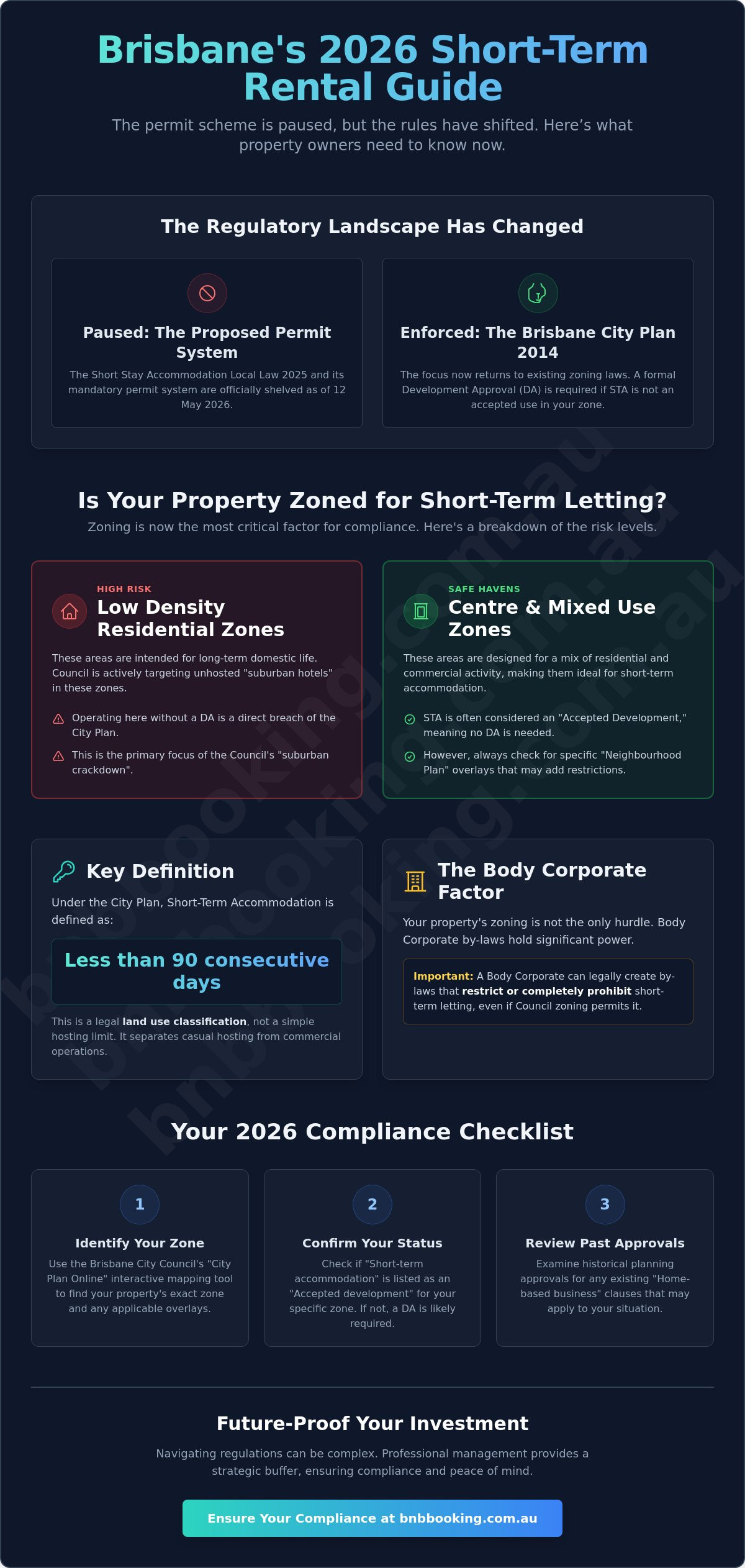
While the airbnb regulations brisbane city council enforced have seen a significant shift in 2026, property owners in strata schemes face an entirely different layer of governance. Many owners ask if a Brisbane Body Corporate can legally ban short-term letting. Under the Body Corporate and Community Management Act 1997, and following the 2024-2025 Queensland legislative updates, the general rule remains that a Body Corporate cannot prohibit a lot owner from using their property for a lawful purpose. However, this doesn’t mean you have a blank cheque. Schemes are increasingly using “nuisance” and “interference” by-laws to curb short-stay activity that disrupts the quiet enjoyment of long-term residents.
Managing the friction between transient guests and permanent neighbours is the hallmark of a successful rental. Issues usually stem from three specific areas: excessive noise, unauthorised parking in common bays, and the misuse of facilities like pools or gyms. Implementing a strict Code of Conduct for every guest is no longer optional; it’s a vital shield. This document should clearly outline expectations regarding common property usage and noise limits, providing you with a legal basis to terminate a stay if rules are breached.
Reviewing your specific scheme’s by-laws is the first step before listing your apartment. Look for “prohibited use” clauses, though you should be aware that these are frequently challenged and overturned if they conflict with state law. If a dispute arises, the Office of the Commissioner for Body Corporate and Community Management is the primary body for resolution. While a blanket ban is difficult, “nuisance” by-laws are the primary tool for enforcement. If you’re facing pushback from your committee, it’s worth considering professional management to bridge the gap and ensure your operations meet the highest community standards.
Maintaining positive relations with adjacent residents is your best insurance against a forced exit from the market. A “Good Neighbour” policy involves proactive communication; let your neighbours know who to contact if an issue arises so they don’t go straight to the committee. Technology also plays a massive role in 2026. Installing non-invasive noise monitoring sensors like Minut allows you to detect potential parties before they escalate into a formal complaint. Professional management often reduces neighbour friction because it replaces an emotional owner-tenant dynamic with a clinical, results-oriented oversight that prioritises the building’s harmony as much as the guest’s experience.
Managing a short-term rental in Brisbane has evolved from a passive side-hustle into a sophisticated regulatory challenge. While the 12 May 2026 decision to pause the new permit scheme offers immediate relief, the underlying airbnb regulations brisbane city council continues to enforce through the 2014 City Plan require constant vigilance. We monitor these legislative shifts in real-time. This ensures your asset never falls foul of a sudden policy pivot or a change in Council’s enforcement priorities. Our team handles the heavy lifting of rates reclassification, insurance alignment, and fire safety audits, so you don’t have to.
A primary friction point for Brisbane hosts is the volume of complaints from neighbours. With approximately 100 complaints lodged annually across the city, Council is quick to investigate properties that disrupt residential peace. Our guest vetting process is designed to deliver zero-nuisance stays. We prioritise high-quality guests who respect the local community standards. By optimising your listing to attract professional travellers and families, we signal to both the market and the Council that your property is a professionally managed, low-impact asset.
The era of “DIY” hosting is becoming increasingly fraught with risk. Council now employs advanced data-sharing protocols to identify unhosted stays in low-density residential zones. If you’re operating without a clear understanding of your property’s zoning, you’re vulnerable to a notice to cease. We specialise in helping owners transition to compliant hosting models. For instance, we recently helped a suburban owner in a high-risk pocket pivot their strategy. By aligning their operation with the Home-based Business Code, we turned an “at-risk” listing into a compliant, high-yield asset that satisfies both the owner’s financial goals and the Council’s suburban character requirements.
Choosing full-service management means your investment is protected by a team that understands the granular nuances of the Brisbane market. We provide a holistic service that encompasses everything from professional cleaning and maintenance to direct Council liaison. We focus on maximising your yield while staying strictly within the “Centre Zone” advantages or the specific B&B rules. This strategic approach ensures your property remains a “future-proofed” investment regardless of state-level regulation changes on the horizon. Ready to secure your property’s future? Book a compliance review for your Brisbane property today to ensure your short-term rental meets every 2026 standard.
The 2026 landscape for property owners is defined by a return to fundamentals. While the pause on new permit schemes offers a breather, the reality of airbnb regulations brisbane city council depends heavily on the City Plan 2014 and meticulous strata management. Success in this market now requires more than just a great listing; it demands a strategic alignment with local zoning and a proactive approach to community relations. Ensuring your unhosted or hosted stay fits the specific requirements of your residential pocket is the only way to safeguard your long-term income.
Protecting your asset from shifting council priorities is simpler with a partner who understands the local terrain. With over 8 years of Brisbane property expertise, we specialise in managing luxury and family-friendly short-stays that meet the highest standards of compliance. We provide proactive monitoring for every asset we manage, ensuring your property stays on the right side of the law while maximising your financial returns.
Don’t leave your investment’s future to chance in a changing regulatory environment. Get a Professional Compliance & Rental Yield Assessment today and secure the peace of mind you deserve. Your property’s potential is waiting to be unlocked.
No, you don’t currently need a specific permit to operate. The proposed permit system was officially paused on 12 May 2026 because of shifting market pressures and improved property management across the sector. However, you must still ensure your property complies with the existing airbnb regulations brisbane city council maintains through its 2014 City Plan. This means checking your zoning and planning approvals rather than applying for a new licence.
If your property falls within this zone, your risk of enforcement is significantly higher. Council views these areas as the heart of suburban living, so unhosted stays often require a formal Development Approval (DA). Operating without one could lead to a notice to cease, especially as the Council continues its targeted review of approximately 500 residential properties identified as potentially non-compliant.
Yes, whole-home rentals are typically placed in the “Transitory Accommodation” rating category. This results in a higher cost compared to standard residential rates. If you’re a hosted B&B operator living on-site, you might be eligible for a standard residential rate, provided you can prove the property remains your primary place of residence and meets the Home-based Business Code requirements.
There is no annual limit on the number of nights you can host in Brisbane. The “90-day rule” mentioned in local laws refers to the legal definition of a short-term stay, not a cap on usage. You can host 365 days a year, provided your property’s zoning and planning approvals allow for commercial short-term accommodation use under the City Plan.
Technically, a Body Corporate cannot issue a blanket ban on short-term letting under Queensland’s current legislation. They can, however, make operations difficult through strict by-laws regarding noise, common property damage, and parking. Most disputes are settled based on whether the guests are causing a “nuisance” to long-term residents, making high-quality guest vetting and professional oversight essential.
Absolutely, though the era of unmanaged, “set and forget” listings is over. Profitability in 2026 relies on professional optimisation and staying on the right side of zoning laws to avoid heavy fines. Properties in Mixed Use or Centre zones remain highly lucrative, especially when managed to attract premium guests who respect the local neighbourhood character and building rules.
You have a legal obligation to meet specific safety standards even if a certificate isn’t always requested. By 2026, this includes having interconnected smoke alarms in every bedroom and along every hallway. You must also display clear evacuation diagrams and have appropriate public liability insurance. Standard landlord insurance usually won’t cover you for short-term stay incidents or commercial land use.
The distinction lies in residency and the “Home-based business” code. A Bed and Breakfast requires the host to live on-site, which often makes it an “accepted development” in many residential zones. An unhosted Airbnb is seen as a commercial “Short-term accommodation” land use, which triggers stricter airbnb regulations brisbane city council enforces through the planning scheme and development application process.