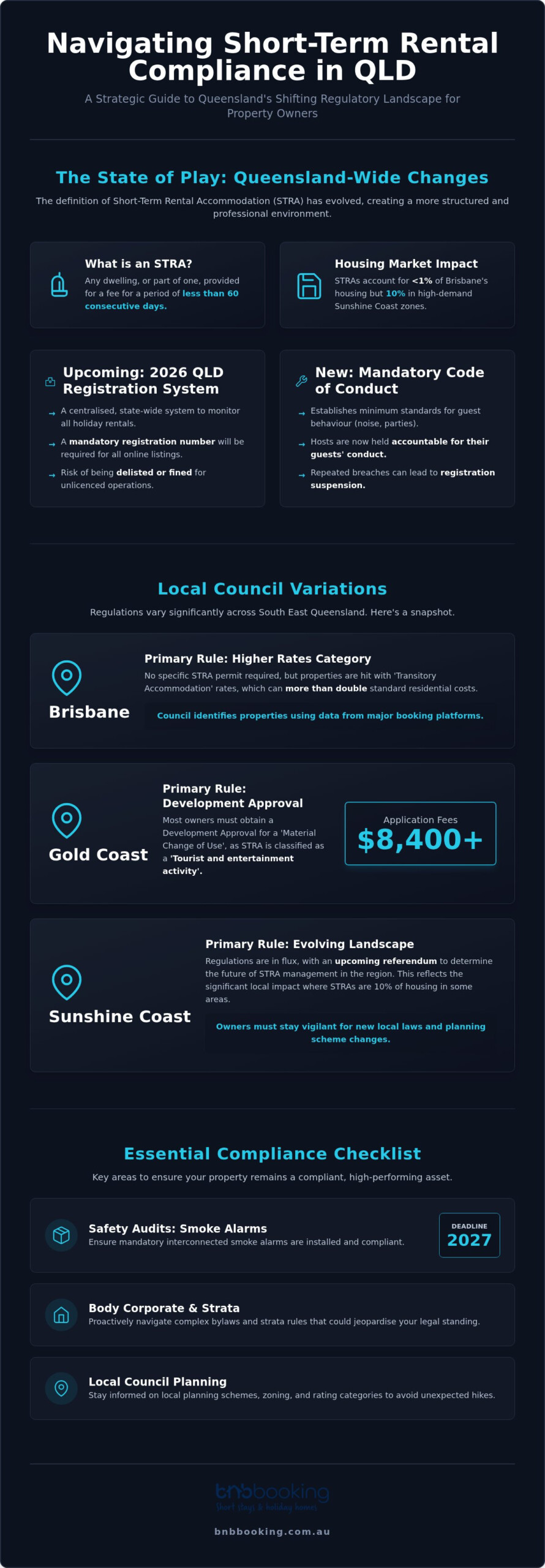
Did you know that a material change of use application for a Gold Coast holiday rental can now cost upwards of $8,400? It is a stark reminder that the regulatory landscape in the Sunshine State is no longer a set and forget affair. As a property owner, you have likely felt the frustration of trying to untangle the messy overlap between state mandates and shifting local council bylaws. The fear of a heavy fine or a sudden Body Corporate crackdown is a significant burden when you are simply trying to provide a premium guest experience and secure a reliable return on your investment.
We understand that maintaining short term rental compliance qld can feel like chasing a moving target. This guide is designed to replace that uncertainty with professional clarity, offering a strategic breakdown of the 2026 requirements. You will learn how to navigate Brisbane’s higher rating categories, prepare for the mandatory 2027 smoke alarm deadline, and understand the implications of the upcoming Sunshine Coast referendum. By the end of this article, you will have a clear checklist to ensure your property is fully protected and positioned as a high performing, compliant asset in a competitive market.
Key Takeaways
- Identify the critical differences in council regulations across Brisbane, the Gold Coast, and the Sunshine Coast to avoid unexpected rating hikes or permit issues.
- Master the essentials of short term rental compliance qld by staying ahead of the latest state registration updates and local planning schemes.
- Ensure your property is fully protected against safety audits by implementing mandatory interconnected smoke alarms before the 2027 deadline.
- Learn how to navigate complex Body Corporate bylaws and strata challenges that could otherwise jeopardise your rental’s legal standing.
- Discover how professional management can streamline the compliance process, ensuring your investment remains profitable and legally sound without the administrative headache.
The State of Play: Short-Term Rental Accommodation (STRA) in Queensland
The definition of Short-Term Rental Accommodation (STRA) in Queensland has shifted from a casual hobby into a sophisticated asset class. Under the latest frameworks, STRA encompasses any dwelling, or part of a dwelling, provided for a fee for a period of less than 60 consecutive days. This evolution reflects a broader professionalisation of the industry. In South East Queensland, the tension between a thriving tourism economy and housing affordability has reached a tipping point. For instance, while short stays account for less than 1% of Brisbane’s housing, they represent 10% of dwellings in high demand coastal zones on the Sunshine Coast according to a 2025 council audit. This disparity is why “doing nothing” is no longer a viable strategy for property owners.
Maintaining short term rental compliance qld is now a prerequisite for market entry. Casual hosts who ignore these shifts face significant financial exposure, such as Brisbane’s “Transitory Accommodation” rates which can more than double standard residential costs. The move toward a more structured environment isn’t just about revenue; it’s about creating a sustainable ecosystem where holiday rentals can coexist with long term residents. Professional management has become the standard for those looking to protect their investment from the risks of non-compliance and local council scrutiny.
The 2026 QLD Registration System
The move toward a centralised registration system represents a major shift in how the state monitors the holiday rental market. This framework aims to provide a single source of truth for regulators, replacing the fragmented approach of previous years. To secure a registration number, you must provide verified property details, proof of ownership, and evidence that your home meets specific safety benchmarks. Once issued, this number is a mandatory requirement for your listing to remain visible on major booking platforms. Without it, your property risks being delisted or facing heavy penalties from local authorities who now have the data to track unlicenced operations with precision.
The Mandatory Code of Conduct
The new Code of Conduct introduces a clear set of obligations designed to professionalise guest management and protect community amenity. It establishes minimum standards for guest behaviour, particularly regarding noise and the prevention of “party house” issues. Hosts are now held accountable for the conduct of their guests, requiring proactive vetting and clear communication of house rules. If a neighbour lodges a formal complaint, the dispute resolution process is far more rigorous than in the past. Repeated breaches can lead to your registration being suspended, making it essential to have a robust management plan in place to handle guest feedback and potential conflicts before they escalate.
Local Council Variations: Brisbane, Gold Coast, and Sunshine Coast
Local councils remain the primary gatekeepers of your property’s earning potential. While the state government provides a broad framework, your local government area (LGA) determines the zoning, rates, and specific operational permits required. In South East Queensland, this creates a patchwork of rules that vary significantly between the river city and the coast. Staying across these nuances is the only way to achieve true short term rental compliance qld and protect your asset from unexpected enforcement actions.
In Brisbane, the regulatory landscape shifted dramatically on 12 May 2026, when the City Council abandoned its proposed mandatory permit system. Currently, you don’t need a specific licence to host in the capital. However, the financial cost remains high through the “Transitory Accommodation” rates category. If your property is identified as a short stay rental, your council rates could more than double. This identification is increasingly automated, as councils now leverage data sharing agreements with major booking platforms to spot “transient” properties and adjust their billing accordingly.
The Gold Coast and Sunshine Coast take a more interventionist approach to maintain the balance between tourism and local amenity. On the Gold Coast, short term accommodation is classified as a “Tourist and entertainment activity” rather than a residential one. This means most owners must obtain a Development Approval for a material change of use. Application fees for this process are substantial, starting at $8,488 for code assessable applications as of July 2026. Meanwhile, Sunshine Coast owners are preparing for a referendum on 17 October 2026, which could introduce a 60-day annual cap on bookings by late 2027.
Brisbane’s Evolving Regulatory Landscape
Brisbane’s focus has moved from permits to tax-based regulation. By categorising holiday rentals as commercial entities, the Council aims to address housing affordability without the administrative burden of a permit scheme. Owners need to be vigilant about how they are classified; once you are on the “transient” list, the overheads change your ROI calculations. Proactive management involves ensuring your property is correctly registered to avoid backdated rating adjustments and potential penalties for non-disclosure.
Coastal Compliance: Gold Coast & Sunshine Coast
Coastal councils are increasingly mandating “boots on the ground” to manage guest behaviour. In high-density beachside zones, you are often required to provide a 24/7 local contact who can respond to noise complaints within a strict timeframe. We recommend installing noise monitoring technology to get ahead of these requirements. It provides a data-backed record of guest behaviour, which is vital for defending your listing against frivolous neighbour complaints. If you find these shifting rules overwhelming, a partner like BnB Booking can help you stay ahead of council changes so you don’t have to.
Essential Compliance Checklist for QLD Property Owners
To achieve total short term rental compliance qld, you must move beyond the basics of hospitality and address the technical safety standards of the property itself. While aesthetic appeal secures the booking, it is your adherence to safety protocols that secures your investment against litigation and council audits. This checklist represents the non-negotiable foundations for any professional holiday rental in South East Queensland. Neglecting these areas creates significant financial exposure, particularly if a guest is injured or a claim is made against a policy that does not explicitly cover short stay activities.
Professionalising your property involves more than just a welcome basket. It requires a rigorous approach to risk management. You should maintain a compliance folder that includes your current pool safety certificate, electrical test and tag records, and proof of specialised insurance. This documentation serves as your first line of defence during a council inspection or a Body Corporate enquiry.
Fire and Electrical Safety Standards
The deadline for Queensland’s new smoke alarm legislation is fast approaching. By 1 January 2027, all dwellings, including holiday rentals, must be fitted with interconnected, photoelectric smoke alarms. These alarms must be located in every bedroom, in hallways connecting bedrooms, and on every level of the property. When one alarm sounds, they all sound, providing guests with the earliest possible warning. Additionally, you must provide clear emergency exit diagrams. These are vital for international guests who may be unfamiliar with the layout of your home or Australian emergency symbols. We also recommend annual electrical safety checks on all provided appliances to mitigate fire risks from faulty equipment.
Insurance and Liability Protection
Standard homeowner or landlord insurance policies rarely cover the unique risks associated with short stay accommodation. Most policies explicitly exclude commercial activities, meaning you could be left entirely unprotected in the event of guest damage or a public liability claim. You must secure a specialised policy that includes public liability coverage. For properties on the Gold Coast, for example, local authorities often mandate a minimum of $10 million in coverage. Professional management agencies typically require these indemnity levels to ensure both the owner and the management firm are shielded from the costs of accidents or legal disputes. Protecting your rental income against unforeseen property damage is a strategic necessity in a high stakes market.
- Pool Safety: Ensure your QLD pool safety certificate is current and prominently displayed near the pool gate.
- Safety Switches: Confirm that safety switches are installed on all required circuits to prevent electrical accidents.
- Record Keeping: Maintain digital and physical copies of all compliance certificates for at least five years for tax and audit purposes.
- Pest Control: Regular professional treatments ensure the property remains at a high standard for corporate and family guests.
Navigating Body Corporate and Strata Challenges
Body Corporate committees often represent the most immediate challenge to your investment strategy. While local council rules provide one layer of regulation, your building’s bylaws can significantly impact your ability to operate. In Queensland, these bylaws can regulate, and in some cases, even prohibit short-term letting entirely, irrespective of what the local council allows. Achieving short term rental compliance qld within a strata environment requires a strategic approach that balances your property rights with the specific restrictions of your community titles scheme.
The tension between permanent residents and holiday guests is often the root cause of strata disputes. As an owner, you’re responsible for ensuring your guests respect the collective rules of the building. This goes beyond simple noise management; it includes everything from correct parking to the appropriate use of shared amenities. Failing to manage these interactions can lead to formal breach notices and, in extreme cases, legal action that could jeopardise your ability to continue hosting.
Reviewing Your Bylaws
You must scrutinise your scheme’s bylaws for clauses that specifically target “transient” occupants or impose unreasonable restrictions on swipe card access. While some bylaws may seem overly restrictive, others are legitimate safety concerns designed to protect the building’s insurance standing. If you encounter anti-short-term rental clauses, your best course of action is often advocacy at the next Annual General Meeting (AGM). Engaging with the QLD Commissioner for Body Corporate and Community Management can provide clarity on whether a specific bylaw is legally enforceable or if it oversteps the committee’s authority.
Managing Shared Spaces and Neighbours
Disruption to shared facilities like pools, gyms, and lifts is the primary catalyst for neighbour anxiety. To protect your standing within the building, your guest “House Rules” must be an exact reflection of the strata bylaws. This includes strict adherence to pool hours and rubbish disposal protocols. We recommend using professional signage within your unit to remind guests of their obligations to the permanent community. Communication is your most effective tool; providing a 24/7 contact point ensures that any minor issues are resolved before they escalate into committee complaints. If you are facing pushback from your committee, BnB Booking can provide the professional oversight and rigorous guest vetting needed to win their trust and maintain a harmonious building environment.
Future-Proofing Your Investment with Professional Management
Self-managing short term rental compliance qld has evolved into a complex administrative role that extends far beyond simple guest communication. Owners who once managed listings in their spare time now face a mountain of technical requirements, from state-wide registration entries to nuanced local council planning approvals. This administrative burden often distracts from the core goal of generating a high-performing return. Professional management transforms these regulatory hurdles into automated systems, ensuring your property remains active and profitable without the constant threat of delisting or heavy council fines.
The regulatory environment in South East Queensland is only set to become more rigorous. As councils refine their data-sharing capabilities with major platforms, the ability to “fly under the radar” has vanished. Professionalising your approach is the only way to protect your asset’s reputation and long-term viability. By outsourcing the technical oversight, you shift the risk of non-compliance onto experts who monitor legislative changes in real-time. This proactive stance is essential for anyone looking to maintain a premium presence in the Brisbane, Gold Coast, or Sunshine Coast markets.
The BnB Booking Approach to Compliance
As a boutique agency with localised authority, we understand that compliance is a dynamic process rather than a one-off task. We fulfil the mandatory 24/7 local contact requirement for our owners, providing a professional buffer that resolves issues before they reach the committee or council level. Our rigorous guest screening process is specifically designed to prevent “party house” incidents, protecting your property and your relationship with neighbours. We also coordinate regular property audits to verify that fire safety, pool certificates, and general maintenance standards align perfectly with current short term rental compliance qld benchmarks.
Maximising Yield While Staying Legal
In a crowded market, compliance serves as a powerful marketing tool. High-quality corporate and family guests prioritise listings that offer a “Safe and Certified” advantage. They want the peace of mind that comes with knowing their accommodation is fully legal and managed by a reputable firm. Our approach combines this regulatory rigour with professional styling and high-end photography to signal a standard of excellence that justifies premium nightly rates. As we look toward the 2032 Olympics, the demand for compliant, top-tier accommodation will only intensify. Positioning your property today ensures you are ready for the global stage when the eyes of the world turn to Queensland. Organise a compliance audit for your property today to secure your investment’s future and start hosting with total confidence.
Securing Your Property’s Future in a Regulated Market
The transition from a casual Airbnb host to a professional property investor requires more than just a well-styled living room. Staying ahead of short term rental compliance qld involves navigating a complex web of state registrations, council rating categories, and strict 2027 fire safety mandates. Whether you are managing a high-rise apartment on the Gold Coast or a suburban retreat in Brisbane, the regulatory landscape is designed to reward those who prioritise safety and community harmony. By professionalising your approach now, you protect your asset from fines and position it to capture premium demand from corporate and family travellers.
Our specialist SE QLD management team is here to take the administrative weight off your shoulders. With comprehensive guest vetting systems and a proven track record in the Brisbane and Gold Coast markets, we ensure your investment is both “bulletproof” and highly profitable. Don’t leave your compliance to chance. Get a Free Compliance and Earnings Review for Your QLD Property today and enjoy the peace of mind that comes with expert oversight. Your property is a significant investment; let’s ensure it thrives for years to come.
Frequently Asked Questions
Do I need a permit to put my Brisbane house on Airbnb in 2026?
No, you don’t currently require a specific permit or licence to operate a short-term rental in Brisbane. The City Council officially abandoned its proposed mandatory permit scheme on 12 May 2026. However, your property will likely be reclassified under the “Transitory Accommodation” rates category. This change can more than double your standard council rates, so it’s vital to factor this increased overhead into your financial strategy.
What is the new QLD Short-Term Rental Code of Conduct?
The Code of Conduct is a mandatory framework establishing minimum standards for guest behaviour, host responsibilities, and platform accountability. It focuses on mitigating “party house” issues and maintaining community amenity through noise limits and clear dispute resolution pathways. Failure to adhere to these standards can result in formal complaints or removal from booking platforms. Maintaining short term rental compliance qld requires proactive guest vetting to ensure these behavioural standards are consistently met.
Can my Body Corporate legally ban me from doing short-term rentals?
Yes, under current Queensland legislation, Body Corporates have the authority to regulate or prohibit short-term letting within their community titles scheme. While there have been various legal challenges, the specific bylaws of your building are often the final word on the matter. You should review your scheme’s bylaws carefully and seek professional advice if you believe a restriction is unreasonable or has been incorrectly implemented by the committee.
How much does the QLD short-term rental registration cost?
As of July 2026, the Queensland government hasn’t legislated a mandatory statewide registration fee for short-term rentals. While a centralised system was recommended to improve market transparency, no specific state-level cost exists currently. However, you should account for local council fees, such as the Gold Coast’s development application costs, which can reach $8,488 for a material change of use for properties with 10 or fewer units.
Do I need a different type of smoke alarm for a holiday rental?
You must install interconnected, photoelectric smoke alarms in your holiday rental by the 1 January 2027 deadline. These alarms aren’t “different” in technology but must be hard-wired or powered by a non-removable 10-year lithium battery. They must be placed in every bedroom, in hallways connecting bedrooms, and on every level of the property. When one alarm is triggered, all alarms in the network will sound simultaneously.
What insurance is best for short-term rentals in Queensland?
You should secure a specialised short-term rental insurance policy that includes comprehensive public liability coverage. Standard homeowner or landlord insurance typically excludes commercial short-stay activities, leaving you exposed to significant financial risk. We recommend a policy with at least $10 million in public liability, which is a mandatory requirement for some councils like the Gold Coast. This ensures you’re protected against guest injuries, property damage, and loss of rental income.
How does the 2026 registration system affect my tax obligations?
While a statewide registration system isn’t yet active, your tax obligations are heavily influenced by the increased data sharing between platforms and government agencies. The Australian Taxation Office (ATO) and local councils now have greater visibility into your rental income and property usage. You must accurately report all earnings and be aware that your property’s “transient” status in Brisbane can lead to higher council rates, which are generally tax-deductible business expenses.
What are the fines for non-compliance with QLD holiday rental laws?
Fines for non-compliance vary depending on the local council and the specific nature of the breach. Operating without a required Development Approval on the Gold Coast or ignoring noise abatement notices can result in penalties reaching thousands of dollars. Repeated breaches of the Code of Conduct or fire safety standards can also lead to your property being barred from major booking platforms. Staying current with short term rental compliance qld is the only way to avoid these costly enforcement actions.



 by
by