
Pool safety for Airbnb in QLD: certificates and host duties
- 22 October 2026
- Blog
A pool at a Queensland short-stay rental comes with a clear compliance duty: pool safety compliance for an Airbnb in QLD requires... Read More
 by BNB Booking

Relying solely on platform protections like AirCover is the most expensive mistake an Australian host can make in 2026. While Airbnb’s discretionary program offers a safety net, it’s far from a comprehensive insurance policy, leaving your most valuable asset vulnerable to the fine print. You’ve likely spent years building equity and months perfecting your property’s aesthetic, so the anxiety of a single ‘party house’ event or a complex liability claim is a genuine weight on your shoulders. Effectively preventing property damage airbnb requires moving beyond hope and into a proactive, “defence in depth” strategy tailored specifically for the Australian market.
We understand that the shift from a casual side-hustle to a professional investment requires a more sophisticated approach to risk. This guide provides a clear framework to bridge the gap between basic guest guarantees and the specialist Australian insurance you actually need. You’ll learn how to master guest vetting, navigate the current regulatory landscape in regions like Brisbane and the Gold Coast, and implement professional oversight that secures your rental yield. By the end of this article, you’ll have a strategic roadmap to protect your property and your peace of mind, ensuring your hosting journey is defined by profit rather than repair bills.
Many Brisbane property owners assume their existing home and contents insurance provides a safety net for their short-term rental venture. This assumption is a dangerous financial gamble. Standard Australian policies are designed for private residences, not income-generating businesses. The moment you list your property on a platform, your risk profile shifts in the eyes of an insurer. Understanding the evolution of the market, from the History of Airbnb to today’s professionalised landscape, helps clarify why traditional insurance hasn’t kept pace with modern hosting.
The primary hurdle is the “Business Activity” exclusion found in almost every standard Product Disclosure Statement (PDS). Insurers view short-term hosting as a commercial enterprise. If a guest causes a fire or a pipe bursts during a stay, the insurer may deny the claim entirely once they discover the property was being used for profit. Standard policies also ignore specific risks like theft by guests or malicious damage. While a typical policy covers a break-in by a stranger, it rarely covers a situation where you voluntarily handed the keys to the person who caused the loss. This gap makes preventing property damage airbnb through specialist cover a non-negotiable step for serious hosts.
There’s also a legal difference between a social visitor and a paying guest. A friend staying the night is a visitor; a person paying via a platform is a customer. Standard insurance is built for the former. Furthermore, the “unoccupied” clause in many policies can trigger a claim denial. If your property sits empty for more than 60 days between bookings, your cover might lapse exactly when you need it most. Specialist policies are designed to handle these fluctuations in occupancy.
It doesn’t take a major party to ruin your investment. Hosting even a single paying guest can void your entire home and contents policy if you haven’t notified your insurer. Without specific short-stay protection, you face the terrifying prospect of personal liability for property repairs and legal fees. A commercial use clause is a specific provision within an insurance policy that excludes coverage for any loss or liability arising from activities conducted for financial gain. This single sentence in your PDS can be the difference between a successful claim and financial ruin.
While some domestic policies offer limited liability, they often fail the moment money changes hands for accommodation. In the Australian holiday rental industry, a public liability limit of A$20 million is the recommended standard. This cover is vital for protecting you against guest injuries, such as a slip in a wet bathroom or a trip on an uneven garden path. These “slip and trip” incidents are the most common source of high-value claims in Queensland. Relying on a standard policy for these risks is ineffective because the insurer will argue that the guest was a commercial tenant rather than a social visitor, leaving you to face potential lawsuits alone.
Airbnb AirCover provides up to US$3 million in host damage protection, yet many Australian owners mistake this safety net for a comprehensive insurance policy. It’s a discretionary guarantee, not a regulated financial product. This distinction is critical because, unlike an insurance provider, Airbnb isn’t bound by the same local regulatory oversight or claim-handling standards. While the platform offers broad coverage, it often acts as a ‘last resort’ responder. This means you may be required to attempt a claim through your private home insurer first, which, as we’ve established, can lead to policy cancellations if you haven’t disclosed your commercial activity.
The limitations of platform guarantees become apparent when you look at the fine print. AirCover generally excludes ordinary wear and tear, identity theft, and, perhaps most importantly, loss of rental income while repairs are underway. If a guest causes significant water damage that takes your property off the market for a month, AirCover won’t reimburse those lost earnings. Relying solely on this guarantee for preventing property damage airbnb financial loss leaves you exposed to the messy realities of property maintenance and market fluctuations.
Specialist providers like ShareCover or Terri Scheer offer policies designed for the specific cadence of the Australian short-stay market. Owners can often choose between an annual policy or a pay-per-night model, allowing for flexibility based on booking volume. These policies typically cover malicious damage and theft by guests, which are common pain points standard insurers avoid. Because these companies are based locally, they use Australian adjusters and understand the specific costs of trades and materials in Brisbane. While Queensland currently has fewer registration requirements than those found in NSW short-term rental regulations, having local, regulated cover is the only way to ensure your asset is truly protected.
Success with an AirCover claim depends on speed and meticulous documentation. You must identify and report damage within 14 days of the guest’s checkout, or before the next guest arrives, whichever is earlier. This creates a high-pressure environment for self-managed hosts who work full-time. The burden of proof is significant, requiring high-resolution, timestamped photos and original purchase receipts for every damaged item. For many owners, engaging professional management services is the most effective way to handle these hurdles, as they provide the rigorous inspection reports and local trade coordination needed to resolve claims quickly and keep the property guest-ready.
Many Brisbane owners think they’re safe because they’ve upgraded to a landlord insurance policy. It’s a common trap. Traditional landlord insurance almost always hinges on the existence of a long-term lease, typically six months or longer, which leaves short-stay hosts completely exposed. If your guest is staying for three nights without a formal Residential Tenancy Agreement, your “landlord” policy may be as ineffective as a standard home and contents plan. Investing in the right policy is a cornerstone of preventing property damage airbnb risks from becoming financial disasters.
The solution lies in specialist short-term rental insurance. These products are purpose-built for high-turnover environments like Airbnb and Stayz. They don’t require long-term leases and specifically account for the unique risks of holiday letting. One major advantage is the “Multi-Platform” factor. While platform guarantees only apply to bookings made through their specific site, a standalone short-stay policy protects your property regardless of whether the guest booked via Airbnb, Stayz, or your own direct booking channel. This holistic protection ensures there are no “blind spots” in your coverage.
Loss of rent is another area where these policies shine. In a long-term rental, loss of rent is simple to calculate based on the fixed lease. For an Airbnb, insurers calculate your payout based on “estimated earnings” derived from your historical booking data and seasonal demand. This ensures that if a guest causes damage that takes your property off the market during a peak Brisbane event, you aren’t just covered for the repairs; you’re compensated for the lost income that keeps your investment viable.
Don’t assume your insurer understands your business model. Ask them directly: “Does your definition of a ‘tenant’ include guests staying without a formal lease under the Residential Tenancies Act?” You’ll often find that rent default coverage rarely applies to Airbnb because there’s no bond or long-term contract to default on. You must also identify if your policy distinguishes between “accidental” damage, like a red wine stain on a rug, and “malicious” damage, such as intentional vandalism. Knowing these definitions helps you set the right house rules and guest expectations from the start.
The ATO views insurance premiums for income-producing holiday homes as a legitimate tax deduction. However, you must be careful with apportionment. If you use your Sunshine Coast property for personal holidays for four weeks a year, you can only claim a deduction for the remaining 48 weeks. Consult your accountant to ensure these costs are correctly integrated into your total rental yield calculation. While specialist premiums may be higher than standard policies, the ability to de-risk your asset makes them a savvy business expense that protects your long-term profit margins.
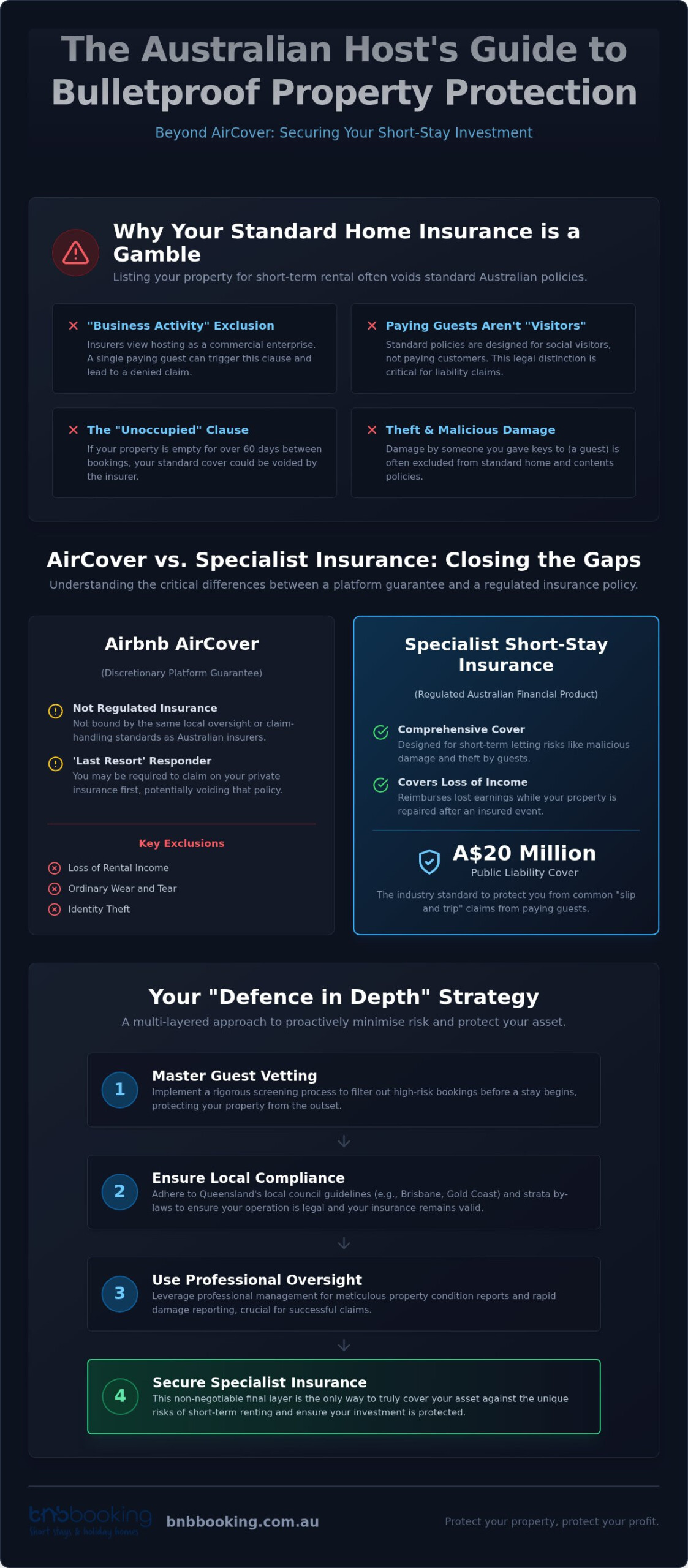
Compliance is the invisible foundation of any successful insurance claim. In Brisbane, the regulatory landscape for short-term rentals has seen significant discussion recently. While the Brisbane City Council’s proposed “Short Stay Accommodation Local Law 2025” was paused and is not proceeding as of August 2026, hosts must remain vigilant. Most specialist insurance policies contain a “compliance with local laws” clause. If a council introduces a registration scheme in the future and you fail to register, your insurer may have grounds to deny a claim for preventing property damage airbnb losses, even if the damage was unrelated to the registration itself.
Beyond council rules, Queensland hosts must navigate the “Excess Trap.” Many standard policies carry a high basic excess, often between A$500 and A$1,000. In a high-turnover Airbnb environment, most damage is incremental, such as a broken coffee table or stained designer linens. If the cost of repair is lower than your excess, you’re effectively uninsured for these common incidents. When selecting cover, look for policies that offer a lower “malicious damage” excess or allow you to bundle multiple small items into a single claim. This ensures that the small “headaches” of hosting don’t erode your monthly rental yield.
If your property is part of a complex, the building’s master insurance policy generally only covers the structure and common areas like lobbies or lifts. It won’t cover the contents inside your unit or your specific liability as a short-stay host. If a guest trips on a loose carpet in the hallway, the Body Corporate policy might respond; if they trip over a rug inside your lounge room, it’s entirely on you. Some Brisbane Body Corporates now require owners to provide a certificate of currency for A$20 million in public liability insurance before they allow short-term letting to continue. Ensure your policy explicitly mentions “short-term rental” to satisfy these by-law requirements.
A policy is only as good as your evidence. You need a comprehensive digital inventory for every room, including high-resolution photos of furniture, appliances, and flooring. High-value items like original artwork or expensive jewellery should be removed from the property or specifically listed as “specified items” on your policy, as they’re often excluded from general contents limits. Meticulously capturing timestamped photos of every room before a guest checks in provides the undeniable evidence required to hold a guest or insurer accountable for new damage. For owners who find this level of detail overwhelming, engaging professional Airbnb management in Brisbane ensures these condition reports are handled with clinical precision after every stay.
Professional management transforms your short-term rental from a vulnerable asset into a resilient, high-performing business. While specialist insurance provides the essential financial safety net, active management serves as the primary barrier against incident. By implementing rigorous operational protocols, we shift the focus from reactive repair to proactive prevention. This strategic oversight is the most effective method for preventing property damage airbnb hosts face in the competitive South East Queensland market. A well-managed property is not just more profitable; it’s a lower risk for insurers, often leading to smoother claim experiences if the unthinkable occurs.
Effective guest vetting goes far beyond checking a star rating on a profile. Our team analyses communication nuances, booking history, and guest intent to identify potential red flags before a reservation is confirmed. We apply strict house rules and booking criteria specifically designed for your Brisbane or Gold Coast property. This filters out high-risk “party house” bookings that standard platform algorithms might overlook. By establishing clear expectations and maintaining a professional presence, we signal to guests that the home is a sophisticated investment rather than a casual party venue. This high-level vetting is exactly what specialist insurers look for when assessing the risk profile of a short-stay asset.
The success of an insurance claim often hinges on the quality of evidence and the speed of reporting. Our professional housekeeping teams do more than just clean; they perform a dual-purpose audit after every departure. We conduct detailed property condition reports, capturing high-resolution, timestamped photos that document the exact state of your home before and after every single guest stay. This meticulous approach ensures we always meet the critical 14-day window required for platform claims.
When damage is identified, our established network of local Brisbane trades allows for rapid repairs. This speed is vital for minimising “Loss of Rent” claims, as it gets your property back on the market faster. We handle the entire headache of evidence collection and trade coordination, providing you with the clinical efficiency of an established management firm. You can rest easy knowing that your investment is being watched by experts who understand the nuances of local compliance and risk mitigation. Protect your investment with BnB Booking’s expert management and trade the stress of damage prevention for the peace of mind that comes with professional oversight.
Successfully preventing property damage airbnb hosts encounter requires a shift from passive hosting to professional asset management. We’ve explored how the gap between platform guarantees and specialist Australian insurance can leave you exposed to significant financial risk. By aligning your property with local compliance and securing a policy that understands the nuances of short-stay turnover, you transform your rental into a resilient, high-performing business. This strategic foundation ensures that your property remains a source of wealth rather than a source of anxiety.
Navigating the complexities of Brisbane and Gold Coast regulations doesn’t have to be a solo effort. As SE Queensland local experts, BnB Booking provides the strategic oversight needed to protect your most valuable asset. Our rigorous guest vetting protocols proactively filter out high-risk bookings, while our professional housekeeping and maintenance coordination ensure every stay is documented with clinical precision. This holistic approach ensures you capture the maximum rental yield while enjoying the peace of mind that comes with professional protection.
Get a Professional Management Appraisal for Your Property today and see why sophisticated owners choose a management partner that is as protective of their investment as they are. Your property deserves the highest standard of care, and we’re here to deliver it.
No, AirCover is a discretionary guarantee rather than a regulated insurance policy. While it offers up to US$3 million in damage protection, it doesn’t cover loss of rent, identity theft, or ordinary wear and tear. Relying on it alone is a major risk for preventing property damage airbnb financial losses. You should always pair it with a specialist Australian short-stay policy to ensure you have legally enforceable coverage and access to local adjusters.
Most traditional landlord insurance policies require a formal Residential Tenancy Agreement with a minimum term, often six months, to be valid. If you’re hosting guests on a nightly or weekly basis without a formal lease, your policy is likely void. Standard landlord cover also fails to account for the high turnover and specific public liability risks associated with holiday letting. You need a policy specifically designed for short-term rental activity to stay protected.
The industry standard for public liability insurance in the Australian short-term rental market is A$20 million. This high limit is essential because it protects you against catastrophic claims, such as a guest suffering a permanent injury on your property. While some platforms offer limited liability, a standalone A$20 million policy ensures you are covered regardless of which platform the booking came from, providing a much stronger shield for your personal assets.
Yes, insurance premiums for an income-producing holiday home are generally tax deductible through the ATO. However, if you use the property for personal holidays, you must apportion the cost and only claim the percentage of time it was available for rent. It’s best to consult with an accountant to ensure your insurance costs are correctly integrated into your rental yield calculations, as this makes professional protection a more affordable business expense.
If a guest is injured, they may seek compensation for medical costs and lost wages. Without specialist public liability insurance, you could be personally responsible for these expenses and any associated legal fees. Standard home insurance will likely deny the claim because the injury occurred during a commercial activity. Having a professional management team ensures that incidents are documented immediately, which is vital for your insurer to assess the situation and manage the claim effectively.
You have a legal duty of disclosure to inform your home insurer about any change in how your property is used. Failing to notify them that you’re running an Airbnb can void your entire policy, including your cover for fire, storm, and theft. Most standard insurers will either increase your premium or tell you that they cannot cover the property at all, at which point you should switch to a specialist short-stay insurance provider.
Standard home insurance typically excludes theft by someone you’ve invited into the home, including paying guests. However, specialist short-stay policies are designed for preventing property damage airbnb issues and often include specific cover for theft or malicious damage by guests. It’s still wise to remove high-value items like jewellery or original art from the property, as these items often require specific listing or have low sub-limits on most policies.
Body Corporate by-laws in Queensland can mandate that you hold a specific level of public liability insurance, often A$20 million, to operate a short-term rental. Crucially, the building’s master insurance policy only covers common areas and the building’s shell. It does not cover your unit’s contents or your specific liability as a host. You must ensure your individual policy complements the strata cover to avoid dangerous gaps in your protection.