Pool safety for Airbnb in QLD: certificates and host duties
- 22 October 2026
- Blog
A pool at a Queensland short-stay rental comes with a clear compliance duty: pool safety compliance for an Airbnb in QLD requires... Read More
 by BNB Booking

The assumption that your standard home and contents policy covers your short-term guests isn’t just a misconception; it’s a financial gamble that could leave your most valuable asset completely unprotected. Most local hosts realise too late that “business use” clauses often void traditional cover entirely, making the search for dedicated airbnb insurance australia a non-negotiable priority. While the promise of AirCover provides a basic safety net, relying on it as your sole protection is a risk that seasoned property owners simply don’t take.
We understand the anxiety that comes with handing over your keys to a stranger, especially when the lines between public liability and property damage seem blurred. This guide provides a clear framework for managing the complexities of the 2026 insurance market, helping you bridge the gap between platform basics and true financial security. You’ll gain a strategic understanding of specialist policy requirements, the impact of new regulations like the Brisbane permit laws, and why professional management is the ultimate safeguard for your investment’s longevity.
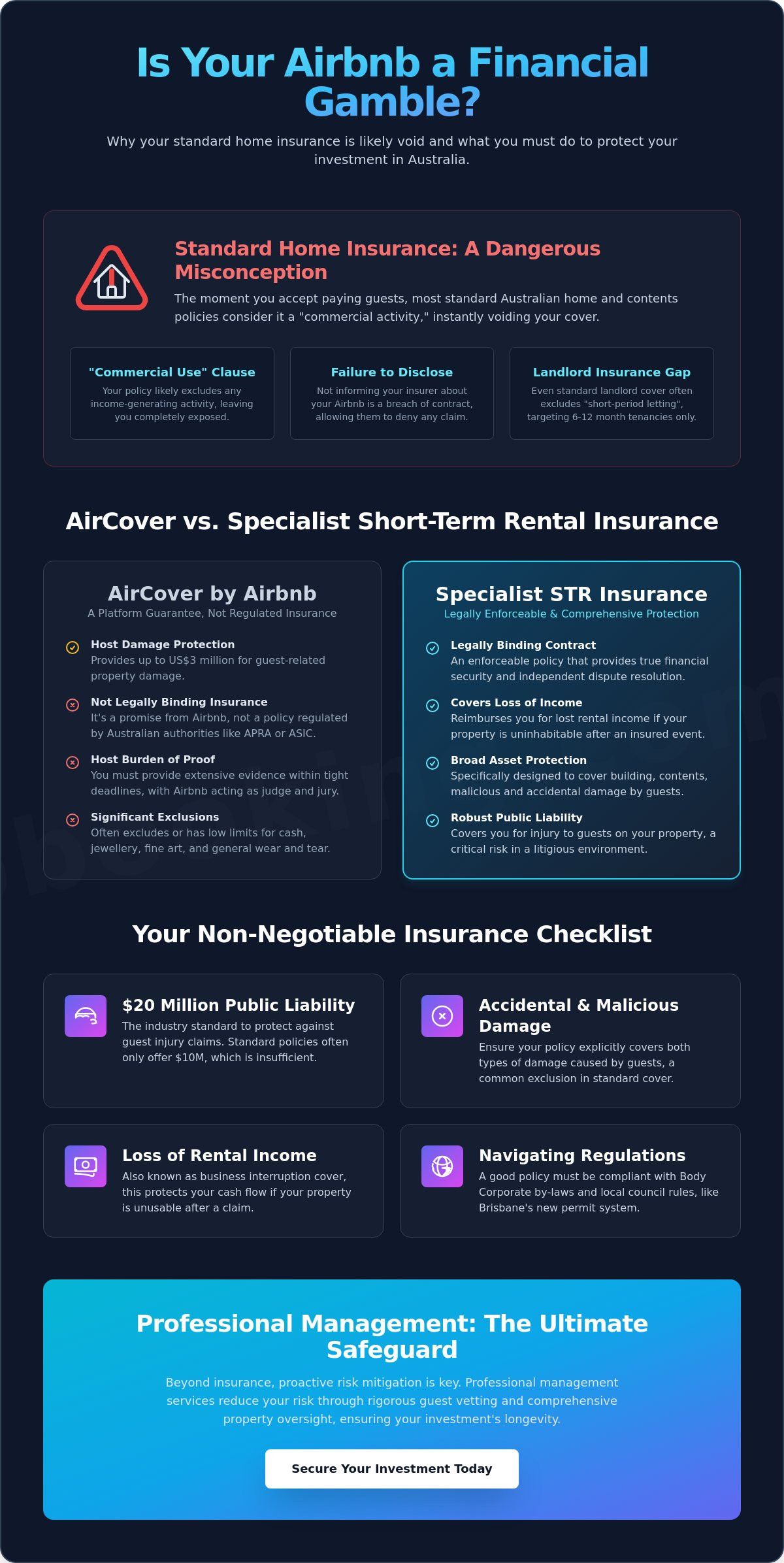
Many Australian property owners assume their existing home and contents policy provides a safety net for their short-stay ventures. This is a dangerous misconception. The moment you list your property on a booking platform, your relationship with your insurer changes fundamentally. Most standard policies are designed for owner-occupiers or long-term residents; they aren’t built to withstand the unique pressures of the high-turnover rental market. Failing to secure specific airbnb insurance australia can leave you personally liable for property damage and legal costs that could easily reach hundreds of thousands of dollars.
The primary issue lies in the duty of disclosure. Under the Insurance Contracts Act, you’re legally required to inform your insurer of any change that might increase the risk they’re covering. Short-term renting is viewed as a significant risk escalation. If you don’t notify them, your insurer has the right to cancel your policy entirely or refuse a claim, even if the damage wasn’t caused by a guest. Even standard landlord insurance, which is designed for six or twelve-month tenancies, often fails here. These policies typically exclude “short-period letting,” leaving a massive gap in your coverage during the very times your property is most active.
Insurers generally categorise short-term guests as a business risk rather than a residential one. In your Product Disclosure Statement (PDS), look for terms like “business pursuits,” “commercial activity,” or “income-generating purposes.” These clauses usually trigger an automatic exclusion. If an electrical fire occurs while a paying guest is staying at the property, your insurer may argue the claim is void because the building was being used for a purpose not covered by a residential policy. This doesn’t just apply to the guest’s room; it can void the cover for your entire building and its contents.
While many basic policies offer $10 million in public liability, this is no longer the benchmark for professional hosts in Australia. We recommend a minimum of $20 million. Public liability is critical because it covers you if a guest is injured on your property. In the context of global short-term rental regulations, Australia remains a highly litigious environment. A simple slip on a wet tile or a fall from a deck can lead to catastrophic financial loss if the guest pursues damages for medical costs and lost income. You must distinguish between building liability, which might cover a passer-by hit by a falling tile, and guest-specific liability, which covers the people actually living in your space. Without dedicated airbnb insurance australia, you’re likely missing this vital layer of protection.
AirCover is often mistaken for a comprehensive safety net, yet it functions as a contractual guarantee rather than a regulated insurance policy. This distinction is vital for every host to understand. While Airbnb provides this protection free of charge, it is a promise made by a global tech platform, not a financial product regulated by Australian authorities like APRA or ASIC. When you rely solely on a platform guarantee, you are essentially allowing the platform to act as both the judge and jury during a dispute. This often results in a significant “burden of proof” problem where the host must provide exhaustive evidence within a very narrow timeframe to secure a payout.
Contrast this with specialist short-term rental insurance, which provides a legally binding contract between you and an insurer. These policies are designed to fill the specific gaps left by platform guarantees, offering more robust protection for your physical assets and your business income. Without a dedicated airbnb insurance australia policy, you may find yourself vulnerable during complex disputes, particularly those involving theft or damage to common areas in strata-titled buildings.
AirCover provides up to US$3 million in host damage protection. While the figure is high, the exclusions are numerous. High-value items, fine art, and jewellery are often subject to strict sub-limits or total exclusion. Furthermore, the definition of “wear and tear” is notoriously subjective. A stained sofa or a scratched floor might be dismissed as standard depreciation by a platform, whereas a specialist insurer might view it as accidental damage. Most importantly, AirCover requires all claims to be lodged within 14 days of checkout. If you have back-to-back bookings and don’t notice the damage until the next guest arrives, you may have already missed your opportunity for recourse.
A specialist Australian policy offers several strategic advantages that global platforms simply cannot match. You gain direct access to local claims adjusters who understand the Australian building and repair market. These policies also provide cover for malicious damage, which is often a different category than simple accidental breakage. Additionally, many dedicated policies cover theft by guests, a risk that is frequently excluded or difficult to prove under platform guarantees. Engaging a full-service Airbnb management partner can further mitigate these risks by ensuring thorough property inspections and photographic documentation are completed after every stay, providing the evidence needed for a successful airbnb insurance australia claim.
Selecting the right airbnb insurance australia requires a strategic look at how your property operates. It’s not just about finding the lowest premium; it’s about matching the policy structure to your specific occupancy patterns and risk appetite. For the sophisticated host, insurance isn’t a mere overhead. It’s a critical tool for asset protection that ensures your investment remains profitable even when the unexpected occurs. Understanding the nuances of your policy can be the difference between a seamless recovery and a significant financial setback.
The Australian market offers two primary structures: “Pay-per-night” models and annual “Set and Forget” policies. Pay-per-night options provide flexibility for casual hosts who only list their primary residence during holidays. However, professional investors and full-time hosts almost always prefer annual fixed-premium policies. These provide consistent coverage and often prove more cost-effective once your occupancy rates climb. When reviewing these, pay close attention to the excess. While a higher excess can lower your annual costs, it may make claiming for smaller, frequent issues like damaged tech or stained designer linens impractical.
Compliance is another factor driving policy choice. Staying ahead of local mandates, such as the Airbnb regulations Brisbane City Council has introduced for 2026, is essential. These rules often require hosts to hold specific levels of liability and permits, which many standard insurers won’t support without a dedicated short-stay add-on.
A robust policy for 2026 must do more than cover fire and flood. It needs to address the specific behaviours of short-term occupants. You must ensure your policy covers both accidental and malicious damage. Accidental cover handles the shattered coffee table or the red wine on the carpet. Malicious damage cover is your safeguard against intentional destruction or “party house” scenarios. Without both, you’re leaving a significant portion of your risk unmanaged. Your airbnb insurance australia checklist should also include:
Don’t forget that insurance premiums for an income-producing property are typically tax-deductible in Australia. This effectively reduces the net cost of your premium, making comprehensive protection a pragmatic business decision for any serious property owner.
The Queensland short-term rental landscape offers a level of stability not found in other states, yet it demands a rigorous approach to compliance. Unlike New South Wales or Victoria, where owners corporations can often vote to ban short-stay activities, the Body Corporate and Community Management Act 1997 prevents Queensland bodies corporate from prohibiting the practice. This freedom is a significant advantage for local investors, but it comes with a heightened responsibility for regulatory adherence. Insurers in the airbnb insurance australia market are increasingly scrutinising local government approvals and safety standards before honouring claims. If you’re operating outside the law, your policy is often worth little more than the paper it’s printed on.
A common trap for unit owners is assuming the Body Corporate’s master policy covers guest-related incidents. It doesn’t. The building’s insurance typically covers the structure, common foyers, and shared amenities like pools; however, it rarely extends to the commercial risks associated with short-term letting inside your individual lot. If a guest causes a flood that damages the apartment below, the Body Corporate insurer may seek recovery from you personally if you lack specific cover. We recommend obtaining formal acknowledgement from your committee before listing. While they cannot legally ban you in QLD, having a record of your intent helps satisfy the “duty of disclosure” requirements of your airbnb insurance australia provider, ensuring there’s no ambiguity during a claim.
Registration is no longer optional in many regions. In Brisbane, the “Short Stay Accommodation Local Law” commencing 1 July 2026 mandates that all operators obtain an annual permit and appoint a 24/7 contact person. Failing to secure this permit doesn’t just invite fines of up to $140,000; it creates a massive loophole for insurers to deny claims based on “illegal activity” clauses. Your insurer expects you to meet all statutory requirements, including the QLD Short-Term Rental Code of Conduct. Non-compliance with the mandatory Queensland smoke alarm legislation, which requires interconnected photoelectric alarms in all bedrooms and hallways, can provide insurers with a valid reason to void fire-related damage claims entirely. For a comprehensive breakdown of how these rules have evolved in 2026, review the latest airbnb regulations Brisbane City Council guidance to confirm your property’s current compliance status.
Managing these regulatory hurdles while maintaining high occupancy requires a professional, strategic approach. To ensure your property remains both compliant and protected, enlist our full-service Airbnb management team to handle the administrative and safety requirements on your behalf.
Insurance is a reactive tool designed to catch you when things go wrong, but professional management serves as a proactive shield for your investment. While the right airbnb insurance australia policy provides financial compensation, the objective for any serious property owner is to avoid the claim process entirely. A high-performing management firm doesn’t just facilitate bookings; it implements a comprehensive risk management framework that addresses the competitive realities of the Australian rental market. By focusing on prevention, we protect the physical integrity of your asset and the continuity of your income stream.
The relationship between professional management and insurance is symbiotic. Many specialist insurers in Australia view professionally managed properties as lower risks, which can sometimes influence premium stability or the ease of claim approvals. This is because a managed property follows a standardised, documented protocol for every guest interaction, leaving very little room for the ambiguity that often leads to denied claims. From meeting the strict 24/7 contact requirements of the 2026 Brisbane local laws to maintaining rigorous safety standards, a professional partner ensures your property remains a “preferred risk” in the eyes of underwriters.
Our rigorous guest screening process for Brisbane properties goes beyond automated platform checks. We utilise a sophisticated blend of data-driven vetting and human oversight to identify red flags before a booking is ever confirmed. This strategic approach significantly reduces the likelihood of “party house” incidents or malicious damage. To further fortify your property, we employ non-invasive noise monitoring technology that alerts our team the moment sound levels exceed a reasonable threshold. This allows for immediate intervention, preventing a noise complaint from escalating into a costly insurance event or a regulatory fine. By maintaining a 24/7 response capability, we meet the 60-minute response mandate required by Brisbane City Council, ensuring your permit remains valid and your insurance remains enforceable.
When an incident does occur, the success of your airbnb insurance australia claim depends entirely on the quality of your documentation. We treat every professional clean as a formal “condition report” for your property. Our teams are trained to capture high-resolution photographic evidence immediately after guest checkout, providing an indisputable timestamped record of the property’s state. This is particularly critical for AirCover claims, which must be lodged within a strict 14-day window. If damage is identified, we coordinate trusted trades for urgent repairs instantly. This speed is vital to minimising “Loss of Rent” claims, as it allows us to return the property to the market as quickly as possible, protecting your cash flow and maintaining your listing’s momentum.
Contact BnB Booking today to see how we protect your Brisbane investment through industry-leading oversight and expert risk mitigation.
The landscape of the Australian rental market is shifting toward greater accountability and stricter regulatory standards. Relying on basic platform guarantees is no longer a viable strategy for hosts who want to protect their equity and cash flow. By securing comprehensive airbnb insurance australia and adhering to local compliance mandates, you transform your property from a high-risk gamble into a professional, resilient business asset.
Success in 2026 requires a “triple-threat” approach: specialised insurance, strict regulatory compliance, and proactive management. Our team brings deep local Brisbane market expertise to ensure your property meets every safety and permit requirement before the first guest arrives. Through our specialised guest vetting protocols and professional maintenance coordination, we stop issues before they become claims. Take the first step toward total peace of mind and optimised returns. Get a Free Rental Appraisal and Risk Assessment for Your Property today. Your property deserves the protection of a dedicated partner who treats your asset with the same clinical efficiency as an established firm.
No, AirCover should be treated as a secondary safety net rather than a primary insurance solution. Because it is a contractual guarantee provided by a global platform, it lacks the regulatory oversight of a formal Australian insurance policy. Many hosts find the 14-day claim window too restrictive, and the lack of coverage for guest theft or common area damage creates significant financial exposure for your asset.
Generally, standard landlord insurance policies are insufficient because they are designed for long-term residential tenancies of six months or more. Most Product Disclosure Statements explicitly exclude “short-period letting” or “commercial use.” If you use a property for high-turnover rentals without a specific short-stay endorsement, your insurer may refuse to pay out for any claim, including fire or storm damage.
Yes, insurance premiums for a property used to generate assessable income are typically tax-deductible in Australia. You can claim the portion of the premium that relates to the time the property was available for rent. This makes comprehensive airbnb insurance australia a cost-effective way to protect your investment while reducing your taxable income at the end of the financial year.
No, Body Corporate insurance generally only covers the building structure and common areas like foyers, elevators, or pools. It does not protect the contents inside your individual unit or provide public liability cover for guest-related incidents within your lot. You need a separate contents and liability policy that specifically acknowledges short-term rental activity to ensure you aren’t personally liable for internal damage.
The best insurance is a specialist policy that covers both accidental and malicious damage while providing at least $20 million in public liability. You should look for a provider that understands the nuances of the local market and offers “Loss of Rent” cover. This ensures your cash flow remains stable if the property becomes uninhabitable due to a guest-related incident or a major insured event like a flood or fire.
If a guest is injured, they may seek damages for medical costs and lost wages, which is where your public liability cover becomes essential. In Brisbane, you must also ensure your property complies with the local laws commencing 1 July 2026, including having a 24/7 contact person. Non-compliance with these safety regulations could provide an insurer with grounds to deny your liability claim entirely.
Yes, you have a legal duty of disclosure to inform your insurer of any change in how the property is used. Failing to notify them that you are hosting short-term guests is considered a material change in risk. This often results in the immediate cancellation of your policy or the rejection of any future claims, even those completely unrelated to your guests’ behaviour.
Specialist airbnb insurance australia policies often include a “Loss of Rent” or “Business Interruption” clause. This covers the income you would have earned, based on your historical booking data, if the property cannot be let while repairs are being made. Standard home insurance policies do not offer this protection, which is why professional investors prioritise dedicated short-stay cover to protect their monthly cash flow.