
Pool safety for Airbnb in QLD: certificates and host duties
- 22 October 2026
- Blog
A pool at a Queensland short-stay rental comes with a clear compliance duty: pool safety compliance for an Airbnb in QLD requires... Read More
 by BNB Booking
What if the regulatory “crackdown” everyone feared for July 2026 simply vanished overnight? On 12 May 2026, Lord Mayor Adrian Schrinner announced a total pause on the proposed Short-Stay Accommodation Local Law, effectively removing the threat of mandatory permits and night caps for the foreseeable future. This sudden shift has completely redefined the brisbane short term rental market, turning a period of high anxiety into a window of significant opportunity for savvy investors. While the “three-strikes” permit system is currently off the table, the landscape remains highly competitive, with active listings climbing to over 5,500 and a clear “flight to quality” taking place across the inner city and suburbs.
You likely feel a sense of relief mixed with caution, wondering how to capitalise on this stability while the 2032 Olympics loom on the horizon. This analysis provides the clarity you need, offering a deep dive into projected 2026 ADRs, such as Nundah’s $220 median, and occupancy rates that currently sit at a robust 81 per cent. We will explore exactly where you can legally operate without friction, how to outpace new apartment stock, and the specific management strategies required to future-proof your asset against the eventual return of council scrutiny.
The brisbane short term rental market has transitioned from a period of explosive, unbridled growth into a phase of sophisticated consolidation. While 2025 saw a massive 19 per cent surge in new listings, 2026 is defined by a “flight to quality.” Guests are no longer satisfied with the “spare room” model; they’re actively seeking professionally managed apartments that offer hotel-grade standards with the warmth of a local home. This shift is particularly evident as the city solidifies its status as the primary tourism hub for South East Queensland.
The “River City” identity isn’t just a marketing slogan anymore. It’s a fundamental driver of year-round occupancy. Unlike coastal markets that often suffer through quiet winter months, Brisbane’s diverse Brisbane’s economic landscape ensures a steady stream of corporate, medical, and leisure travellers. With median annual revenue reaching $66,000 and occupancy rates holding at a robust 81 per cent, the market reward remains high for those who can meet the rising expectations of the 2026 guest.
As of January 2026, there are 5,585 active short-term rental listings across the city. The massive influx of new apartment stock in the CBD and Fortitude Valley has created a more competitive environment, but it has also elevated the overall standard of the brisbane short term rental market. We’ve seen a clear move away from casual “side-hustle” hosting. Successful owners are now viewing their properties as high-performing assets that require professional oversight to remain profitable. This consolidation means that while there are more units available, the top-tier listings, those with professional photography, seamless check-ins, and premium styling, are capturing the lion’s share of the revenue.
The typical guest in 2026 is increasingly the “Bleisure” traveller. These professionals often arrive on a Tuesday for corporate meetings and extend their stay through the weekend to explore the Howard Smith Wharves or the South Bank cultural precinct. This hybrid demand pattern helps smooth out the traditional midweek troughs that once plagued inner-city hosts.
This mix of high-frequency corporate stays and event-driven leisure travel creates a resilient ecosystem for property owners who understand the rhythm of the city. Success in 2026 requires more than just a listing; it requires a strategic understanding of these shifting guest personas.
The regulatory climate of the brisbane short term rental market shifted dramatically on 12 May 2026. For months, the industry braced for a June 30 deadline that threatened to “cull” hundreds of listings in low-density residential zones. However, the Lord Mayor’s announcement to pause the Proposed Short Stay Accommodation Local Law has provided a significant reprieve. This decision, driven by economic pressures and rising interest rates, means that Brisbane currently remains the most permissive major capital for short-stay operators in Australia. There are no mandatory night caps, and the feared “three-strikes” permit system is not proceeding at this time.
While the immediate threat of a crackdown has receded, the Council has made it clear that this pause is a strategic deferral rather than a total abandonment. The political pressure remains high due to a long-term rental vacancy rate that has hovered around 0.6 per cent throughout early 2026. For owners, this means that “zoning” is still the most critical word in your investment vocabulary. Operating with a high degree of professional transparency is the best way to ensure your property remains a welcome part of the community rather than a target for future reforms.
The original proposal targeted properties in low-density residential zones, aiming to return roughly 500 homes to the long-term rental market. Although the mandate is paused, the sentiment behind it persists. Suburban listings in areas like Holland Park or Carindale are under more scrutiny regarding noise and parking than high-density tourism zones in the CBD or South Brisbane. If you are operating in a suburban pocket, maintaining a flawless reputation is vital. To ensure your listing meets the gold standard of local compliance, you might consider how professional Airbnb management can insulate your investment from future policy pivots.
Even without a new permit system, existing local laws and state requirements continue to evolve. Queensland’s interconnected smoke alarm legislation, for instance, becomes mandatory for all rental dwellings on 1 January 2027. To remain compliant and competitive in 2026, every host should adhere to these professional benchmarks:
The Schrinner Council’s current “hands-off” approach is a rare opportunity for growth. By adopting professional standards now, you position your asset to survive any future “flight to quality” or regulatory return.
The brisbane short term rental market is proving remarkably resilient. While national economic headwinds have tightened household budgets, Brisbane’s Average Daily Rate (ADR) remains steady, bolstered by a unique combination of corporate necessity and high-octane event tourism. We see a distinct “Queen Street Mall” effect in the data; the closer a property is to the CBD retail and banking heart, the more it resists seasonal fluctuations. This central gravity ensures that while suburban ADRs might shift, the core tourism zones maintain a premium price point year-round.
Reliable peaks are the lifeblood of a successful Brisbane investment. Events like the NRL Magic Round, State of Origin fixtures, and the spectacular Riverfire festival create “micro-seasons” where demand far outstrips supply. During these windows, professionally managed properties often see nightly rates surge by 40 per cent or more. This performance is supported by broader national trends; as noted in a recent Australian Housing and Urban Research Institute report, the professionalisation of the short-stay sector is a key driver in maintaining yield consistency across major Australian capitals.
Success in 2026 requires looking beyond the obvious. While South Brisbane and West End remain cultural heavyweights with occupancy potential frequently exceeding 90 per cent, other pockets are emerging as high-yield contenders. Carindale and Nundah have surprised many with median ADRs of $226 and $220 respectively, driven by a lack of traditional hotel infrastructure in these growing hubs. Meanwhile, the Northside is seeing a surge in demand. Suburbs like Chermside and Northgate are becoming essential for hospital-related stays, providing a steady, recession-proof booking base that complements the city’s leisure travel.
The “Short-Term Premium” remains significant. Even after accounting for management fees and utilities, many owners find their net yield is substantially higher than the $680 per week median long-term house rent. This gap is widened through strategic listing optimisation. Before making the switch, it is worth using a short term rental income calculator tailored to Queensland’s 2026 conditions to accurately model your true net returns after platform fees, management costs, and seasonal fluctuations. Properties that lean into family-oriented or pet-friendly amenities are seeing a higher booking frequency, as these guests often stay longer and are less price-sensitive than solo travellers. High-end linen services and professional cleaning aren’t just costs; they’re investments that justify the higher nightly rates required to outpace the long-term rental market.
Ultimately, 2026 revenue growth is directly correlated with quality. In a market with over 5,500 active listings, the properties that stand out are those that offer a seamless, hotel-standard experience within a local, residential setting.
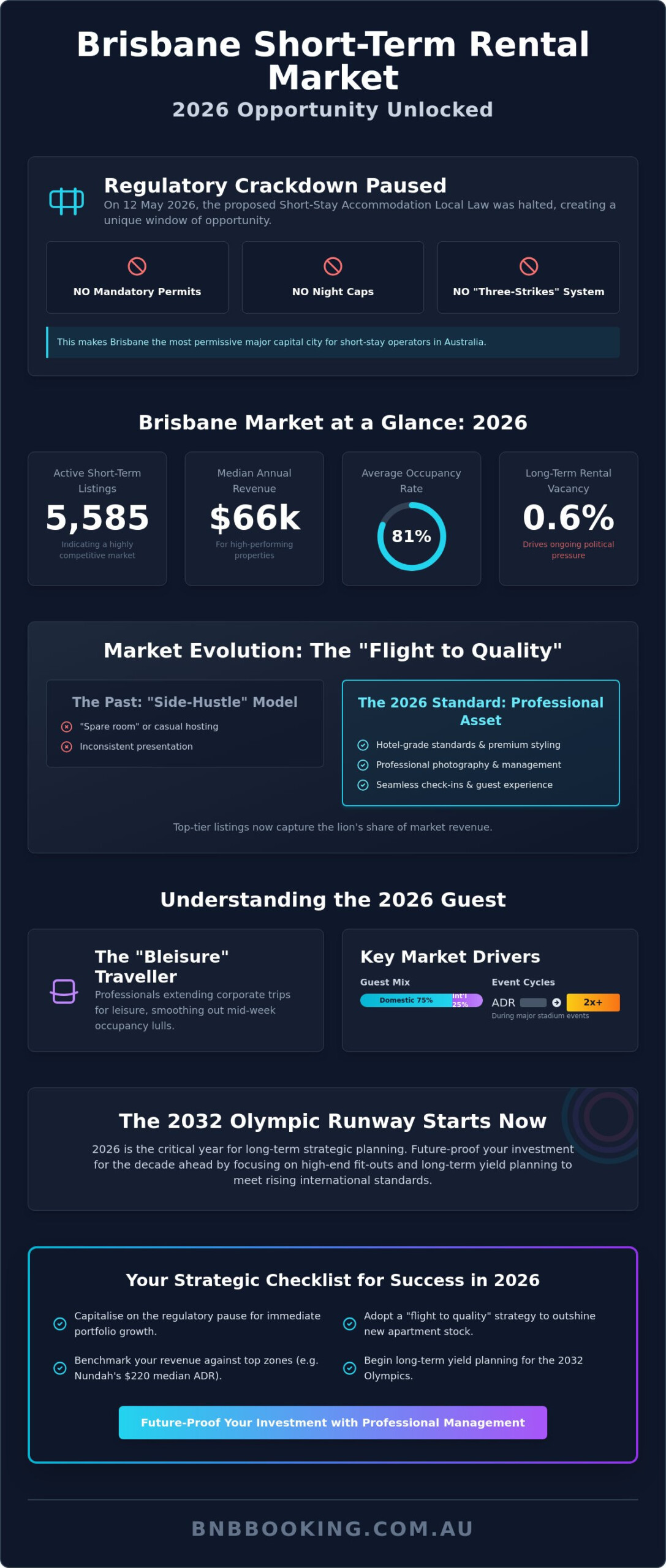
While the 2032 Summer Olympic and Paralympic Games might feel like a distant milestone, 2026 represents the critical commencement of the “Olympic Runway.” This year is a strategic pivot point for the brisbane short term rental market. We are moving beyond simple leisure travel into a phase dominated by massive infrastructure investment. The Gabba rebuild and the final stages of the Cross River Rail project are no longer just future plans; they are active construction sites requiring thousands of specialised consultants, engineers, and project managers. This influx of professional talent is creating a unique, high-yield demand that exists independently of traditional holiday seasons.
For property owners, 2026 is widely considered the final “buying window” before Olympic speculation begins to peak. As infrastructure projects accelerate, the surrounding property values and rental demand are expected to follow a steep upward trajectory. Investing in high-end styling and premium fit-outs today is not merely about 2026 returns. It is about establishing a prestige listing that will command top-tier rates when the eyes of the world turn to Brisbane. High-quality assets in Woolloongabba, Kangaroo Point, and the CBD are already seeing the benefits of this early momentum.
There is a growing “hidden market” within the short-stay sector: the mid-term corporate stay. We are seeing a significant shift toward bookings of 14 to 28 days. These guests are typically project managers or technical consultants who prefer the comforts of a fully equipped home over the sterile environment of a hotel. Corporate-ready listings, featuring high-speed internet, dedicated workspaces, and seamless self-check-in, are currently outperforming basic holiday homes by a wide margin. These stays offer the dual benefit of lower guest turnover and consistent, high-occupancy cycles that align with major project milestones.
The review score you build in 2026 is your most valuable currency for 2032. Airbnb and Stayz algorithms heavily weight historical performance; properties with a multi-year track record of excellence will dominate search results as Olympic demand intensifies. Establishing “Superhost” status now creates a defensive moat that new entrants simply cannot replicate overnight. Professional guest communication and proactive maintenance are essential to protecting this asset. To ensure your property is positioned at the top of the pack, you should partner with a professional Airbnb management team that understands the nuances of building long-term brand equity in a competitive market.
Ultimately, the “Olympic Effect” is a compounding force. The standards you set today, the styling choices you make, and the professional reputation you cultivate will determine your success over the next decade. 2026 is the year to transition from a passive host to a strategic hospitality investor.
The “set and forget” era of property hosting has officially concluded. Success in the 2026 brisbane short term rental market now demands a level of clinical efficiency and hospitality expertise that goes far beyond simply handing over a set of keys. As the city enters its Olympic runway, the gap between amateur listings and professionally managed assets is widening. BnB Booking bridges this gap by transforming residential properties into high-performing hospitality assets. We handle the complexities of the evolving regulatory landscape, ensuring your investment remains compliant with existing local laws while positioning it to capture the highest possible yield.
A primary pillar of our strategy is multi-channel distribution. By listing your property across Airbnb and Stayz, and leveraging our direct booking channel, we reduce reliance on single platforms. This direct engagement is a core point of differentiation, often resulting in significant savings for guests and higher net returns for owners. When combined with professional listing optimisation and high-end photography, this holistic approach ensures your property stands out in a crowded market of over 5,500 active listings. In a landscape where guests are increasingly discerning, “full-service” is the only viable way to scale without compromising on quality or compliance.
Unlike impersonal, mass-market firms, BnB Booking provides localised authority across specific South East Queensland precincts. We treat every property as a unique investment, not just a number in a database. Our service encompasses far more than physical access; we manage the entire guest experience. This includes professional housekeeping, proactive maintenance coordination, and real-time ROI tracking through transparent reporting. By maintaining these high standards, we protect your asset’s physical condition and its digital reputation, which is crucial for long-term visibility as competition intensifies.
Transitioning from a long-term rental to the short-stay sector requires a calculated approach. With the current long-term vacancy rate at 0.6 per cent, the decision to pivot must be backed by concrete data. Our team conducts a comprehensive audit of your property to ensure it meets 2026 Council expectations and state-level safety requirements. We look at everything from zoning compliance to interconnected smoke alarm readiness, ensuring you are prepared for the 2027 mandates.
If you’re ready to move away from the $680 weekly median and tap into the premium potential of the river city, the first step is a professional valuation. You can book a free rental yield assessment with BnB Booking today to discover the true earning capacity of your Brisbane property.
The 2026 landscape is defined by a rare combination of regulatory stability and accelerating infrastructure demand. While the Council’s decision to pause new permit systems offers immediate relief, the long-term success of your asset depends on outperforming a crowded field through uncompromising quality. We’ve seen that the brisbane short term rental market rewards those who transition from passive hosting to strategic hospitality, particularly as the city prepares for its global debut in 2032.
Achieving these results requires more than just a listing; it requires a partner who understands the granular nuances of South East Queensland precincts. As local experts since 2016, our team provides full-service management that encompasses everything from Council compliance assistance to high-end property styling. We focus on a luxury portfolio to command premium ADRs and ensure your investment remains resilient against future market shifts.
It is time to elevate your property’s performance and secure your share of the Olympic runway. Maximise Your Brisbane Rental Yield with BnB Booking and turn current market momentum into a lasting legacy. The opportunity to lead the market is yours for the taking.
Yes, short-stay accommodation is entirely legal in Brisbane. Following the Lord Mayor’s announcement on 12 May 2026, the city remains the most permissive major capital in Australia for hosts. There are currently no night caps or mandatory registration requirements, allowing you to operate your property 365 days a year without the restrictions seen in other states.
The 30 June deadline was the original commencement date for the Proposed Short-Stay Accommodation Local Law 2025. However, this deadline is no longer in effect. The Council paused the regulations in May 2026 due to economic factors, meaning the planned “crackdown” on suburban listings has been deferred for the foreseeable future.
Properties in the brisbane short term rental market saw a median annual revenue of $66,000 between February 2025 and January 2026. This represents a significant potential premium over the long-term market, where median house rents currently sit at approximately $680 per week. Even after accounting for management fees, the high occupancy rates of 81 per cent often result in superior net yields.
No, you don’t currently need a special permit from the Brisbane City Council to operate an Airbnb. The planned permit system was part of the regulations paused in early 2026. You must still adhere to existing building codes and ensure your property meets the 1 January 2027 deadline for interconnected photoelectric smoke alarms as required by state law.
High-performing suburbs for Average Daily Rate (ADR) include Carindale at $226 and Nundah at $220. For those seeking consistent occupancy, the CBD and South Brisbane remain heavyweights. Chermside is also emerging as a top choice for hospital-related stays, providing a steady booking base that complements the city’s broader leisure and corporate travel demand.
The “three-strikes” rule was a proposed enforcement mechanism where permits would be revoked after three substantiated noise or nuisance complaints. Since the new local law is not proceeding at this time, this specific rule is not in effect. Hosts are still expected to manage guest behaviour proactively to avoid fines under existing local nuisance laws.
The 2032 Olympics are already influencing the brisbane short term rental market through massive infrastructure projects like the Gabba rebuild. Consultants and project managers working on these venues are driving a surge in demand for mid-term stays right now. This early activity allows owners to build the necessary review history and “Superhost” status required for peak 2032 returns.
Professional management fees are typically calculated as a percentage of the gross rental income generated by your property. This rate varies depending on the level of service you require, such as full-service guest communication, professional cleaning, and maintenance coordination. Most owners find that the increase in occupancy and ADR achieved through professional optimisation more than covers the management cost.