Pool safety for Airbnb in QLD: certificates and host duties
- 22 October 2026
- Blog
A pool at a Queensland short-stay rental comes with a clear compliance duty: pool safety compliance for an Airbnb in QLD requires... Read More
 by BNB Booking

In the shifting landscape of 2026, many Australian hosts are discovering that a high booking rate no longer guarantees a healthy bank balance. You’ve likely felt the sting of the 15.5% flat host fee or spent sleepless nights worrying about the July 2026 Brisbane City Council permit requirements. It’s frustrating to see your hard-earned revenue swallowed by unexpected “tradie” bills or new state levies before you’ve even accounted for your own time. Understanding the true costs of running an airbnb australia is now the only way to ensure your property remains a sophisticated asset rather than a logistical burden.
We’ve created this comprehensive guide to help you move beyond gross revenue and focus on what actually matters: your net yield. You’ll gain a clear ROI framework and a realistic budget for professional styling that attracts premium guests. We’ll examine the tax-deductible nature of your expenses, the impact of the 7.5% Victorian short-stay levy, and how to stay ahead of the ATO’s latest rulings on holiday homes. By the end of this article, you’ll have the strategic insight needed to transform your rental into a high-performing business that balances local hospitality with clinical efficiency.
Success in the Australian short-term rental market begins long before the first guest arrives. It starts with a strategic capital injection. In a competitive city like Brisbane, the “flat-pack and hope” method is a recipe for mediocre reviews and low occupancy. Modern guests aren’t just looking for a place to sleep; they’re purchasing a curated experience. This shift is central to how Airbnb’s business model has evolved to favour high-end, professionally styled spaces that stand out in a crowded feed.
When calculating the initial costs of running an airbnb australia, you must account for a comprehensive “Guest Ready” inventory. This includes everything from high-thread-count linens and kitchen essentials to the decorative accents that make a property feel like a home. Cutting corners on these items often leads to higher replacement costs later. Durable, commercial-grade furniture is essential to withstand the wear and tear of frequent guest turnovers. It’s an investment in your property’s longevity and your peace of mind.
Your property needs a “Hero Shot.” This is the primary image that stops a potential guest from scrolling past your listing. Investing in professional styling packages, which typically range from $4,000 to over $10,000 for full property curation, ensures your home has the visual appeal to drive clicks. For a standard two-bedroom apartment, a mid-range furnishing budget of $12,000 to $25,000 is often the sweet spot. It provides a balance of aesthetic charm and structural durability. Premium setups can easily exceed $50,000, but they command significantly higher nightly rates in luxury sub-regions.
Smartphone photos are a liability in 2026. High-quality imagery is a non-negotiable investment for ranking well in search results. Beyond standard stills, many successful hosts now include professional floor plans and 3D tours to provide total transparency to guests. This level of detail builds trust and reduces the likelihood of negative reviews regarding property layout. When you invest in professional airbnb photography brisbane, you aren’t just buying pictures; you’re securing your property’s digital storefront. Pair this with professional copywriting that highlights your unique value proposition to ensure your listing is optimised for conversion from day one.
The 15.5% Host Service Fee is the primary overhead most hosts face in 2026. Unlike the older split-fee models, this simplified pricing structure means guests see the true nightly rate while you absorb the platform cost. This fee applies to the booking subtotal and the cleaning fee. It’s vital to remember that the Australian Taxation Office (ATO) views this fee as a cost of doing business, but you must also account for GST on these services if your annual turnover exceeds the $75,000 threshold. Many hosts find that these percentages quickly erode their margins if they haven’t priced their properties strategically.
Insurance is another non-negotiable expense that often catches new owners off guard. Standard landlord policies almost always exclude short-term stays. Specialist short-term rental insurance typically costs 50-100% more than standard coverage, but it provides essential protection against public liability, guest-specific damage, and loss of income. Without this tailored cover, a single incident could erase your entire annual profit. Navigating the complex short-term rental regulations in Australia is the only way to safeguard your investment and ensure long-term viability.
While Airbnb’s 15.5% fee is the industry standard, Stayz and other regional platforms maintain their own commission structures. The real competitive advantage for savvy owners lies in developing direct booking channels. By bypassing major platforms, you can save significant percentages on every stay, which directly improves your bottom line. This direct engagement is a cornerstone of professional management, allowing you to offer better value to guests while increasing your net yield. If the administrative burden of managing multiple calendars and secure payments feels overwhelming, seeking professional management support can help bridge the gap between high platform fees and higher profits.
For those in South East Queensland, the regulatory environment is tightening significantly. The Brisbane City Council’s “Short Stay Accommodation Local Law” takes full effect on July 1, 2026. This requires a mandatory permit and annual renewal fees, creating a permanent line item in your budget. Failing to register can lead to heavy fines and the potential removal of your listing. Beyond council rules, if your property is in a strata-titled building, your body corporate may have specific bylaws regarding short-term letting. You might face higher strata levies or be required to upgrade fire safety systems. This includes interconnected smoke alarms and clearly displayed evacuation plans, which are essential for both legal compliance and guest safety. These regulatory hurdles are significant factors in the overall costs of running an airbnb australia.
While your dashboard might show impressive gross revenue, the day-to-day operational friction is where many hosts see their margins evaporate. It’s a common mistake to view the cleaning fee as a simple pass-through cost. In reality, the gap between what a guest is willing to pay and the actual cost of a high-end turnover can be significant. When you factor in periodic deep cleans, carpet steaming, and window washing, the costs of running an airbnb australia often exceed initial projections. These are the non-negotiable standards required to maintain a five-star rating in a market that now demands hotel-level precision.
Consumables represent another steady bleed on your bank account. Providing “the basics” is no longer enough to secure Superhost status. You need to budget for premium coffee pods, luxury toiletries, and high-quality pantry staples. These small touches create the aspirational experience guests expect, but they require meticulous inventory management. If you aren’t tracking every bottle of boutique hand wash or box of artisan tea, these micro-expenses will quietly erode your net yield over the course of a financial year.
A professional short-term rental turnover is fundamentally different from a standard domestic clean. It requires a clinical eye for detail and a strict adherence to sanitisation protocols. In South East Queensland, the logistics of linen can be particularly challenging. Many successful hosts opt for professional linen hire services rather than laundering on-site. This ensures every guest receives crisp, hotel-quality sheets and plush towels without the wear and tear on residential machines. Integrating a dedicated airbnb cleaning service brisbane allows you to outsource this logistical headache while ensuring your property remains “guest-ready” at all times.
The “Tradie Premium” is perhaps the most overlooked expense in the industry. When a hot water system fails at 8 PM on a Friday night, you aren’t just paying for a repair. You’re paying for an emergency call-out fee and likely a guest rebate to prevent a retaliatory review. You must establish a “sinking fund” specifically for these moments. We recommend setting aside 5-10% of your monthly revenue for ongoing maintenance and the eventual replacement of appliances and furniture. For coastal properties, you must also factor in the higher costs of pool chemicals and professional gardening to combat the salt air and rapid tropical growth. Having a reliable network of tradespeople on speed dial isn’t just a convenience; it’s a strategic necessity for protecting your investment’s reputation.
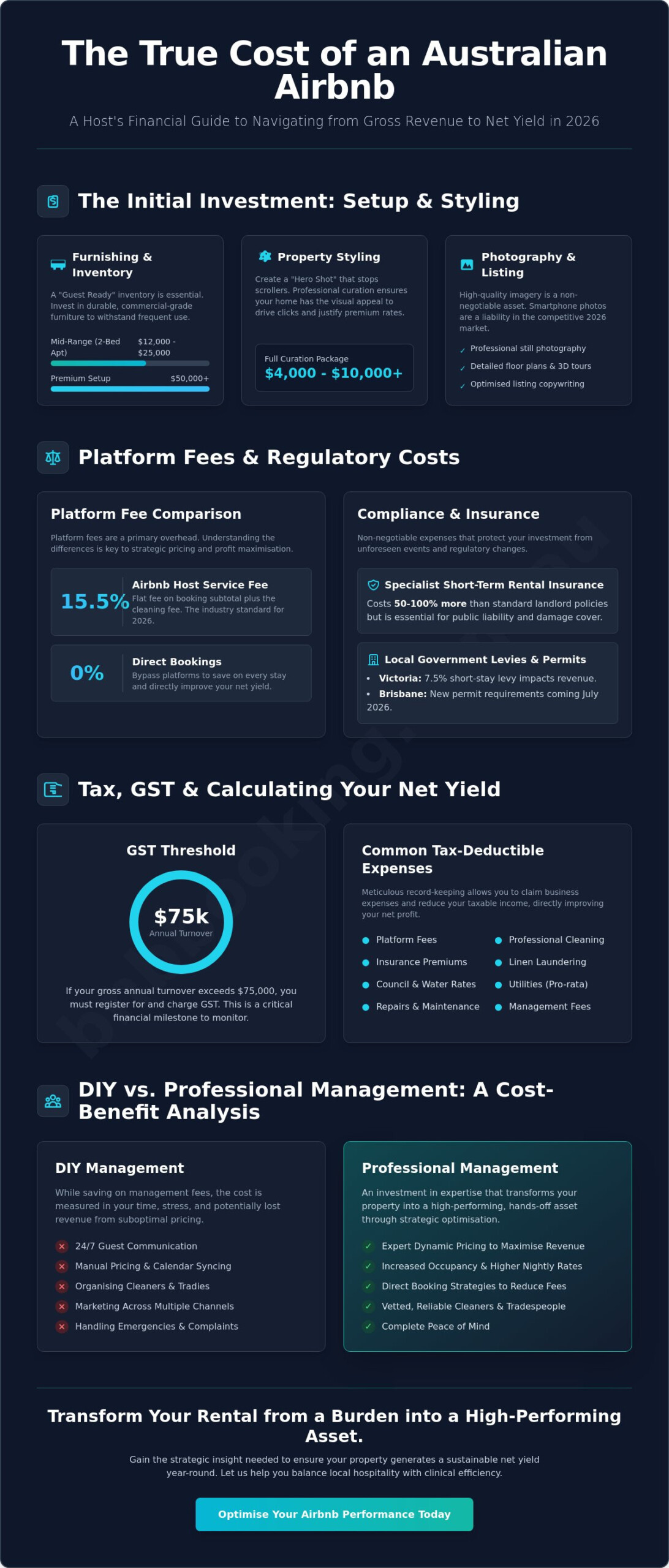
Generating high revenue is only half the battle. The true measure of your success is your net yield. This is the figure that remains after you’ve stripped away platform commissions, operating expenses, and your tax obligations. Calculating this accurately requires a clinical approach to your ledger. You must use a precise formula: Gross Revenue minus (Platform Fees + Operating Costs + Tax Liability) equals your True Net Profit. Without this level of granular oversight, the costs of running an airbnb australia can easily mask a property that is underperforming on a risk-adjusted basis.
One of the most significant financial considerations for 2026 is the impact of Capital Gains Tax (CGT). If you’re renting out a portion of your primary residence or a property you intend to sell, you may lose part of your main residence exemption. The Australian Taxation Office (ATO) tracks these income streams closely. When you eventually sell the asset, the percentage of the home used for income-producing purposes, and the length of time it was active, will determine your CGT bill. It’s a long-term cost that must be factored into your initial investment strategy.
The ATO’s 2026 rulings, specifically TR 2026/1, have tightened the requirements for claiming holding costs. To deduct interest on your mortgage, council rates, and land tax, you must prove the property is held “mainly to produce income.” This means maintaining commercial pricing and ensuring availability during peak periods like school holidays. You can also claim depreciation on furniture and equipment through a professional depreciation schedule. These non-cash deductions are vital for reducing your assessable income. For a deeper dive into optimising your returns, consult our airbnb tax guide australia to ensure you aren’t leaving money on the table.
Registration for GST becomes mandatory once your annual turnover from short-term rentals exceeds $75,000. This threshold is calculated on gross income, not profit. Once registered, you must add 10% GST to your nightly rates, which can impact your competitiveness if your neighbours aren’t registered. However, it also allows you to claim back the GST paid on your own business expenses, such as professional management fees and cleaning supplies. Meticulous record-keeping is essential. You’ll need to lodge regular Business Activity Statements (BAS) and keep digital receipts for five years to satisfy audit requirements. If you want to move beyond guesswork and secure a professional financial strategy, it’s time to calculate your property’s potential yield with our expert team.
Many property owners view the 15% to 25% management fee as a cost they can simply avoid by doing the work themselves. This perspective often ignores the significant “time cost” associated with high-level service. When you quantify the hours spent on guest vetting, late-night communication, and maintenance coordination, the DIY model often becomes a low-yield hobby rather than a streamlined investment. A professional manager doesn’t just manage your property; they optimise its market position. By leveraging sophisticated data and local market expertise, a full-service partner can often increase your gross revenue by 20% to 30%. This effectively makes the management service self-funding while freeing up your personal time for other pursuits.
Choosing a boutique Brisbane-based manager over a global firm provides a distinct advantage in the South East Queensland market. Global platforms often rely on automated, one-size-fits-all algorithms that lack the nuanced understanding of local sub-regions. A local expert understands the specific demand cycles of New Farm versus the CBD. They can adjust pricing in real-time based on local events or sudden shifts in supply. This granular approach is essential for balancing the costs of running an airbnb australia against the need for maximum occupancy and premium nightly rates.
Professional listing optimisation is about more than just a well-written description. It involves a strategic understanding of search visibility and dynamic pricing. Managers use specialised software to adjust your Average Daily Rate (ADR) based on hyper-local demand. During major Brisbane events like Riverfire or the peak school holiday periods, these adjustments ensure you aren’t leaving money on the table. A DIY host might set a flat seasonal rate, but a professional manager will capture the true market value of every single night. In competitive areas like the Brisbane CBD, this expertise often results in a significantly higher net yield compared to self-managed properties, even after management fees are deducted.
The financial value of peace of mind is difficult to overstate. Professional vetting protocols are your first line of defence against high-cost damage and the “party house” nightmare. By implementing rigorous guest screening, a management firm protects your asset and your relationship with the body corporate. They also provide 24/7 guest support. This ensures that small issues don’t escalate into expensive repairs or negative reviews. Proactive oversight is a critical component of risk management. If you’re ready to transition from a hands-on host to a hands-off investor, it’s time to Get a free rental appraisal for your Brisbane property and discover your true earning potential.
Navigating the evolving landscape of 2026 requires more than just a beautiful property; it demands a clinical understanding of your bottom line. We’ve explored how the 15.5% platform fee and new regional permits have fundamentally changed the financial equation for hosts. By accurately forecasting the costs of running an airbnb australia, you can move beyond simple revenue tracking and focus on sustainable net yield. Every strategic decision, from professional styling to establishing a sinking fund for maintenance, must protect your property’s long-term profitability.
As specialists in the Brisbane, Gold Coast, and Sunshine Coast markets, we understand the granular details that drive success in South East Queensland. Our high-performing portfolio is built on a foundation of full-service excellence, including professional cleaning and hotel-quality linen. You don’t have to navigate these regulatory and operational complexities alone. Maximise your rental yield with BnB Booking’s expert management and transform your property into a sophisticated, hands-off asset. We’re here to help you turn these challenges into a distinct competitive advantage.
Yes, short-term rentals remain a viable investment in 2026, though success now relies on professionalisation. High occupancy rates, such as the 81% median for managed Brisbane properties, show that demand for quality stays is strong. However, the total costs of running an airbnb australia mean you must focus on net yield rather than gross revenue. Sophisticated owners who use dynamic pricing and professional styling continue to outperform the standard long-term rental market.
Brisbane City Council requires a permit under the Short Stay Accommodation Local Law, which takes full effect on July 1, 2026. This permit must be renewed annually to ensure compliance with local safety and community standards. While the exact fee schedule is determined by council and updated periodically, failing to register can lead to significant fines. It’s essential to check the official council portal for the current application and renewal costs before listing your property.
You can certainly claim setup costs, but they are treated differently depending on the item. Consumables like luxury toiletries or coffee pods are usually immediate deductions. Larger investments, such as premium furniture or appliance upgrades, must be depreciated over several years using a professional depreciation schedule. Under the ATO’s TR 2026/1 ruling, you must prove the property was held primarily to produce income to secure these deductions.
Cleaning fees for larger Queensland properties depend on the level of service and whether professional linen hire is included. A 3-bedroom property requires a deep turnover that usually takes several hours to meet guest expectations for a “hotel-grade” experience. This fee is typically passed on to the guest, but you must ensure it covers the actual cost of a professional team. Inadequate cleaning is the most common cause of negative reviews and lower search rankings.
You absolutely need specialist short-term rental insurance because standard homeowner or landlord policies typically exclude commercial short stays. These specialist policies cover unique risks like public liability for guests, accidental or malicious damage, and loss of rental income. While these policies cost more than standard cover, they are a vital component of the costs of running an airbnb australia. Operating without tailored insurance leaves your asset exposed to significant financial risk.
While self-managing avoids a management fee, it’s rarely “cheaper” when you factor in the value of your time and the lost revenue from static pricing. Professional managers use advanced algorithms to increase nightly rates during peak events, often boosting revenue by 20% or more. When you subtract the time spent on guest vetting and 24/7 support, most owners find that professional management delivers a superior return on investment and a more passive income stream.
If damage occurs, your first line of defence is a combination of Airbnb’s AirCover and your own specialist insurance policy. You should document the damage immediately and submit a claim through the platform’s resolution centre. However, the most cost-effective approach is prevention through rigorous guest vetting. Professional management teams use sophisticated screening tools to identify high-risk bookings, significantly reducing the likelihood of expensive repairs or “party house” incidents before they happen.
The 15.5% host service fee is a flat commission deducted by Airbnb from your booking subtotal, which includes your nightly rate and cleaning fee. This model, introduced in late 2025, means guests no longer see a separate service fee at checkout. While it simplifies the pricing for the traveller, it means you must adjust your nightly rates upward to maintain your margins. It’s a significant overhead that must be factored into your annual budget and tax planning.