

Pool safety for Airbnb in QLD: certificates and host duties
- 22 October 2026
- Blog
A pool at a Queensland short-stay rental comes with a clear compliance duty: pool safety compliance for an Airbnb in QLD requires... Read More
 by BNB Booking

Why does your Airbnb “Total Earnings” figure always seem so much more generous than the actual cash that lands in your bank account? It’s a common frustration for property owners across Brisbane and the Gold Coast who find themselves squinting at a screen, trying to reconcile a high gross booking value with a significantly smaller net payout. Mastering the art of understanding airbnb owner statements is the first step toward treating your holiday rental like the high-performing asset it is.
We’ll show you exactly how to calculate your true profit after the 15.5% host service fee, professional cleaning costs, and GST are accounted for. This guide provides a clear breakdown of every line item on your report, from management fees to maintenance expenses. You’ll gain a streamlined system for your records and the peace of mind that your investment is actually profitable as we prepare for the 2026 tax season. By the end, you’ll be ready to provide your accountant with perfect documentation while meeting the ATO’s latest compliance rulings with confidence.
The discrepancy between your Airbnb dashboard and your monthly bank statement is often the biggest source of stress for South East Queensland property investors. While the platform provides a high-level view of your earnings, these figures rarely reflect the complex reality of running a high-performing short-term rental. Truly mastering the task of understanding airbnb owner statements requires a shift in perspective. You need to look past the top-line revenue and focus on the mechanics of how money moves from a guest’s credit card to your bank account.
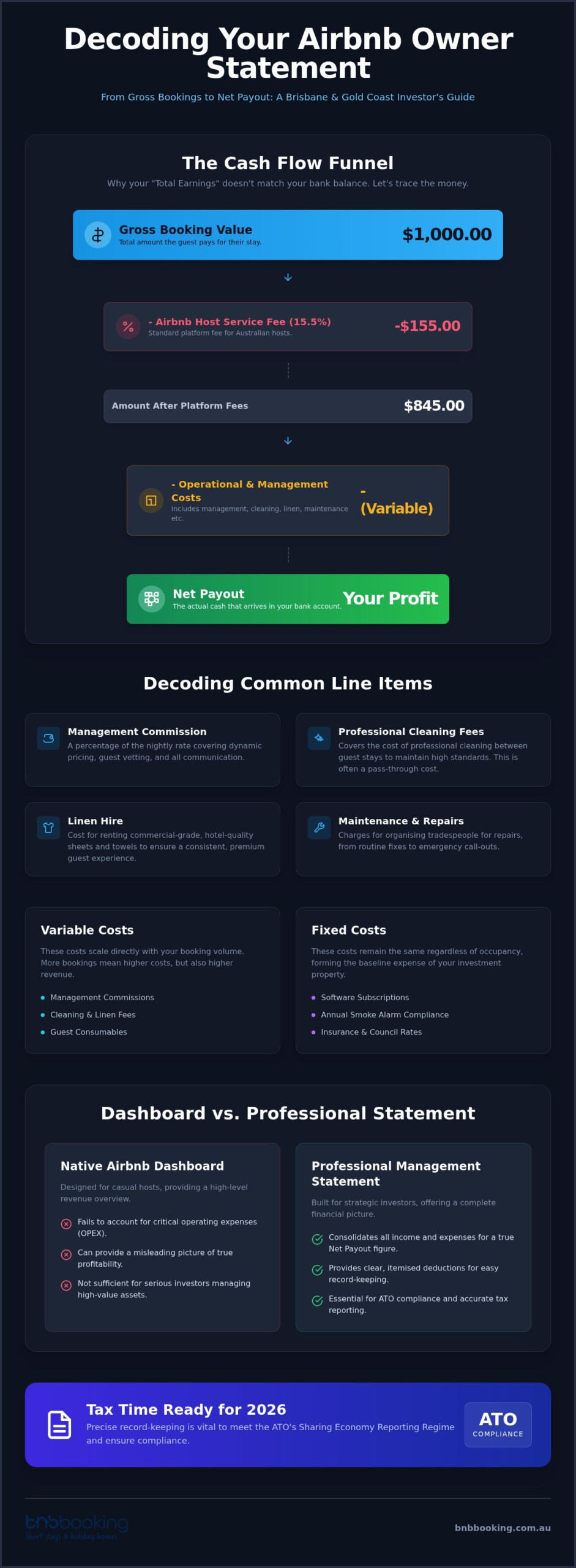
Gross Booking Value represents the total amount a guest pays to secure your property. This includes the nightly rate, cleaning fees, and platform-level taxes. Since the global expansion of the platform (find more About Airbnb here), the way these fees are displayed has evolved significantly. In the Australian market, the transition to a host-only fee model means the gross figure you see is often much higher than what you’ll actually receive, even before professional management commissions are taken into account.
To see how the “missing gap” appears, let’s look at a hypothetical $1,000 weekend stay in a Brisbane apartment. While the guest pays $1,000, your statement will immediately show a deduction for the Airbnb Host Service Fee. As of 2026, this is a flat 15.5% for all Australian hosts. This means $155 is removed before you even consider the costs of linen hire or professional cleaning. The gross amount listed on your dashboard might look like $845, but this is still a far cry from your actual take-home pay. You must also account for the 10% GST on these services if your rental turnover has crossed the $75,000 threshold.
The native Airbnb “Earnings” tab is designed for casual hosts; it isn’t built for strategic investors managing high-value assets on the Gold Coast. It consistently fails to account for operating expenses (OPEX) such as maintenance, emergency repairs, or professional management commissions. In 2026, with the ATO’s Sharing Economy Reporting Regime in full effect, tracking these expenses with precision is vital for your return on investment. If you don’t account for the 15-20% difference that covers platform fees and immediate operational costs, your financial projections will be fundamentally flawed. Net Payout is the final figure after all variable and fixed costs are deducted.
Once you’ve identified the gap between your gross revenue and your net payout, the next step is scrutinising the specific deductions that appear on your monthly report. Mastering the nuances of understanding airbnb owner statements requires a granular look at how professional management firms categorise their services. These line items aren’t just costs; they are the operational gears that keep your property performing at a high level. Understanding these figures allows you to evaluate the efficiency of your investment with precision.
The management commission is typically your largest line item. It is calculated as a percentage of the nightly rate and covers the strategic oversight of your listing. This includes dynamic pricing, guest vetting, and platform communication. Effective financial management for short-term rentals hinges on knowing exactly what this percentage covers to ensure you aren’t being double-charged for basic administrative tasks or platform-related troubleshooting.
Two often misunderstood items are linen hire and maintenance coordination. Unlike standard laundering, linen hire involves renting commercial-grade, hotel-quality sheets and towels. This ensures a consistent guest experience and removes the need for you to constantly replace your own worn-out stock. Maintenance coordination is a specific administrative fee charged when your manager must organise local Brisbane tradespeople for repairs. It covers the time spent vetting contractors, scheduling access around guest check-ins, and verifying that the work meets professional standards.
Your statement will generally feature two distinct types of expenses. Variable costs, such as management commissions and cleaning fees, scale directly with your booking volume. If your property is vacant, these costs drop to zero. Fixed costs are different. These include monthly software subscriptions, listing setup fees, or annual smoke alarm compliance checks. Spotting one-off charges, like emergency plumbing on a Sunday afternoon, is much easier when you can distinguish between these recurring operational costs and unexpected maintenance outlays.
In the Australian market, the cleaning fee is typically a “pass-through” cost. The guest pays this amount upfront, and your manager then uses it to pay professional housekeepers. It shouldn’t be viewed as profit, but rather as a necessary expense to maintain Gold Coast luxury standards. At BnB Booking, we emphasise total transparency in these costs to ensure you can see exactly where every dollar goes. If you want to see how this looks in practice, you can explore our management approach to see how we handle these essential operational details.
The native Airbnb “Earnings” tab provides a sleek, user-friendly interface that works perfectly for casual hosts with a spare room. However, for serious property investors in Brisbane and the Gold Coast, this dashboard is a closed loop that fails to capture the full financial reality of a high-performing asset. Achieving a true level of understanding airbnb owner statements requires moving beyond the platform’s basic interface and into a comprehensive, consolidated reporting system. Relying solely on platform data is like trying to manage a business by only looking at the cash register while ignoring the invoices on the back desk.
A professional statement provides the “Full Picture” by merging data from various sources. While Airbnb is a dominant player, sophisticated owners often list across multiple channels to maximise occupancy. A native report cannot see your Stayz bookings or the high-margin revenue generated through direct booking channels. Without a consolidated view, you are forced to manually reconcile different spreadsheets, which is a process prone to human error and oversight. Professional management bridges this gap, providing a single source of truth for every dollar your property generates.
While this guide focuses on Australian requirements, the need for detailed financial oversight is a priority for investors everywhere. For those with assets in the United States, ALPN Vacations offers tailored vacation rental management in Southwest Colorado, applying similar principles of transparency to help owners track their true profit.
Platform reports are fundamentally limited because they only track digital transactions that occur within their ecosystem. They ignore the physical reality of property ownership, such as offline maintenance costs, emergency repairs, or strata levies. If a tradesman is called to a Broadbeach apartment to fix a burst pipe, that expense will never appear on your Airbnb dashboard. This creates a significant risk of “double-counting” income if you rely solely on bank statements without cross-referencing against an itemised expense report. In the 2026 regulatory environment, where the ATO uses sophisticated data-matching through the Sharing Economy Reporting Regime, these reporting gaps can lead to costly accounting headaches during tax season.
A high-quality owner statement provides strategic insights that go far beyond a simple list of payouts. It includes critical performance metrics such as your Average Daily Rate (ADR) and monthly occupancy percentages, allowing you to see how your property stacks up against the local market. Each guest stay is itemised with its associated costs, from platform fees to linen hire, providing total transparency. At BnB Booking, we ensure our monthly summaries are “Accountant-Ready” by providing a clear net owner funds transfer summary. This level of detail ensures you aren’t just seeing what you earned; you are seeing exactly how your investment is growing, with every deduction and credit clearly defined and ready for your financial records.
The Australian Taxation Office (ATO) has significantly intensified its focus on the short-term rental market. With the full implementation of the Sharing Economy Reporting Regime (SERR) in 2026, platforms are now legally required to report all host income and transaction data directly to the tax office. This level of transparency means that understanding airbnb owner statements is no longer just about tracking profit; it is a critical component of legal compliance. New tax rulings, specifically TR 2026/1 which took effect on July 1, 2026, provide the ATO with stricter guidelines to scrutinise rental income and deduction claims with clinical precision.
Meticulous record-keeping is your best defence against a potential audit. Your monthly statements serve as the primary evidence for your income and expenses. The ATO requires you to keep these digital records for five years, so relying on a platform’s temporary dashboard history is a risky strategy. Professional management ensures that every management fee, cleaning cost, and maintenance repair is documented in a format that stands up to regulatory scrutiny. This proactive approach protects your investment while ensuring you aren’t paying more tax than necessary.
Navigating GST is often where South East Queensland hosts feel the most anxiety. While long-term residential rent is typically input-taxed and GST-free, short-term rentals are often categorised differently for tax purposes depending on the level of service provided. In Australia, you must register for GST if your annual turnover from taxable activities reaches or exceeds the A$75,000 threshold. If you are registered, you can generally claim back the 10% GST included in your professional management fees, cleaning costs, and linen hire. This can represent a significant saving on your operating expenses, provided your records are categorised correctly from the outset.
A consolidated annual statement is your most valuable asset when meeting with your Brisbane accountant. Instead of handing over a messy digital folder of individual booking confirmations, a professional summary categorises your outgoings for you. This is particularly helpful when distinguishing between immediate repairs, which are generally deductible in the year they occur, and capital improvements, which must be depreciated over time. Your accountant will specifically look for itemised management fees and verified maintenance costs. To ensure your property is fully compliant and tax-ready, contact our expert management team for a transparent reporting audit.
Managing a premium property in South East Queensland should be a rewarding investment, not a full-time administrative burden. While the previous sections have detailed the complexities of ATO compliance and the nuances of platform fees, the ultimate goal for any serious investor is to move from manual tracking to strategic oversight. Our boutique management approach is built on the foundation of total transparency. We eliminate the guesswork that often plagues the process of understanding airbnb owner statements by providing a clear, clinical breakdown of every transaction affecting your bottom line.
Our commitment to a “No Hidden Fees” policy means your monthly report will never contain surprise administrative charges or unexplained deductions. We handle the entire lifecycle of a booking, from the initial guest vetting process to the final payout, ensuring that the figures you see in your bank account align perfectly with your performance reports. By centralising your data, we provide a level of financial clarity that native platform dashboards simply cannot match.
The BnB Booking Owner Portal provides you with real-time access to your property’s financials, allowing you to monitor performance whenever it suits you. Our monthly owner statements are designed to be intuitive and easy to read, clearly separating your gross revenue from operational expenses. We provide detailed tracking for all maintenance coordination, which helps protect your asset’s long-term value while giving you a verified paper trail for your records. A unique advantage of our service is the emphasis on direct-channel engagement. By facilitating direct bookings, we help you bypass significant platform service fees, and these tangible savings are reflected clearly in your net profit figures.
Our expertise in the Brisbane and Gold Coast markets allows us to navigate local demand cycles with precision. We understand the competitive realities of the South East Queensland rental market, and we use this knowledge to optimise your nightly rates and occupancy levels. This localized authority ensures that your property isn’t just another listing, but a high-performing business asset. By choosing a partner that prioritises professional asset management over simple physical access, you can reclaim your lifestyle and focus on your broader investment goals while we handle the spreadsheets and guest feedback metrics.
Ready for hassle-free hosting? Contact BnB Booking for a property appraisal today.
Transforming your short-term rental into a high-performing business asset requires more than just high occupancy. It demands a clinical approach to your finances. By mastering the art of understanding airbnb owner statements, you can accurately track your true return on investment and remain fully compliant with the ATO’s strict 2026 reporting regime. You now know how the gap between gross revenue and net payout is filled with essential operational costs like linen, cleaning, and platform fees.
Moving beyond the basic platform dashboard to a consolidated, professional report ensures your records are always accountant-ready. This level of transparency is exactly what we provide at BnB Booking. Our expert local Brisbane management team handles the heavy lifting, including professional cleaning and linen services, so you can focus on your lifestyle. We believe in 100% transparent reporting with no hidden surprises, giving you the peace of mind that your investment is being protected and optimised for growth.
Maximise your rental yield with BnB Booking: Enquire Now
Your property deserves the oversight of a dedicated partner who treats your investment with the same care as you do.
You can download your earnings by navigating to the “Payments & Payouts” section of your account and selecting “Earnings.” From there, filter by the specific financial year and export the data as a CSV or PDF file. This document is essential for the 2026 tax season, providing the raw data your accountant needs to reconcile platform income with the figures reported to the ATO via the Sharing Economy Reporting Regime.
Yes, the ATO treats cleaning fees as assessable income because they form part of the total payment made by the guest. While this increases your gross income figure, you are entitled to claim a deduction for the actual cost of the cleaning service. If you use a management firm like BnB Booking, these costs are itemised on your statement, making it simple to offset the income against the professional housekeeping expense.
Gross Earnings represent the total amount the guest paid for the booking, including the nightly rate and any additional fees. In contrast, an Airbnb Payout is the net amount deposited into your bank account after the platform removes its service fee. Achieving a high level of understanding airbnb owner statements requires recognising that your payout is not your final profit, as it doesn’t yet account for management commissions or maintenance.
You are required to register for and pay GST only if your annual turnover from short-term rentals and other taxable activities exceeds the A$75,000 threshold. In Brisbane, most individual hosts with a single property don’t reach this limit, but it is a critical consideration for those with multiple luxury listings. If you are registered, you can generally claim credits for the GST included in your professional management and cleaning fees.
Professional management in South East Queensland typically operates on a commission-based structure where the fee is a percentage of your gross rental income. This ensures your manager’s incentives are aligned with your property’s performance. At BnB Booking, this fee covers end-to-end service, while separate fixed charges apply for professional cleaning and linen hire. This transparent model ensures you only pay for results while maintaining your property to a high standard.
Yes, our property owners have 24/7 access to their financials through the dedicated BnB Booking Owner Portal. This platform allows you to view upcoming bookings, historical performance, and itemised expenses as they occur. Providing real-time transparency ensures you are never waiting until the end of the month to know how your Brisbane or Gold Coast investment is performing, allowing for more proactive financial planning and strategic oversight.
You can deduct any expense directly related to the income-producing use of your property. Common deductions found on your management statement include management commissions, professional cleaning fees, linen hire, and maintenance coordination charges. You may also be able to claim for repairs, smoke alarm compliance, and a portion of your rates or body corporate fees. Always ensure your records are kept for five years to satisfy ATO data-matching requirements.
The “Service Fee” is the 15.5% host-only fee that Airbnb deducts to cover the cost of platform operations and 24/7 guest support. This flat-rate model was fully implemented for all Australian hosts by September 2026 to provide greater price transparency for guests. While it appears as a deduction on your statement, it is a necessary operational cost that allows your listing to reach a global audience of high-value travellers.