
Pool safety for Airbnb in QLD: certificates and host duties
- 22 October 2026
- Blog
A pool at a Queensland short-stay rental comes with a clear compliance duty: pool safety compliance for an Airbnb in QLD requires... Read More
 by BNB Booking

Contrary to the stern notices often posted in building lifts, your Body Corporate likely doesn’t have the legal power to ban your Airbnb venture. It’s understandable if you’re feeling a bit of trepidation right now. Between the shifting Gold Coast City Council permits and the dense legalese of strata by-laws, many owners worry that one “party house” complaint could see their investment sidelined or result in a costly legal battle. Understanding the specific body corporate rules airbnb gold coast residents must follow is the first step toward turning that anxiety into a high-performing asset.
We’ll show you how to master the intricacies of Queensland strata laws and council permits to ensure your short-term rental stays compliant and profitable. You’ll gain a clear understanding of your legal rights and a roadmap to secure strata approval without the stress. We’ll preview the crucial differences between the BCCM Act and BUGTA, explain the latest council zoning requirements, and share professional vetting strategies that keep your neighbours happy and prevent by-law breaches before guests even arrive.
The short answer is a reassuring “no” for the vast majority of property owners. In Queensland, the legal framework is designed to protect your property rights, provided you are using the lot for residential purposes. Most modern Gold Coast apartments are governed by the Body Corporate and Community Management (BCCM) Act 1997. This specific Act is built on the principle that a body corporate cannot restrict how you use your lot if that use is residential and lawful. Because short-term letting is legally classified as a form of residential use, a committee cannot simply vote to ban it because they dislike the idea of travellers in the building.
Many committees attempt to bypass these protections by promoting the “Commercial Use” myth. They might draft by-laws that label Airbnb hosting as a “business activity” or “commercial venture,” arguing that the building is for residential use only. However, Queensland courts and tribunals have consistently seen through this tactic. They’ve ruled that the actual activity occurring inside the unit—sleeping, eating, and relaxing—is fundamentally residential. The fact that money changes hands or the stay is short doesn’t magically turn your apartment into a commercial shopfront. Consequently, body corporate rules airbnb gold coast committees try to enforce often fail the moment they are challenged in court.
Section 180(3) of the BCCM Act is the primary safeguard for owners; it explicitly states that a by-law cannot restrict the type of residential use of a lot if that use is lawful. Professional strata management firms are well aware of this, yet some committees still push the boundaries. The Queensland Civil and Administrative Tribunal (QCAT) has a long history of striking down bans, viewing them as an overreach of power. Before you list your property, your Community Management Statement (CMS) is the first document you should check. While the CMS outlines your building’s specific rules, any by-law that contradicts the BCCM Act is legally unenforceable and can be overturned.
Exceptions to this rule are rare but significant. A small number of older Gold Coast developments are governed by the Building Units and Group Titles Act (BUGTA) rather than the BCCM Act. Under BUGTA, the legal framework is less permissive, and bans have been upheld in high-profile cases like the “Fairway Island” precedent. This usually applies to specific gated communities or older schemes established before 1997. You should also confirm your building doesn’t have “special” zoning within the Gold Coast City Plan. If the land is strictly zoned for permanent residents only, the council’s restrictions might give the body corporate the leverage they need to limit body corporate rules airbnb gold coast compliance.
The vast majority of Gold Coast high-rises and townhouses operate under a specific legal umbrella that favours owners. Approximately 90% of community title schemes in Queensland are governed by the Body Corporate and Community Management Act 1997. This modern legislation was designed to prevent committees from overreaching into the private lives and financial decisions of lot owners. However, the age and specific location of your property play a decisive role in which set of rules you must play by. If your home is situated in a resort-style enclave like Sanctuary Cove or Hope Island, or if it was built before the late 90s, you might be subject to a different set of body corporate rules airbnb gold coast investors often find more challenging.
Identifying your governing Act is straightforward. You can find this information by conducting a title search or reviewing your Community Management Statement (CMS). If the document mentions a “scheme number” (e.g., CTS 12345), you’re almost certainly under the BCCM Act. If it refers to a “Building Units Plan” (BUP) or “Group Titles Plan” (GTP), you are likely under the older BUGTA framework. Knowing this distinction is the foundation of a compliant short-term rental strategy. It determines whether a committee can legally restrict your right to host or if they are simply blustering.
The BCCM Act is built on a foundation of lot-owner flexibility. Its primary advantage is the robust dispute resolution process managed by the Commissioner’s Office. If a committee tries to enforce an illegal ban, you can apply for an Adjudicator’s order to have the by-law overturned. While timelines vary, most disputes are resolved within four to six months. This legal safety net ensures that body corporate rules airbnb gold coast committees try to invent don’t stand in the way of your rental yield. For owners who want to avoid these disputes entirely, partnering with a professional management team can help bridge the gap between committee concerns and your hosting goals.
The Building Units and Group Titles Act (BUGTA) still governs roughly 200 older or unique schemes in Queensland. Unlike the BCCM Act, BUGTA allows bodies corporate much broader powers to restrict “Type of Use.” In these buildings, a by-law that limits letting periods to a minimum of six months can be legally valid. Owners in these schemes have fewer options for legal recourse through an Adjudicator. Success here often requires a more diplomatic approach, such as lobbying the committee for a change in by-laws or demonstrating that professional management will mitigate any potential guest issues.
While we’ve established that a committee usually can’t ban your short-term rental, they have significant power to regulate the conduct of your guests. This is where most strata friction occurs. The Queensland Government body corporate rules allow for by-laws that ensure the peaceful enjoyment of the scheme for all residents. You must distinguish between your right to use the property and your responsibility to ensure that use doesn’t interfere with others. If your guests are treating a residential tower like a 24-hour nightclub, the body corporate will quickly shift from passive observation to active enforcement. This regulatory power extends to noise, common property usage, and even how you manage your keys.
Understanding the specific body corporate rules airbnb gold coast managers look for is essential for long-term success. Most disputes aren’t about the act of renting itself, but rather the fallout from poorly managed stays. Building managers are often the first line of defence; they aren’t necessarily anti-Airbnb, but they are anti-headache. By aligning your management style with the building’s expectations, you transform from a “problem host” into a professional partner who contributes to the building’s prestige rather than detracting from it.
Section 167 of the BCCM Act prohibits any use of a lot that causes a nuisance or hazard. In the context of body corporate rules airbnb gold coast committees enforce, this usually translates to noise complaints from the balcony at midnight. A single group of rowdy guests can result in a formal Contravention Notice. To stay ahead of this, you need a 24/7 contact person who can respond to building managers immediately and de-escalate situations before they become formal legal disputes.
Parking is the most common cause of neighbour rage in Gold Coast high-rises. Guests often park in reserved bays or block access ways, creating an immediate headache for permanent residents. Misuse of gyms and pools after hours can also trigger a committee crackdown. Security is another concern; leaving keys in unsecured lockboxes on public fences is often a by-law breach. Effective Screening Airbnb Guests: How to Avoid Bad Experiences is your best defence to ensure your guests respect shared spaces.
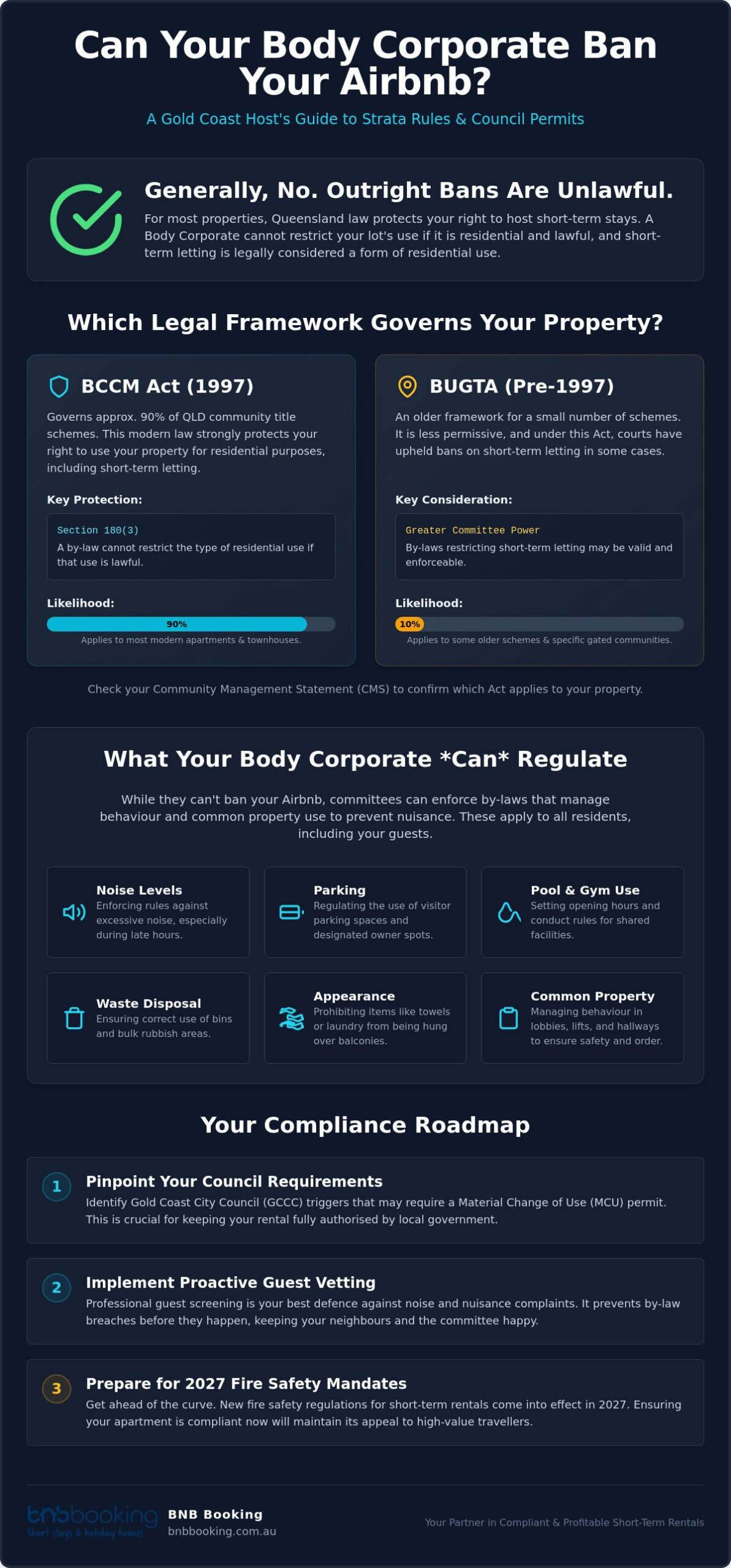
While strata by-laws are your most immediate concern, they don’t exist in a vacuum. The Gold Coast City Council (GCCC) operates its own layer of oversight through the City Plan, which can be just as restrictive as any committee decision. A common mistake for homeowners is assuming that a “yes” from one authority equals a “yes” from the other. In reality, council approval and body corporate rules airbnb gold coast committees enforce are two separate hurdles. You could have a council-approved Material Change of Use (MCU) permit, yet still face fines from your body corporate for breaching noise or parking by-laws. Conversely, a body corporate cannot grant you permission to bypass council zoning requirements.
The hierarchy of these regulations is often a source of confusion. Council rules generally focus on the land use and the impact on the broader neighbourhood, while body corporate rules focus on the impact within the building itself. To be fully compliant and protect your investment from legal challenges, you must satisfy both. If you’re unsure where your property stands, our full-service Airbnb management team can audit your current compliance status to ensure you aren’t at risk of council or strata intervention.
The GCCC defines short-term accommodation as any property rented for less than three consecutive months. Depending on your specific pocket of the Gold Coast, your property may already be in a zone that permits this use, or you may be required to lodge an MCU application. You can check your property’s zoning via the GCCC interactive map. If your apartment is in a strictly residential zone, the council may require a formal development approval. Failing to secure this can give your body corporate the leverage they need to shut down your operation, as most by-laws require that your use of the lot remains “lawful” at all times.
Fire safety is no longer a “set and forget” obligation. By January 1, 2027, all Queensland dwellings, including short-term rentals, must have interconnected photoelectric smoke alarms installed in every bedroom, in hallways connecting bedrooms, and on every storey of the home. This is a non-negotiable safety standard that body corporate committees are increasingly using as a compliance check. They may demand proof of installation before allowing you to continue hosting. Ensuring your alarms are interconnected means that if one goes off, they all go off, providing the high-level protection expected in modern holiday accommodation.
Body Corporate committees often view “DIY” hosting as an inherent liability. When an owner manages their own listing, they frequently lack the sophisticated vetting tools and 24/7 presence required to manage the complex dynamics of a high-density building. This lack of oversight is usually what triggers the strict body corporate rules airbnb gold coast committees feel forced to implement. By shifting from a self-managed model to a professional management partnership, you replace committee anxiety with the reassurance of an established, high-performing firm. We don’t just manage physical access; we manage the building’s reputation and the owner’s investment with equal vigour.
The primary solution to strata friction is high-standard guest vetting. Our team acts as a proactive shield, identifying and filtering out high-risk bookings before they ever reach your front door. By maintaining the “quiet enjoyment” of long-term residents through strict house rules and rigorous screening, we ensure your property remains a welcome part of the building community. Building managers across South East Queensland prefer working with agencies like BnB Booking because we provide a single point of professional contact, resolving potential issues before they escalate into formal complaints or contravention notices.
We act as a dedicated liaison between you and your Body Corporate, ensuring every compliance box is ticked. This includes providing up-to-date insurance certificates and proof of fire safety compliance, which are essential for maintaining a “lawful use” status. In one notable Surfers Paradise high-rise, our professional management approach reduced noise-related complaints significantly within the first six months of oversight. This level of transparency and results-oriented management turns a potentially hostile committee into a supportive partner in your success.
Our direct booking platform offers a significant competitive edge by attracting a different calibre of traveller. While impersonal global platforms can sometimes feel like a revolving door, our direct channel focuses on higher-quality, low-impact guests who value the boutique experience we curate. This reduces the strain on common property and enhances building security. If you’re ready to transition from a stressful DIY operation to a polished, compliant investment, you can organise a compliance check for your Gold Coast property today with BnB Booking to ensure your venture stays on the right side of every by-law.
Understanding the legal protections of the BCCM Act and staying ahead of 2027 fire safety mandates are the pillars of a sustainable rental strategy. Success in this competitive market isn’t just about knowing the law. It requires active diplomacy and professional management that respects the quiet enjoyment of your neighbours. Mastering the body corporate rules airbnb gold coast committees enforce ensures your property remains a high-performing asset rather than a source of strata friction.
As specialists in SE QLD Body Corporate compliance, BnB Booking provides the professional guest vetting and 24/7 support necessary to keep your building manager on side. We focus on protecting your investment while maximising your returns through our direct booking platform. Don’t let regulatory confusion hold back your property’s potential. Take the first step toward a stress-free, fully compliant short-term rental venture today.
Get a Free Compliance and Yield Assessment for Your Gold Coast Property
Your journey toward a profitable and harmonious Airbnb experience starts with the right local expertise. We’re here to help you navigate every council permit and strata by-law with confidence.
No, a body corporate cannot issue fines directly to an owner or guest for short-term letting. Instead, they must follow a formal process by issuing a “future contravention notice” if they believe a by-law is being breached. If the behaviour continues, the matter can be taken to the Magistrate’s Court, where a judge has the authority to impose financial penalties. Using professional management ensures you stay within the body corporate rules airbnb gold coast committees expect, preventing these legal escalations.
The primary difference lies in the level of control the committee has over your property use. Most modern apartments fall under the BCCM Act, which generally protects your right to host short-term guests. Older resorts or gated communities, such as those in Hope Island, often operate under the BUGTA framework. BUGTA schemes have significantly more power to legally enforce by-laws that restrict or ban rentals of less than six months.
It depends entirely on your property’s specific zoning within the Gold Coast City Plan. While many areas allow short-term accommodation, properties in strictly residential zones may require a Material Change of Use (MCU) permit if they are rented for less than three consecutive months. Operating without a required permit can lead to council enforcement and may give your body corporate grounds to challenge your operation as “unlawful.”
Generally, a body corporate cannot single out guests and ban them from using common facilities like pools or gyms. Guests have the same rights to use these spaces as any other resident. However, the committee can enforce by-laws that regulate the behaviour and hours of use for everyone in the building. As long as your guests follow these standard house rules, their access to common property is legally protected.
If a guest causes a disturbance, the building manager or committee will likely contact you or your property manager immediately. A formal contravention notice may be issued if the noise is deemed an “unreasonable interference” with other residents’ lives. This is why we prioritise professional guest vetting; it’s the most effective way to keep high-risk groups out and maintain a positive relationship with your neighbours.
Yes, all Queensland dwellings used for short-term rentals must have interconnected photoelectric smoke alarms by January 1, 2027. These alarms must be installed in every bedroom and in the hallways that connect them. Many body corporate rules airbnb gold coast committees now require proof of this compliance to ensure the building’s insurance remains valid and all residents are protected from fire risks.
Changing a by-law requires a special resolution at a general meeting, which means you’ll need support from other owners. If you are under the BCCM Act and a by-law is clearly invalid, such as an outright ban on Airbnb, you can apply for an Adjudicator’s order to have it struck down. This process involves proving the by-law is oppressive or contradicts the Act’s protections for residential property rights.
Airbnb’s AirCover provides some protection, but it often falls short when it comes to common property damage like lift scuffs or lobby breakages. Most body corporate insurance policies also exclude damage caused by short-term guests. We always recommend that owners secure specialised short-term rental insurance to bridge this gap, ensuring you aren’t personally liable for expensive repairs to the building’s shared infrastructure.