
Pool safety for Airbnb in QLD: certificates and host duties
- 22 October 2026
- Blog
A pool at a Queensland short-stay rental comes with a clear compliance duty: pool safety compliance for an Airbnb in QLD requires... Read More
 by BNB Booking

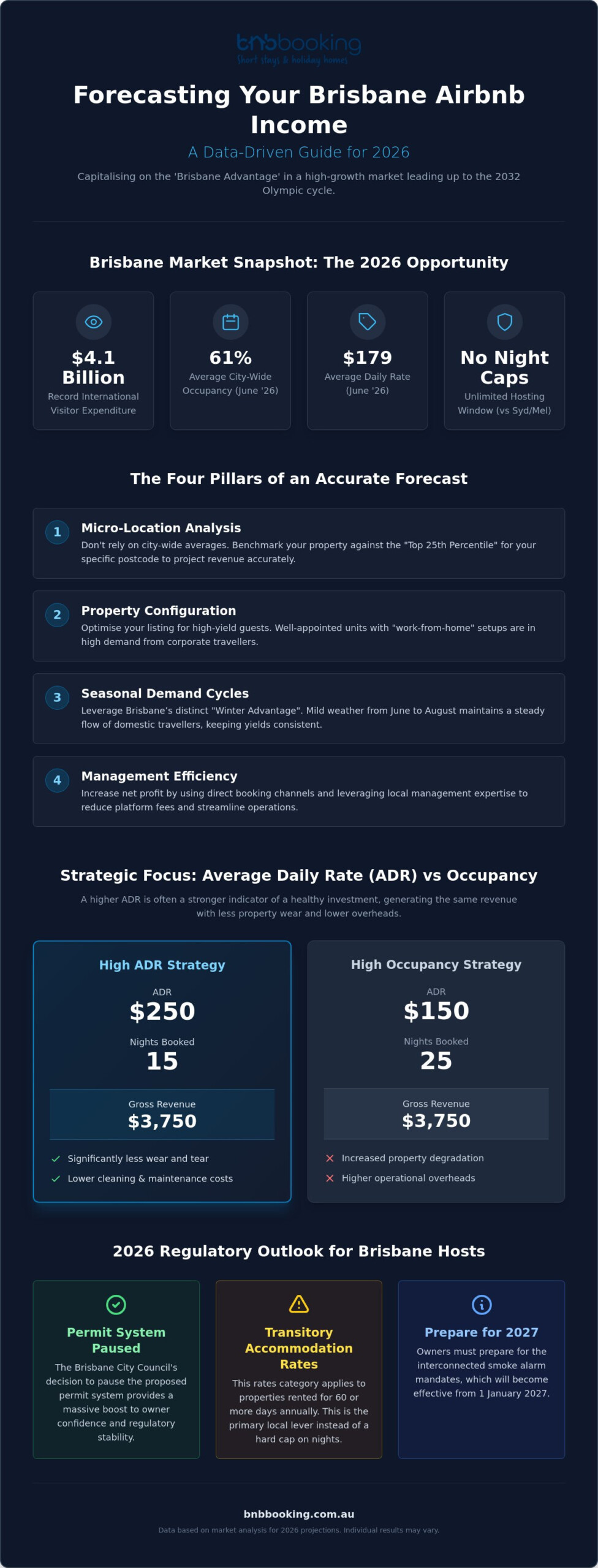
With international visitor expenditure in the River City hitting a record $4.1 billion this year, the opportunity for property owners has never been more significant. While other Australian capitals are tightening restrictions, Brisbane’s decision to pause the new short-stay permit system provides a unique “Brisbane Advantage” for savvy investors. If you are currently forecasting Airbnb income Brisbane 2026, you are likely weighing the potential of a $179 average daily rate against the rising costs of property maintenance and the complexities of the Transitory Accommodation rates category.
It’s understandable to feel a sense of uncertainty regarding seasonal fluctuations or the looming 2027 smoke alarm mandates. This strategic guide promises to replace that guesswork with a reliable, data-driven financial forecast for the year ahead. You will gain a clear understanding of how to navigate local regulations and implement high-yield occupancy strategies that ensure your investment thrives as we edge closer to the 2032 Olympic cycle. We will examine the shift toward unit demand and how to optimise your listing to outperform the current city-wide occupancy average of 61%.
Forecasting Airbnb income Brisbane 2026 is a precise exercise in balancing market data with local momentum. At its core, this forecast is the calculation of your projected gross revenue by multiplying your Average Daily Rate (ADR) by your expected occupancy percentage across the calendar year. In 2026, this calculation is underpinned by a level of regulatory certainty that our southern neighbours simply don’t enjoy. While Sydney and Melbourne grapple with restrictive 180-day night caps, Brisbane property owners benefit from an unlimited hosting window, provided they are in the correct council zones and meet specific rating requirements. The current market benchmarks, such as the June 2026 average daily rate of $179 and an occupancy rate of 61%, serve as the baseline for your projections.
This year marks a pivotal moment. We are now six years away from the 2032 Olympic Games, a timeframe where infrastructure projects transition from blueprints to reality, driving a surge in contractor and executive travel. Understanding Brisbane’s economic landscape is vital for any owner looking to capitalise on this growth, as the city’s GDP continues to outpace national averages through diversified sectors like tech and construction. This economic stability makes the River City a safer bet for short-term rental yields compared to more volatile tourism-only markets.
The Brisbane City Council’s decision on May 12, 2026, to pause the proposed permit system has provided a massive boost to owner confidence. Currently, the primary local lever is the “Transitory Accommodation” rates category, which applies to properties let for 60 or more days annually. By avoiding a hard cap on nights, the council allows owners to maximise their ROI during peak seasonal events without the fear of being forced into the long-term market halfway through the year. It’s a pragmatic approach that rewards high-performing listings in approved residential and mixed-use zones, though owners must still prepare for the interconnected smoke alarm mandates effective from January 1, 2027.
The tourism profile of the city has matured rapidly. With the Queen’s Wharf precinct now fully operational, the CBD and Fortitude Valley have become magnets for high-yield corporate travellers who require the amenities of a home rather than a standard hotel room. We are seeing a distinct trend where interstate travellers are bypassing the Gold Coast in favour of Brisbane’s urban sophistication and world-class dining. This shift is inflating demand for well-appointed units, particularly those that offer a seamless “work-from-home” setup. When forecasting Airbnb income Brisbane 2026, factoring in this corporate-leisure “bleisure” mix is essential for setting a competitive ADR that reflects the city’s new status as a global destination.
Reliable financial planning moves away from the “finger in the wind” approach. When forecasting Airbnb income Brisbane 2026, you must examine the four pillars of a professional projection: micro-location, property configuration, seasonal demand cycles, and management efficiency. Many owners make the mistake of prioritising occupancy at all costs. However, a high Average Daily Rate (ADR) is often a stronger indicator of a healthy investment. A property booked at $250 for 15 days generates the same gross revenue as one booked at $150 for 25 days, but with significantly less wear and tear and lower cleaning overheads. This margin-first mindset is what separates hobbyist hosts from professional investors.
You also need to account for the “New Listing” honeymoon period. Booking platforms often boost new properties in search results to gather initial reviews and data. If your first three months show 80% occupancy, it is risky to assume this will persist indefinitely without a sophisticated pricing strategy. Conversely, Brisbane offers a distinct “Winter Advantage.” While southern markets experience a sharp decline in travel during the colder months, our mild June to August climate maintains a steady flow of domestic travellers. This keeps yields more consistent than in Sydney or Melbourne, providing a reliable floor for your annual revenue.
Don’t settle for city-wide averages. While the 61% occupancy rate recorded in June 2026 is a useful baseline, you should look at the “Top 25th Percentile” for your specific postcode. A luxury 1-bed apartment in South Brisbane performs differently to a 4-bedroom family home in Ascot. High-performing properties often exceed the city average by 15% or more through superior styling and guest communication. By focusing on the top tier of similar properties, you set a realistic target for what a full-service Airbnb management partner can achieve for your asset.
Gross revenue is a vanity metric; net yield is what actually impacts your bank balance. Your 2026 forecast must be ruthless about deductions to provide a true picture of ROI. Ensure your spreadsheet accounts for these essential costs:
This granular approach ensures your 2026 projections are grounded in market reality, allowing you to make informed decisions about property improvements or portfolio expansion.
Maximising your returns requires more than just a listing; it requires an understanding of how the city’s physical transformation dictates guest behaviour. In 2026, the centre of gravity for short-term rentals is shifting away from the traditional CBD core toward emerging precincts. The Gabba precinct redevelopment is a primary example, as it turns surrounding suburbs like Woolloongabba and East Brisbane into year-round hotspots for both sports fans and construction executives. When forecasting Airbnb income Brisbane 2026, you must look beyond historical averages and account for these structural changes that create localised demand pockets.
Guest preferences have evolved significantly. Listings that offer pet-friendly stays and dedicated work-from-home setups are currently seeing the highest engagement in search filters. This isn’t just a trend; it’s a reflection of the modern traveller’s desire for flexibility and long-stay amenities. To capture this interest, professional photography remains your most vital investment. High-quality imagery that highlights a dedicated workspace or a secure courtyard for pets can justify a significantly higher ADR compared to standard listings that rely on smartphone photos.
While the 2032 Games are still years away, the infrastructure milestones reached in 2026 are already acting as a magnet for international contractors and specialised consultants. The full operational status of the Queen’s Wharf precinct has created a permanent uplift in city-wide demand, particularly for premium accommodation that offers an experience rather than just a bed. You should anticipate sharp ADR spikes during major sporting events or cultural festivals, as the city’s capacity is frequently tested by the record $4.1 billion international visitor spend. Every major infrastructure milestone completed in the city acts as a permanent catalyst for increased nightly rates and sustained occupancy levels.
South Brisbane and West End continue to dominate as the cultural and corporate hubs, offering proximity to both the CBD and the arts district. Paddington and New Farm remain the go-to choices for the premium lifestyle and staycation markets, where guests are willing to pay a luxury tax for local charm and heritage aesthetics. However, the inner-north is the sleeper hit of 2026. Suburbs like Ascot and Hamilton are seeing a surge in short-stay demand due to their proximity to the airport and the evolving Northshore Hamilton precinct, making them essential inclusions in any strategic forecast. These areas often provide better entry points for investors while delivering yields that rival the more established inner-city suburbs.
Deciding between a stable long-term tenant and the high-yield potential of the short-stay market is the most critical choice a Brisbane property owner faces. While a traditional 12-month lease offers predictable cash flow, the financial reality in 2026 is that short-term rentals in the River City frequently outperform long-term yields by 40% or more. This premium is driven by the city’s unique position as a year-round destination with no restrictive night caps. When forecasting Airbnb income Brisbane 2026, you must weigh this increased revenue against the variable nature of the market; however, the data suggests the “volatility risk” is largely mitigated by the city’s record-breaking international visitor expenditure.
Beyond the raw numbers, the non-monetary ROI of flexibility is a significant factor. Short-term hosting allows you to block out dates for your own family holidays or maintenance, an option that is impossible with a standard residential tenancy. For Queensland owners, the tax implications also lean in favour of the professional host. While you must account for GST if your turnover exceeds specific thresholds, the majority of management expenses, professional cleaning, and property maintenance are tax-deductible. This helps to offset the higher “Transitory Accommodation” rates applied by the council to properties used for short-term letting for 60 or more days a year.
Long-term rentals are not without their own hidden costs. A standard lease often involves a “letting fee” equivalent to one week’s rent plus GST every time a tenant moves on, alongside potential vacancy periods that can span weeks. In 2026, with the Brisbane rental vacancy rate sitting at a tight 1.8%, the demand for any housing is high. However, the short-term model uses constant turnover to its advantage, allowing for frequent professional cleaning and guest vetting that actually reduces the risk of long-term property damage. A well-managed short-stay asset is often kept in better physical condition than a long-term rental where issues might go unreported for months.
Consider a typical 2-bedroom unit in the CBD with a median value of $884,881. In the long-term market, this property might command a strong weekly rent, but it remains capped regardless of city events. Under a short-term model, dynamic pricing allows the nightly rate to surge during events like the Brisbane Festival or international cricket matches at the Gabba. By utilising a full-service Airbnb management partner, owners can optimise their calendar to hit that elusive 80% occupancy mark during peak periods, far exceeding the city-wide average of 61%. This strategic approach ensures that your asset isn’t just sitting idle but is actively responding to the real-time demand of the 2026 market.
A successful investment isn’t just about predicting the numbers; it’s about the clinical efficiency required to exceed them. While global management platforms rely on broad, impersonal algorithms, BnB Booking provides a sophisticated blend of local authority and strategic oversight. When forecasting Airbnb income Brisbane 2026, the difference between a generic listing and a professionally managed asset often equates to thousands of dollars in net profit. We move beyond mere aesthetics, focusing on the competitive realities of the market and the necessity of high-level service to secure premium guest feedback and repeat bookings.
One of our primary signatures is the emphasis on direct-channel engagement. By diverting a portion of your bookings away from third-party platforms, we significantly reduce the burden of platform commissions, ensuring more of your gross revenue stays in your pocket. Listing optimisation in 2026 also requires a holistic approach. It’s no longer enough to have attractive photos; your listing must be engineered to satisfy specific search filters for work-from-home amenities and pet-friendly features while maintaining the prestige of a boutique stay. Professional cleaning and proactive maintenance further protect your asset’s long-term value, ensuring that “wear and tear” is managed with the same precision as your pricing strategy.
Global software often misses the nuance of a city’s specific rhythm. Our approach to Full-Service Airbnb Management Brisbane combines advanced data tools with granular local expertise. We understand that Riverfire, Magic Round, and University graduation weeks create distinct demand profiles that standard algorithms might overlook. By adjusting rates in real-time based on these specific events, we ensure your property captures the maximum ADR when demand is highest. This proactive strategy is essential for any owner looking to hit the upper quartiles of their 2026 revenue projections and capitalise on the city’s growing international profile.
Managing a high-performing rental shouldn’t be a second job. We provide a comprehensive management service that encompasses everything from 24/7 guest communication to professional housekeeping that meets strict hotel standards. This level of oversight protects your investment by ensuring that minor maintenance issues are identified and resolved before they become costly repairs. By removing the hidden costs of self-management and the stress of guest coordination, we allow you to enjoy the financial rewards of your investment without the operational burden. If you are ready to move from estimation to execution, Get a Free Rental Yield Forecast for Your Property today and discover the true potential of your Brisbane asset in the lead-up to 2032.
Navigating the transition from simple property ownership to high-yield asset management requires a shift in perspective. By aligning your strategy with Brisbane’s unique regulatory stability and the physical transformation of the Gabba and Queen’s Wharf precincts, you position your investment for sustained success. Mastering the data-driven methodology for forecasting Airbnb income Brisbane 2026 is the first step toward outperforming the city’s standard occupancy benchmarks. Success in this market isn’t found in passive hosting; it’s earned through the clinical application of local knowledge and dynamic pricing.
With over 10 years of experience in South East Queensland, BnB Booking provides the strategic authority required to navigate these shifts. Our specialised corporate and family-friendly listing strategies have a proven track record of outperforming market occupancy averages by up to 20%. We treat your property as a premier destination, balancing the warmth of a local host with the efficiency of an established management firm. To move beyond general market data and understand the specific potential of your asset, Request Your Custom 2026 Brisbane Income Forecast today. The River City is ready for its global debut, and your property should be too.
Earnings depend heavily on property type and location, but the average active short-term rental in Brisbane earned $21,600 in the twelve months leading up to June 2026. Properties in premium suburbs or those with professional styling often achieve higher results. With an average daily rate of $179 across the city, high-performing listings that leverage professional management and dynamic pricing can significantly exceed these baseline figures.
Brisbane currently has no hard limit or “night cap” on how many days you can host guests throughout the year. This provides a significant advantage over cities like Sydney, where a 180-day cap applies. However, you should be aware that Brisbane City Council applies a higher “Transitory Accommodation” rates category to properties used for short-term letting for 60 or more days annually.
Management fees for short-term rentals in Brisbane are typically structured as a percentage of the gross booking revenue. These fees cover the comprehensive oversight required to maintain a high-performing listing, such as 24/7 guest support, professional cleaning coordination, and listing optimisation. It is important to choose a management partner whose fee structure reflects a commitment to protecting your asset while maximising your net yield.
Short-term rentals in Brisbane frequently outperform traditional long-term leases by 40% or more in terms of gross revenue. While the short-stay market involves higher operating costs and turnover, the ability to adjust nightly rates during peak events often leads to a higher net profit. When forecasting Airbnb income Brisbane 2026, many owners find that the increased yield and property flexibility outweigh the stability of a 12-month lease.
Standard residential landlord insurance usually does not cover short-term stay activities, making specialised host insurance essential for your protection. You should look for a policy that specifically covers public liability, guest-related property damage, and loss of income. Ensuring you have the correct coverage is a critical step in de-risking your investment and maintaining the long-term viability of your short-term rental asset.
The primary regulatory factor for your forecast is the council’s “Transitory Accommodation” rates category, which applies if you host for more than 60 days a year. While the proposed 2026 permit system was paused, you must still comply with existing local laws and state-level requirements. This includes the Queensland smoke alarm legislation, which mandates the installation of interconnected photoelectric smoke alarms in all rental properties by January 1, 2027.
The average occupancy rate for short-term rentals in Brisbane was 61% as of June 2026, which is a 2.2% increase from the previous year. While this serves as a city-wide benchmark, occupancy can vary significantly between sub-regions and property types. Professional management strategies often aim to outperform this average by targeting the corporate “bleisure” market and aligning availability with the city’s major sporting and cultural event calendar.
You retain complete flexibility to use your property for personal holidays or maintenance whenever you require. Unlike a traditional long-term tenancy that restricts your access for the duration of the lease, our management model allows you to block out dates on your calendar as needed. This flexibility is a primary reason many owners choose the short-term market, as it allows them to enjoy their investment personally while generating income.