

5 Ways to Earn 5-Star Airbnb Reviews Through Better Hosting
- 23 October 2026
- Blog
In 2024, 85% of Airbnb reviews were five stars, so guests clearly value a stay that delivers on its promise. To understand... Read More
 by BNB Booking

Could a single oversight in your local council paperwork cost you $17,270 in fines before the 2032 Olympics even arrive? With the value of a penalty unit in Queensland rising to $172.70 on 1 July 2026, the financial stakes for property owners have never been higher. It is completely understandable if you feel overwhelmed by the conflicting information surrounding short term rental compliance qld. Between Brisbane’s sudden pause on its proposed permit system and the Sunshine Coast’s tightening zoning restrictions, the regulatory landscape often feels like a moving target. You want to provide a premium guest experience, but the constant anxiety over Body Corporate threats or shifting registration fees can make your investment feel more like a legal liability than a strategic asset.
We believe that professional property management should offer absolute peace of mind, not just a busy booking calendar. This guide provides the clarity you need to navigate the three-tier framework of state, council, and strata rules with total confidence. You will find a definitive checklist of your legal obligations, from the mandatory 2027 interconnected smoke alarm deadline to the specific public liability requirements currently enforced on the Gold Coast. We’ll examine the critical differences between local regions and show you exactly how to protect your portfolio against shifting legislation, ensuring your holiday rental remains both profitable and perfectly legal.
Short-Term Rental Accommodation (STRA) in Queensland is no longer the “wild west” of the property market. Historically, many owners treated holiday hosting as a casual side hustle, but the landscape in 2026 requires a more sophisticated, business-first approach. Understanding Short-Term Rentals within a global context shows that Queensland is following a worldwide trend toward tighter regulation. For owners, short term rental compliance qld now involves a strict three-tier hierarchy: state-wide registration, local council planning schemes, and Body Corporate bylaws. Each layer must be satisfied to ensure your investment remains both profitable and protected from legal scrutiny. Compliance is the foundation of your business. It protects your insurance validity and ensures your property remains eligible for high-performing booking platforms.
The regulatory environment reached a tipping point following the University of Queensland’s comprehensive review. This led to the introduction of a state-wide registration framework designed to bring transparency to the sector. Government agencies and major booking platforms now share data with unprecedented efficiency, making it almost impossible to operate “under the radar”. This increased oversight is largely a response to the housing crisis. Regional authorities are tightening rental laws to protect long-term housing stock, particularly in high-demand coastal pockets. You’ll find that councils are now more proactive in auditing property uses to ensure they align with local zoning intent.
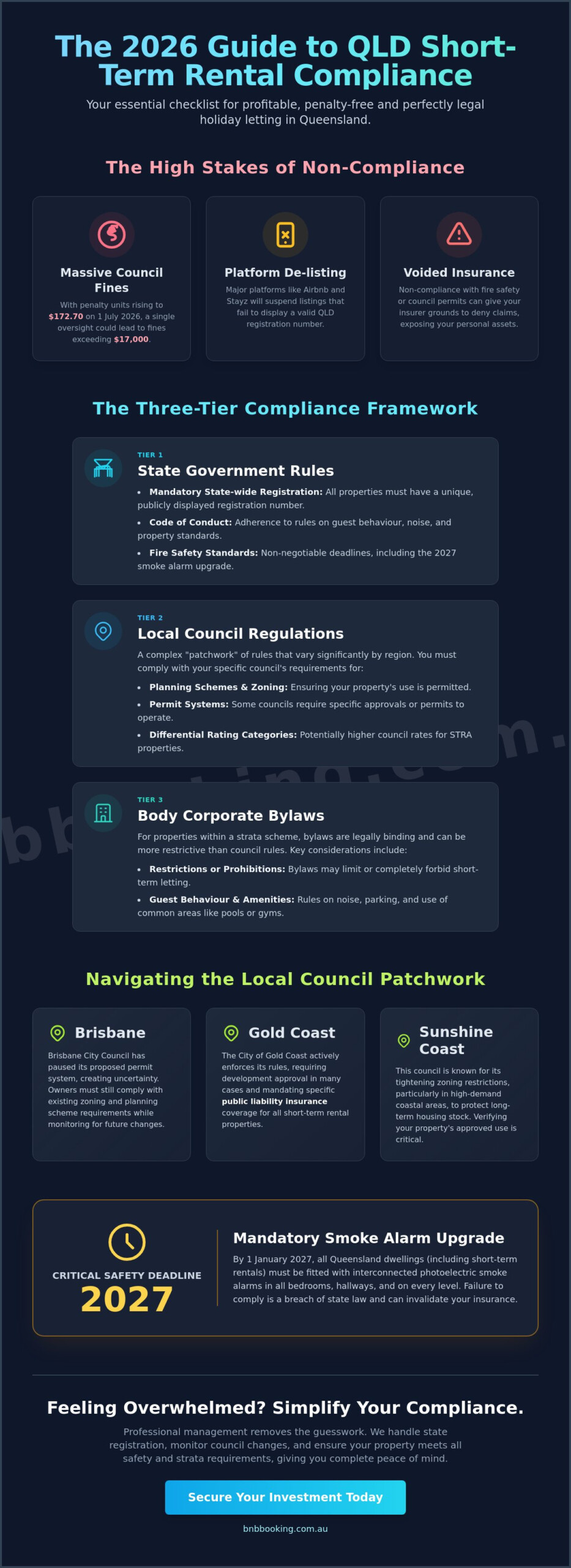
The risks of ignoring these rules are both financial and operational. Local councils have the power to issue significant fines for the unauthorised use of a premises. With the Queensland penalty unit value rising to $172.70 on 1 July 2026, even a small number of infringements can lead to a massive bill. Beyond council fines, non-compliance is a fast track to being de-listed from major platforms. If your registration details don’t match government records, your listing could vanish overnight. Most critically, failing to maintain short term rental compliance qld can void your specialised insurance. If an accident occurs and your property doesn’t meet state fire standards or council permits, your insurer may refuse to cover the claim, leaving your personal assets exposed.
Success in this market requires staying ahead of these shifts. It’s about moving from a passive income mindset to an active management strategy. By aligning your property with state and local requirements, you aren’t just avoiding fines; you’re building a resilient, high-value asset that guests and platforms trust.
Queensland’s approach to short-term accommodation has matured significantly, moving toward a centralised system that prioritises transparency. Central to this evolution is the mandatory state-wide registration system. This isn’t just a database; it’s a regulatory anchor that ensures every holiday rental operates within a clear legal framework. Every property must now display its unique registration number prominently on all digital listings, including Airbnb, Stayz, and Booking.com. Failing to include this number can lead to immediate platform suspension or fines based on the state’s penalty unit value. This system ensures that all hosts adhere to the high standards expected under Queensland renting regulations, creating a level playing field for the entire industry.
To secure your registration in 2026, you’ll need to navigate the official QLD Government STRA portal. Start by gathering your essential documentation, including proof of ownership and up-to-date safety certificates. You’ll also need to confirm that your property is on track to meet the 2027 fire safety standards for interconnected photoelectric alarms. Once your details are uploaded and the prescribed annual registration fee is processed, your unique number is issued. It’s a yearly commitment; you must renew your registration and report data on nights booked to help the state monitor housing impacts. Many owners find that full-service Airbnb management takes the sting out of this administrative burden by handling the entire portal process and annual renewals on their behalf.
The 2026 Code of Conduct is designed to balance tourism growth with the quiet enjoyment of local neighbourhoods. It places a heavy emphasis on preventing “party houses” and managing noise complaints in real-time. As a host, you’re legally responsible for your guests’ behaviour from the moment they check in. If a guest causes a significant disturbance that impacts neighbour amenity, it counts as a “strike” against your property. Under the state framework, the “two strikes” rule is unforgiving. Two verified serious breaches within a 12-month period can result in a total ban from all booking platforms. This makes proactive guest vetting and the installation of noise monitoring technology essential tools for achieving short term rental compliance qld while protecting your investment.
Compliance isn’t a one-off task; it’s a cycle of annual renewals and constant vigilance regarding guest conduct. By staying on top of your reporting obligations and display requirements, you protect your listing’s longevity and your reputation within the Queensland community. This proactive approach ensures your property remains a high-performing asset in a increasingly regulated market.
State registration provides the regulatory baseline, but local councils hold the final authority over how your land is actually used. This creates a complex overlay where a property might be registered with the state but remain technically “unauthorised” under local planning schemes. Achieving short term rental compliance qld requires you to understand three specific development categories. “Exempt” development allows you to host without a permit. “Self-assessable” means you must meet specific criteria without a formal application. “Code-assessable” properties require a full planning application and council approval before you can welcome your first guest. While Queensland rental laws establish the broad legal framework for property use, your local council dictates the granular details of permits, parking, and noise management.
Brisbane currently stands as one of the most host-friendly major cities in Australia. On 12 May 2026, Lord Mayor Adrian Schrinner announced that the proposed Short Stay Accommodation Local Law would be paused indefinitely. This means the anticipated permit system and its associated fees are not proceeding for the 2026-2027 financial year. Despite this “monitoring” stance, you aren’t exempt from all rules. You must still ensure your property is correctly categorised within the Brisbane City Plan rating categories. Most owners avoid a full planning application unless they are performing a Material Change of Use or operating in a way that significantly deviates from standard residential living. This flexibility makes Brisbane a high-demand market, though council rates for short-term properties remain higher than standard residential levies.
The coastal councils take a much more hands-on approach to regulation. On the Gold Coast, compliance is tied directly to your council rates and insurance. You must ensure your property is registered in the specific “short-term accommodation” rates category to avoid significant back-charges. Furthermore, Gold Coast operators are required to maintain a minimum of $10 million in public liability insurance specifically for short-stay guests. Beyond meeting these insurance and rating requirements, effective airbnb guest management gold coast is essential for maintaining the high guest satisfaction scores that protect your listing’s visibility and reputation on major platforms. Failing to meet these standards can result in fines that scale with the new $172.70 penalty unit value effective from 1 July 2026.
The Sunshine Coast Council is arguably the most restrictive. Short-term accommodation is generally prohibited in low-density or rural residential zones under the 2014 Planning Scheme. If you’re in a permitted zone, you often need a Material Change of Use (MCU) permit. This process usually requires a formal “management plan” that outlines how you’ll handle guest behaviour and parking. Before investing in a coastal property, you must check for specific suburb overlays. Some pockets have implemented total prohibitions to protect local housing availability, making short term rental compliance qld a matter of geographic luck as much as administrative diligence.
Compliance isn’t just about digital paperwork; it’s about the physical safety of your guests and the legal integrity of your property. If your property doesn’t meet specific safety standards, your insurance is effectively worthless. You must distinguish between standard landlord insurance and specialised short-term rental accommodation (STRA) insurance. Most standard policies exclude commercial activities, meaning a guest injury or accidental damage could lead to total financial exposure. Ensuring short term rental compliance qld means aligning your coverage with the reality of high-turnover hosting to protect your personal assets.
Fire safety is the most critical non-negotiable for hosts in 2026. Beyond having an extinguisher and a fire blanket in the kitchen, you must provide clear evacuation diagrams. These diagrams must be permanently fixed in a prominent position, typically behind the main entry door or in a visible hallway. You are also required to complete an annual fire safety statement to confirm all equipment is functional and compliant. By 1 January 2027, all Queensland dwellings must have interconnected, photoelectric smoke alarms complying with Australian Standard 3786-2014 installed in every bedroom, connecting hallways, and on every level.
Many owners live in fear of a Body Corporate ban. In Queensland, Section 180(3) of the Body Corporate and Community Management Act generally prevents a Body Corporate from prohibiting short-term rentals if the lot is used for residential purposes. However, they can enforce strict bylaws regarding noise, parking, and common property use. To maintain a positive relationship, present a professional management plan to your strata committee. This plan should detail your guest vetting process and your use of noise monitoring technology. These devices alert you to decibel spikes before they become a neighbour’s formal complaint.
Reviewing your strata bylaws for “prohibition” clauses is essential, even if they are often legally unenforceable under current state law. Some committees attempt to use “nuisance” clauses to target hosts. By staying proactive and transparent, you transform the Body Corporate from an adversary into a stakeholder. To ensure your property meets every safety and strata requirement without the stress, consider partnering with our team for full-service Airbnb management. We handle the technical details so your investment stays protected and your neighbours stay happy.
Managing a high-performing holiday rental in 2026 is no longer a set-and-forget venture. As we’ve explored, the administrative burden of maintaining short term rental compliance qld can quickly erode the joy of property ownership. Between the state-wide registration portal, annual data reporting, and the constant monitoring of local council rating categories, the workload is substantial. Many owners find that the transition from a casual host to a compliant business operator requires more time than they can realistically spare. This is where professional management moves from being a luxury to a strategic necessity for protecting your asset’s longevity.
Professional managers act as your regulatory shield. We handle the heavy lifting of state registration and ensure your unique number is correctly displayed across all digital platforms to prevent sudden de-listing. Beyond the paperwork, our role involves coordinating the technical aspects of compliance, such as professional cleaning schedules that double as safety audits. We ensure that every turnover includes a check of essential safety equipment, keeping you aligned with the strict fire safety statements and the looming 2027 smoke alarm deadlines. This proactive oversight ensures that your property remains a safe, legal, and attractive option for guests.
Our methodology is built on a foundation of local expertise and clinical efficiency. We provide Full-Service Airbnb Management Brisbane and across the coastal regions, taking total responsibility for council permits and state registration renewals. A key part of our service is sophisticated guest vetting. By filtering for high-quality travelers and managing all guest communication, we significantly reduce the risk of neighbour disputes and “party house” strikes. We don’t just react to problems; we prevent them through rigorous standards that uphold the 2026 Code of Conduct, ensuring your property maintains its status as a respected part of the community.
The regulatory landscape in Queensland will continue to evolve as the 2032 Olympics approach. Staying ahead of these legislative changes requires a dedicated partner who understands the nuances of the market. We focus on maximising your yield and occupancy rates while strictly adhering to local restrictions, such as the specific rating categories in Brisbane or the insurance mandates on the Gold Coast. This balance ensures your investment remains profitable even as legal overheads and penalty unit values increase. Don’t leave your compliance to chance and risk a $17,270 fine. You can organise a compliance health check for your property today to ensure your portfolio is fully protected for the years ahead.
The shift toward a more regulated short-stay market in 2026 represents a significant opportunity for owners who prioritise professional standards. By mastering the state-wide registration process and staying ahead of local council rating shifts, you position your property as a premier choice for high-value travellers. It’s clear that short term rental compliance qld is no longer a matter of ticking a few boxes; it requires ongoing vigilance regarding fire safety deadlines and evolving Body Corporate expectations. Protecting your investment means moving beyond the “set and forget” mentality of previous years.
Since 2016, we’ve managed luxury Queensland portfolios with a focus on clinical efficiency and strategic growth. Our full-service management model takes the complexity out of the equation, covering everything from Brisbane City Council local law expertise to mandatory state registration. You can ensure your property is 100% compliant with BnB Booking while we focus on maximising your yield and guest satisfaction. The road to the 2032 Olympics is paved with potential for savvy hosts. We’re here to ensure your journey is both profitable and perfectly legal.
No, you don’t currently need a specific local council permit to host short-term guests in Brisbane. Lord Mayor Adrian Schrinner indefinitely paused the proposed Short Stay Accommodation Local Law on 12 May 2026. While the permit system is not proceeding, you must still ensure your property is correctly categorised for council rates and meets all state-level registration requirements to maintain short term rental compliance qld.
The 2026 Code of Conduct is a mandatory set of rules designed to protect neighbour amenity and prevent “party houses” in residential zones. It outlines clear responsibilities for both hosts and guests regarding noise, parking, and general behaviour. Under this framework, a “two strikes” rule applies; two verified serious breaches within a 12-month period can result in your property being banned from all major booking platforms.
In most instances, a Body Corporate cannot legally ban short-term rentals if your lot is used for residential purposes. Section 180 of the Body Corporate and Community Management Act generally protects an owner’s right to lease their property. However, committees can enforce strict bylaws regarding the use of common property and noise levels, which makes professional management essential for maintaining a harmonious relationship with the strata committee.
The cost to register your property is an annual fee paid directly through the QLD Government STRA portal. This fee covers the administrative costs of the state-wide database and the data-sharing initiatives between platforms and the government. You should check the official portal for the most current pricing before your annual renewal, as government levies are subject to periodic adjustments based on the state budget.
Yes, fire safety standards for holiday rentals are much more rigorous than for standard long-term residences. To achieve short term rental compliance qld, you must display permanent evacuation diagrams and ensure all safety equipment is serviced annually. By 1 January 2027, your property must also have interconnected photoelectric smoke alarms installed in every bedroom, connecting hallways, and on every level of the home to meet Australian Standard 3786-2014.
You require a specialised Short-Term Rental Accommodation (STRA) insurance policy that specifically covers commercial guest stays. Standard landlord insurance often contains exclusion clauses for short-stay activities, which could leave you exposed in the event of a guest injury or property damage. If your property is on the Gold Coast, you are legally required to maintain a minimum of $10 million in public liability insurance to satisfy council requirements.
You are generally required to register for and pay GST only if your total annual turnover from all business activities exceeds $75,000. While long-term residential rent is input-taxed, short-term accommodation is often viewed as a commercial service by the ATO. It’s important to seek advice from a qualified accountant to determine how your specific rental income and turnover levels impact your GST obligations and potential tax deductions.
If a guest causes a disturbance, you are responsible for resolving the situation immediately to minimise the impact on your neighbours. A verified noise complaint can result in a formal strike against your property under the state-wide Code of Conduct. Because two serious strikes can lead to a platform ban, many owners now use noise monitoring technology to receive real-time alerts and intervene before a neighbour feels the need to contact authorities.