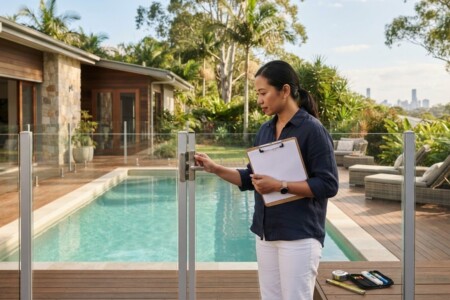
Pool safety for Airbnb in QLD: certificates and host duties
- 22 October 2026
- Blog
A pool at a Queensland short-stay rental comes with a clear compliance duty: pool safety compliance for an Airbnb in QLD requires... Read More
 by BNB Booking

Choosing to forgo professional fees to manage your own short-term rental might actually be the most expensive decision you make for your Brisbane investment property this year. It is a common strategy for many local owners who believe that handling their own bookings and guest relations is the fastest way to maximise their net yield. You likely started with the best intentions, thinking a bit of personal effort would easily outweigh the expense of professional oversight.
However, the real cost of self-managing Airbnb in Brisbane in 2026 involves far more than just your time. Between navigating the Brisbane City Council’s significant transitory accommodation rates surcharge and managing the rising expectations of luxury travellers, the hidden drains on your profit can be substantial. We will explore the true financial and personal burdens of the DIY model, from the logistics of hotel-standard turnovers to the upcoming 2027 smoke alarm compliance deadlines. This guide provides a clear breakdown of expenses versus returns, giving you the confidence to choose a management model that actually protects your lifestyle and your asset.
Many Brisbane property owners believe that by bypassing a management agency, they are successfully “saving” 20% of their revenue. This is a common misconception in the local market. In reality, the cost of self-managing Airbnb in Brisbane involves a suite of unavoidable overheads that usually consume 15% to 20% of your gross income before you even factor in your own labour. While Airbnb typically charges a 3% host fee, other platforms like Booking.com often require 15% or more. Relying on a single platform to avoid these fees is a risky strategy that often leads to lower occupancy rates, which averaged 61% across Brisbane in mid-2026.
Managing a high-performing listing requires more than just an active account. You need a tech stack to remain competitive. Most successful DIY hosts find themselves paying for dynamic pricing tools, channel managers to prevent double bookings, and automated guest messaging systems. When you add up these monthly subscriptions, the “0% commission” dream quickly evaporates. Understanding the broader landscape of Short-term rental regulations and market standards is essential for any owner trying to navigate these expenses without professional help.
To achieve the 21.2% revenue growth seen in Brisbane listings over the last year, you cannot rely on static pricing. Subscription costs for dynamic pricing tools like PriceLabs or Wheelhouse are essential for adjusting rates based on local events or seasonal demand. DIY hosts also face transaction fees for processing direct payments and the high cost of initial marketing. Professional-grade listing optimisation and SEO are not one-off tasks; they require constant monitoring and adjustment to stay ahead of the 13,386 active listings currently competing for guests in the River City.
A professional management fee is often a strategic investment rather than a pure expense. Agencies like BnB Booking specialise in luxury corporate and family stays, using high-end photography and professional copywriting to drive significantly higher conversion rates. A 20% fee is frequently offset by a substantial increase in occupancy and daily rates that an amateur host simply cannot match. Furthermore, established managers provide access to direct booking platforms. These channels bypass the hefty commissions of major OTA platforms, allowing owners to retain a larger slice of the booking value while benefiting from a fully managed, “hands-off” investment model.
Beyond the platform commissions and software subscriptions, the day-to-day operational outgoings represent a massive portion of the cost of self-managing Airbnb in Brisbane. While a standard residential clean might suffice for a long-term rental, holiday letting requires a hospitality-grade turnover. In 2026, professional Airbnb cleaning services in Brisbane for a 1-2 bedroom unit average between $120 and $180 per stay. If you own a larger 3-4 bedroom house, those costs climb to between $220 and $330. These figures don’t include the “linen trap” or the constant replenishment of high-end consumables that luxury guests now expect as standard.
Research from an independent public policy think tank suggests that the operational intensity of short-term rentals often leads to “host burnout” when managed individually. This is particularly true when emergency maintenance arises. A Sunday afternoon plumber call-out in Brisbane can easily cost upwards of $300 just for the attendance fee. Without a professional trade network to lean on, DIY hosts often pay premium “retail” rates for every repair, which quickly erodes the thin margins of self-management.
A specialised turnover checklist is far more rigorous than a standard domestic sweep. It includes sanitising high-touch surfaces, checking for property damage, and ensuring the presentation matches your listing photos exactly. Reliability is the biggest hurdle for the DIY host. If a cleaner pulls a “no-show” on a back-to-back booking, the owner is often forced to drop everything to clean the property themselves. Many owners find that leveraging a professional turnover service is the only way to maintain five-star reviews without sacrificing every weekend to logistics. You must also factor in quarterly deep cleans and carpet steaming, which are essential to protect your asset from the high foot traffic of short-stay guests.
Linen is a significant depreciating asset. High-thread-count sheets and plush towels have a limited lifespan under the stress of commercial laundering. Professional linen services in Brisbane start from around $45 per clean, providing a fresh, hotel-standard set for every guest. If you choose to buy and wash your own, you must calculate the cost of water, electricity, and the inevitable replacement of stained or worn items. For a typical 2-bedroom Brisbane apartment, the cost-per-stay for premium consumables; including artisan coffee, luxury toiletries, and essential cleaning supplies; typically ranges from $25 to $40. Creating a “luxury” first impression with a welcome pack is effective for reviews, but it adds another layer of expense that many DIY hosts fail to track accurately.
While cleaning fees and platform commissions are highly visible, the administrative and regulatory cost of self-managing Airbnb in Brisbane often catches owners off guard. These “hidden” expenses aren’t optional. They are mandatory requirements for operating a legal and protected short-term rental in the River City. Navigating these local nuances requires a strategic approach to ensure your investment remains profitable after the Council and the taxman take their share.
The most significant local expense is the Brisbane City Council’s “transitory accommodation differential” rates surcharge. If your property is listed for short-term stays for more than 60 days a year, you are subject to this higher rates category. As of the 2024-25 budget, this involves a cumulative surcharge that has reached 75% above standard residential rates. While the proposed “Short Stay Accommodation Local Law 2025” and its associated permit fees were paused indefinitely in May 2026, the rates surcharge remains a heavy, ongoing hit to your bottom line.
Compliance also extends to physical safety. By 1 January 2027, every short-term rental in Queensland must be fitted with interconnected, photoelectric smoke alarms in every bedroom and hallway. For a DIY host in 2026, the cost of supply and professional installation for a multi-bedroom home represents a significant capital outlay. Failing to meet these standards doesn’t just risk a fine; it could void your insurance entirely.
Standard landlord insurance is rarely sufficient for the high-turnover nature of holiday letting. You need specialised short-term rental insurance that specifically covers public liability, guest-related damages, and loss of income. While platform-provided guarantees like AirCover offer a basic safety net, they often have complex claiming processes and significant exclusions. A dedicated policy for a luxury Brisbane property provides the clinical security needed to protect your asset. These premiums are typically higher than standard residential policies, reflecting the increased risk profile of hosting 13,386 active listings across the city.
Administrative costs also include the legal complexities of Body Corporate by-laws. Many Brisbane apartment complexes have specific rules regarding short-term letting. A DIY host may need to pay for legal advice or mediation to secure strata approval or defend their right to host. Finally, don’t overlook your tax obligations. If your annual turnover exceeds the GST threshold, you must register and account for GST on every booking. Specialised accounting for short-term rentals is an essential cost of self-managing Airbnb in Brisbane, ensuring you maximise your depreciation claims while remaining compliant with the ATO.
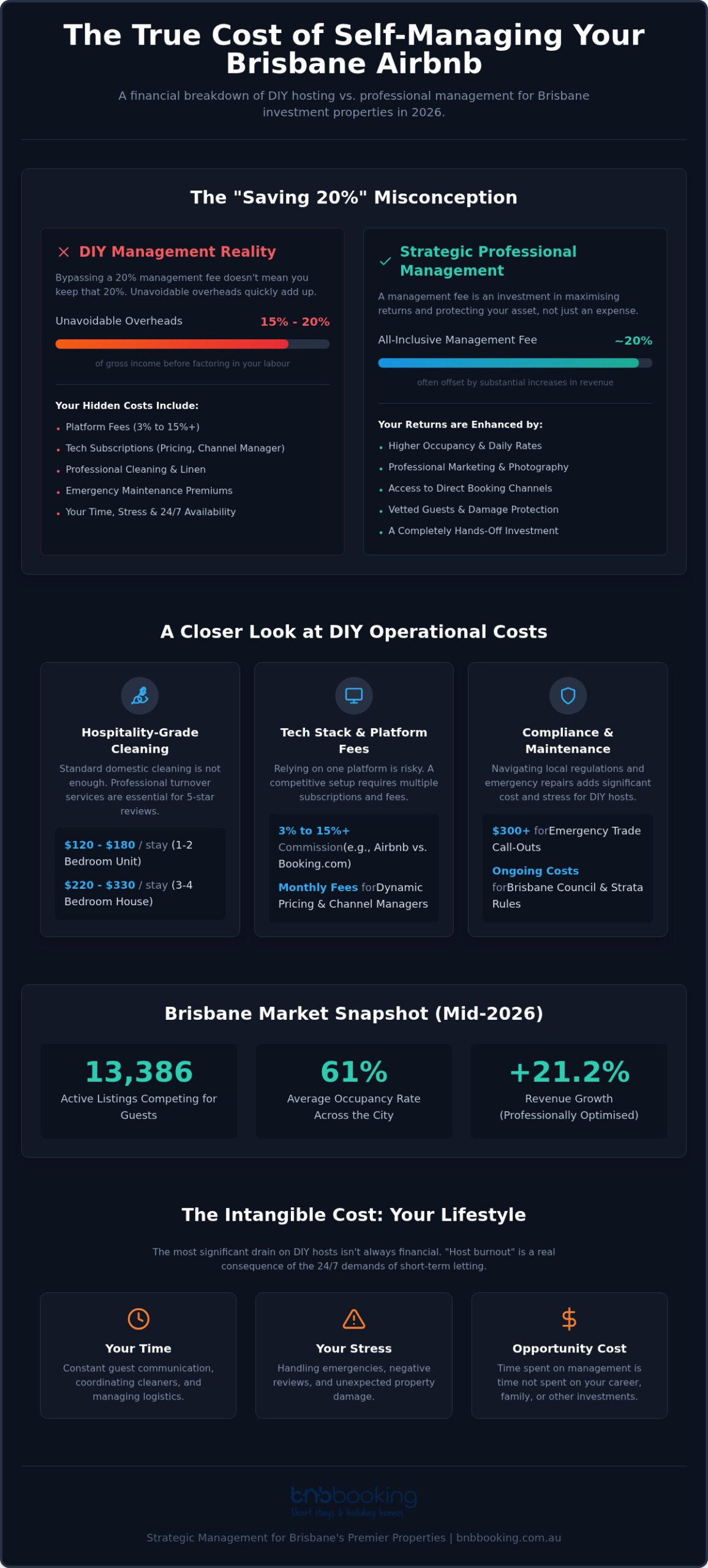
While the spreadsheets capture the visible outgoings, the true cost of self-managing Airbnb in Brisbane is often measured in lost sleep and diminished sanity. Hosting is not a passive income stream; it is a high-stakes hospitality role that demands 24/7 availability. In a market as competitive as the River City, the pressure to provide an immediate response is relentless. Guests don’t wait for business hours to ask about Wi-Fi passwords or report a minor issue; they expect a resolution within minutes, regardless of whether you are in a board meeting or at a family dinner.
The “Review Economy” adds another layer of mental load. A single 3-star rating can be devastating for your listing’s visibility in local search results. Search algorithms prioritise properties with flawless track records, meaning one disgruntled guest can significantly reduce your future booking enquiries. Managing these expectations requires a level of emotional labour that many owners underestimate. When you factor in the time spent obsessing over guest feedback and the anxiety of potential “party house” bookings, the psychological burden often outweighs the perceived savings of the DIY approach.
Handling late-night check-in issues is a rite of passage for the self-managing host. Whether it’s a guest struggling with a lockbox at 2:00 AM or a “where is the key” phone call during your child’s school play, these interruptions are unavoidable. Professional guest vetting acts as a critical filter, serving as the most robust insurance policy against the accelerated wear and tear that often plagues unmanaged properties. Without this rigorous screening process, you are essentially leaving the keys to your most valuable asset in the hands of strangers, hoping for the best while preparing for the worst.
Most DIY hosts spend between 10 and 15 hours per week on property-related tasks. This includes guest messaging, coordinating turnovers, replenishing supplies, and performing basic maintenance. To understand the real cost of self-managing Airbnb in Brisbane, you must quantify this time against your own professional value. If your professional hourly rate is $100, that “side hustle” is costing you upwards of $1,500 every single week in lost productivity or leisure.
Instead of sacrificing your weekends to logistics, consider how full-service Airbnb management can reclaim your time while actually increasing your net returns through professional expertise. Choosing to step back from the daily grind allows you to treat your property as a true investment rather than a second job.
While the initial cost of self-managing Airbnb in Brisbane might seem lower on paper, the strategic advantage of professional management often results in a higher net profit for the owner. Transitioning from a DIY model to a managed service isn’t just about offloading chores; it’s about shifting from an amateur operation to a high-yield business. By leveraging professional SEO and listing optimisation, we ensure your property doesn’t just sit among the 13,386 active listings in the city but actually captures the attention of the highest-paying guests. This level of visibility is difficult to achieve without the dedicated tools and market insights that a professional firm brings to the table.
One of the most significant financial levers we pull is our direct booking platform. As discussed in previous sections, relying solely on major OTAs can eat into your revenue through high commission structures. By driving traffic to our own booking channel, we bypass many of these platform fees, allowing you to retain a larger percentage of your gross revenue. This direct engagement, combined with our local trade network that avoids the “retail” rates of emergency call-outs, ensures your investment remains lean and profitable.
First impressions dictate your nightly rate. High-quality, professional photography is not a luxury; it is a fundamental requirement that can increase your Average Daily Rate (ADR) by 20% or more. When guests see a property that has been professionally styled and captured, their perception of value shifts, allowing you to command a premium over the Brisbane market average. This visual appeal, paired with data-driven pricing that adjusts in real-time to local demand and seasonal cycles, ensures you aren’t leaving money on the table during peak periods like the Brisbane Festival or major sporting events at Suncorp Stadium.
Choosing a local, boutique agency provides a level of geographic expertise that impersonal, global platforms cannot match. We understand the specific nuances of Brisbane sub-regions, from the corporate demand in the CBD to the family-oriented appeal of the leafy inner-suburbs. Our team handles the end-to-end process, including guest vetting, hotel-standard cleaning, and ongoing compliance with the latest fire safety regulations. This holistic approach eliminates host burnout and protects your asset from the risks associated with unmanaged stays. If you are ready to stop trading your time for a second job, it’s time to get a professional appraisal of your Brisbane property’s potential and see how strategic management can transform your investment returns.
The true cost of self-managing Airbnb in Brisbane often exceeds the commission of a professional partner once you factor in the 75% council rates surcharge, specialised turnover logistics, and the heavy mental load of 24/7 guest communication. Transitioning to a managed model allows you to reclaim your personal time while benefiting from higher nightly rates and superior occupancy. By leveraging professional photography and data-driven pricing tools, you can consistently outperform the market average without the risk of host burnout.
Since 2016, our team has provided South East Queensland with local expertise specialised in high-yield luxury and corporate stays. We handle everything from comprehensive cleaning and maintenance coordination to guest vetting, ensuring your asset is protected at every turn. Take the first step toward a truly passive, high-performing investment and request a free rental income estimate for your Brisbane property today. Your property deserves the clinical efficiency and warm hospitality that only a dedicated local expert can provide.
Yes, professional management fees are generally tax deductible in Australia as they are an expense incurred in the production of assessable rental income. You can also typically deduct costs for professional cleaning, repairs, and the specialised software required for the cost of self-managing Airbnb in Brisbane. It is essential to consult with a qualified accountant to ensure you are correctly claiming all eligible property expenses and depreciation.
Brisbane City Council applies a “transitory accommodation differential” surcharge to properties listed for short-term stays for more than 60 days a year. This surcharge has increased significantly in recent years; starting at 50% in the 2022-23 budget and rising to approximately 75% above standard residential rates by the 2024-25 budget. This represents a substantial ongoing expense that DIY hosts must factor into their annual operating budgets.
Airbnb provides a basic level of protection through AirCover, but it is not a comprehensive insurance policy. AirCover often involves complex evidence requirements and may not cover specific types of wear and tear or public liability issues. Most successful hosts in Brisbane invest in specialised short-term rental insurance to ensure they have robust protection against guest-related damages and legal liabilities that platform guarantees might exclude.
Most DIY hosts find they spend between 10 and 15 hours per week managing a single property. This time is consumed by guest vetting, 24/7 communication, and the logistical coordination of cleaning and maintenance. When calculating the true cost of self-managing Airbnb in Brisbane, you should value this time against your professional hourly rate to determine if the effort is providing a genuine financial return.
Professional management fees in the Brisbane market typically range from 15% to 25% of the gross rental income for a full-service model. This fee generally covers listing optimisation, guest vetting, and the coordination of all turnover services. While some companies might offer lower rates, these often exclude essential services like professional photography or emergency maintenance coordination, which are critical for maintaining high occupancy levels.
Professional cleaning is not legally mandated by council regulations, but it is practically essential for maintaining five-star ratings. Guests in the luxury and corporate sectors expect hotel-standard hygiene, which is difficult to achieve with standard domestic cleaning. Failing to meet these standards often results in negative feedback, which directly impacts your listing’s visibility and your ability to command premium nightly rates.
Yes, individual body corporate by-laws can legally restrict or prohibit short-term letting within a specific building or townhouse complex. While Brisbane City Council has an open policy regarding short-stay accommodation, strata rules operate independently. You should always review your scheme’s by-laws and seek professional advice if there is any ambiguity regarding your right to host guests in a strata-titled property.
To calculate the ROI, compare your current net yield as a DIY host against the projected revenue from professional management. A professional manager can often increase your Average Daily Rate by 20% through superior photography and SEO. When you subtract the management fee from this higher revenue and factor in the savings from direct booking channels, the net profit is frequently higher than the results achieved through self-management.